Revest Review 2026: Robocash Alternative with up to 16% Interest
Translated from the German original, last updated 11 Nov 2026. Read the original (German)
High interest from Kazakhstan via a platform from Croatia: in this article I share my experience with Revest and this young P2P platform, which is not regulated, but is backed by UNICREDO, a KASE bond issuer, as its main lender. There are now two product lines: short-term Consumer Loan Claims with 13.5% and Business Loan Claims with up to 16% interest and a 24-month lock-in. Since September there has also been a secondary market. This positions Revest as a Robocash alternative and, for investors with a longer investment horizon, also as a Swaper alternative.
- Period: 05.10. to 30.11.26 (starts on Monday).
- For whom: New and existing investors, including for eligible purchases on the secondary market.
- Tiers (original claim term, interest + cashback):
- 25 days → 13.50% p.a. + 0.25%
- 1 month → 14.00% p.a. + 0.25%
- 3 months → 14.50% p.a. + 1.00%
- 6 months → 15.00% p.a. + 2.00%
- 12 months → 15.50% p.a. + 4.00%
- 24 months → 16.00% p.a. + 6.00%
- How it works: In the portfolio, under "Cashback Preference", you choose Instant (full cashback immediately into the wallet, default) or Flexible (cashback proportionally with the ongoing payments). Claims bought on the secondary market receive cashback proportionally to the remaining term.
- Payout: With Instant, if a claim is sold early on the secondary market, the cashback for the remaining term is deducted from the sale proceeds. If the borrower repays early, the full cashback is retained.
- Combinable: For the first time combinable with Refer-a-Friend and the Welcome Offer. (Promotion details here)
This item describes a promotion by the provider, such as a bonus or cashback. It reproduces the provider's statements and is not a recommendation. The provider's terms apply.
Revest: data at a glanceAs of 12 Nov 2026
- My platform rating
- 38 out of 100, rank 30 of 46
- Outstanding portfolio
- 5.0m EUR
The Key Revest Data at a Glance
Before going into detail, here is an overview of the most important and relevant data on the P2P lending platform Revest (platform figures as of 2026-11-09):

| Founded | Platform live since 01.12.2025; company registered 18.01.2024 |
| CEO | Vadims Marinecs, CEO since 07/2026 (Quelle) |
| Regulated | No (platform); lender UNICREDO with MFO licence No. 02.21.0069.M (Quelle) |
| Headquarters | FINTECH PLATFORM d.o.o., Bunarska cesta 47 A, Pula, Croatia |
| Lender location | FINTECH PLATFORM d.o.o., Bunarska cesta 47 A, 52100 Pula, Croatia |
| Loan types | Unsecured payday loans to private individuals; group financing of GM Group Limited |
| Lenders | UNICREDO MFO LLP, MoneyPlus MFO LLP, GM Group Limited (group financing) |
| Financed loan volume | €13.91 million acquired, of which €4.28 million outstanding |
| Collateral | Consumer claims unsecured; lender's buyback obligation from the 31st day of default |
| Minimum investment | €10 per claim (including partial claims) |
| Investment strategies | Auto-invest only (no manual purchase) |
| Rating | P2P Rating: 38/100 (rank 30 of 46) · BaFin check: 47/100 |
| Secondary market | Yes, since 03.09.2026; sale at outstanding nominal value, not guaranteed |
| Withholding tax | None; interest is credited gross |
| Acquired receivables | 13.91 million € acquired, 8.28 million € repaid, 4.28 million € outstanding |
| Investors | 1,024 active (2026-11-09) |
| Return | Consumer 13.5%; Business 13.5% to 16.0%; Ø according to the platform 14.17% |
| Annual report | Platform: not on website. UNICREDO: 2025 financial statements audited, unqualified |
| New customer bonus | 1.0% cashback for 90 days (on consumer loans 0.25%) (via this link*) |
Figures from the platform's website, its reports and public registers, as of 11 Nov 2026. Not every figure can be independently verified.
Sign up with Revest: 1.0% cashback for 90 days (on consumer loans 0.25%)*
The two latest Revest news items
Revest provides regular updates through its own blog. Here are the two latest posts:
- Revest introduces Instant and Flexible cashback options with campaign from 5 October 2026
From 5 October 2026, Revest users can choose between Instant and Flexible cashback when acquiring eligible claims. A campaign running until 30 November 2026 offers cashback of up to 6%. Instant cashback is credited to the wallet once a purchase is completed, while Flexible cashback is paid alongside scheduled claim payments.Telegram - Revest to close cashback campaign and launch new feature next week
Revest is nearing the end of its current cashback campaign, which users can still join before it closes. Rewards earned under the campaign will be paid into Revest wallets by 2 Oct. Next week, the platform plans to launch a new feature alongside a further cashback campaign, with details to follow at launch.Telegram
What is Revest?
Revest is a young P2P platform based in Croatia, through which we buy receivables from short-term consumer loans and medium-term Business Loan Claims from Kazakhstan. The platform itself is not an independent lender. It acts as a financing channel for the lenders of a Kazakh group of companies. We know this model, in which a platform collects capital from investors and passes it on to lenders behind it, in a similar form from Robocash* or Swaper*.
The main lender trades as UNICREDO MFO LLP and operates under the brand GMoney. It has been issuing short-term loans (payday loans) to consumers in Kazakhstan since 2019 and holds an official Kazakh microfinance licence. The LLP has no shares, but UNICREDO has placed bonds on the Kazakh stock exchange KASE (issuer ticker MFUC), and four series have already been repaid in full. This comes with regular reporting obligations. For investors this is a transparency advantage, because the main lender's quarterly key figures can be looked up directly on the KASE website.
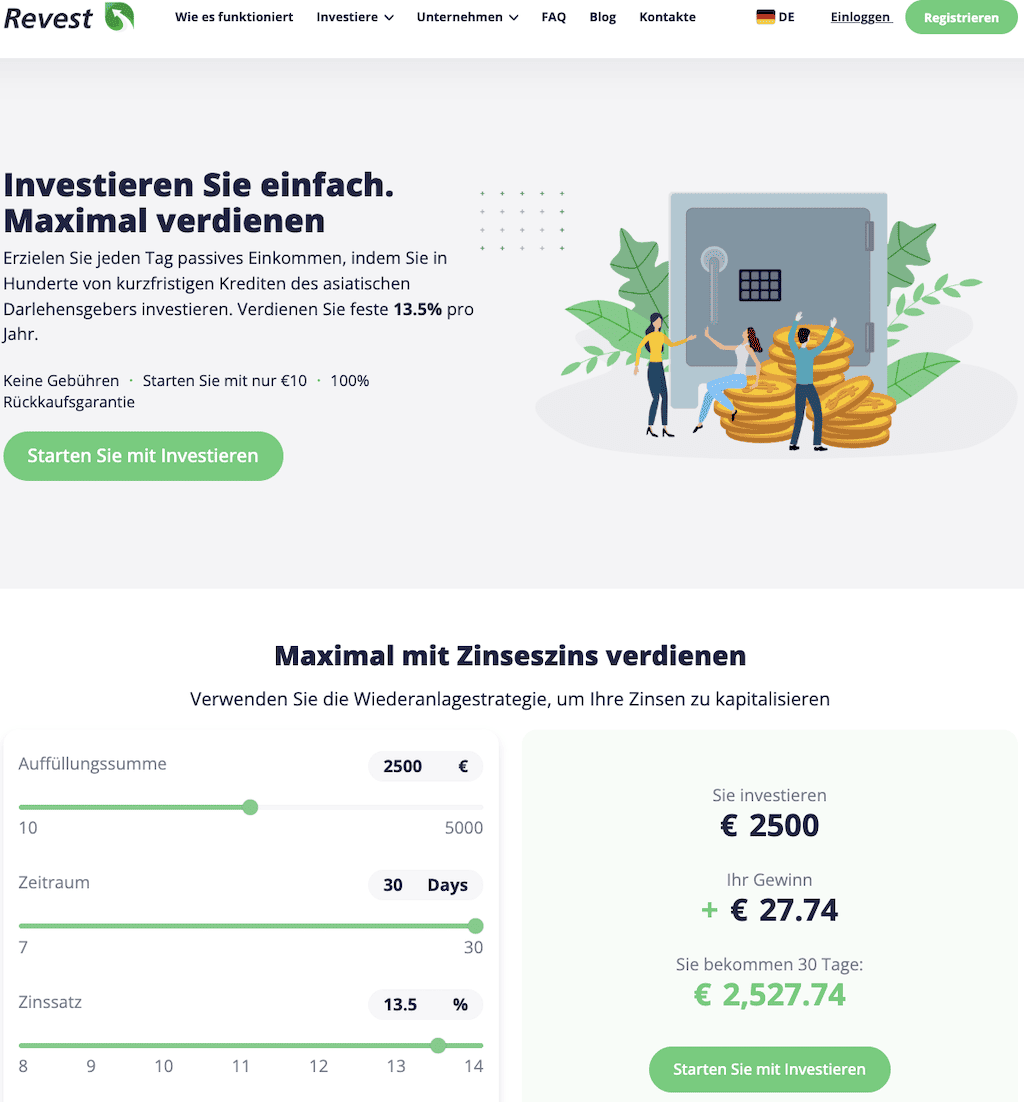
The platform itself is not regulated. The EU Crowdfunding Regulation (ECSP) also applies in Croatia, but Revest does not regard its model as a crowdfunding service. It sees it as the purchase of assigned loan receivables, and therefore has no EU licence. Investing is done exclusively through Auto Invest, since July 2026 in two product lines:
- Consumer Loan Claims: 25 days term, 13.5% interest
- Business Loan Claims: 25 days to 24 months, 13.5 to 16% depending on the term
- Protection for both: buyback obligation of the respective lender for overdue receivables (details under defaults)
Who runs Revest?
Since July 2026 the platform has been run by Vadims Marinecs. By his own account he was involved in product development from the start and brings over 15 years of experience in lending and the P2P industry, according to Revest including at Bigbank, Privatbank and EstateGuru. His predecessor Dainis Rupainis had built up Revest and had previously worked at EstateGuru and Indemo. However, a change at the top after just seven months is not something I simply tick off.

The same team page lists Yuriy Kan as the founder of the platform. This name appears several times when you look at the lenders, and I will come back to exactly that further below.
Unicredo's business figures
As the platform itself is still too young for its own annual reports, we look directly at the main lender. Quite a lot has happened here: in August 2026 Revest published the half-year reports of both Consumer Loan lenders, along with UNICREDO's audited annual financial statements 2025, with an unqualified audit opinion from Russell Bedford A+ Partners LLP dated 4 May 2026. For an unregulated platform, this is real progress.
| Key figure (KZT million) | Full year 2024 | Full year 2025 | First half of 2026 |
|---|---|---|---|
| Total assets | 3,923.1 | 5,749.7 (~€9.7m) | 5,812.2 (~€10.6m) |
| Loan portfolio | 1,312.0 | 2,630.0 (~€4.4m) | 2,954.1 (~€5.4m) |
| Equity | 651.2 | 811.6 (~€1.4m) | 1,243.1 (~€2.3m) |
| Liquid funds | 484.1 | 298.3 | 36.1 |
| Interest income | 960.8 | 2,251.4 | 615.4 |
| Net profit | 109.2 | 160.4 | 431.5 |
| Result excluding other income | −406.7 | +46.8 | −61.5 |
| Equity ratio | 16.6% | 14.1% | 21.4% |
| Debt to equity | 5.02x | 6.08x | 3.68x |
The headline reads well at first. Net profit rises from 160.4 to 431.5m KZT, an increase of 169%. To be fair, though: this sets half of 2026 against the whole of 2025, so the percentage should be treated with caution. The balance sheet has still become clearly more solid, with the equity ratio up from 14.1 to 21.4% and debt down from six times to 3.7 times equity.
It gets more interesting with interest income. It falls from 2,251.4 to 615.4m KZT. Even if I fairly extrapolate the half-year to a full year, a decline of a good 45% remains. At MoneyPlus, at 42%, it looks much the same. How does that fit together, profit up and interest income gone?
The answer is in Revest's own report. Alongside interest, the first half included 493m KZT of other income, among other things a good 356m from released loss provisions and 140m in currency gains. Without these items, GMoney would have reported a loss of around 61m instead of a profit of 431m. A key figure from the report shows the same: in 2025, out of 100 tenge of interest income, a good 7 tenge ended up as profit, and in the first half of 2026 it was 70. So the lending business is precisely not what carries this profit.
In fairness, I should add: Revest says this itself and explicitly points out that with income of this kind, one has to ask how sustainable the return will be in future. Highlighting plus 169% would have been easier. I credit the platform for that.
The pattern is not a one-off, however. In 2024 too, the result excluding other income was around −407m KZT, and what saved it then was the release of impairment allowances of 746m KZT. The audited 2025 statements also show:
- Almost half of interest income (1,076 of 2,251m KZT) is interest on overdue loans.
- Related parties owe UNICREDO 1,018m KZT, which is 125% of equity.
- The regulatory capital ratio k1 stood exactly at the minimum value of 0.1 (rounded) at the end of both 2024 and 2025.
What I like less is the liquid funds. They fell from 298.3 to 36.1m KZT, so by around 88%. The money went into the loan portfolio and into repayment, so it can be explained. Even so, a thick buffer looks different.
Revest sign-up and the welcome bonus
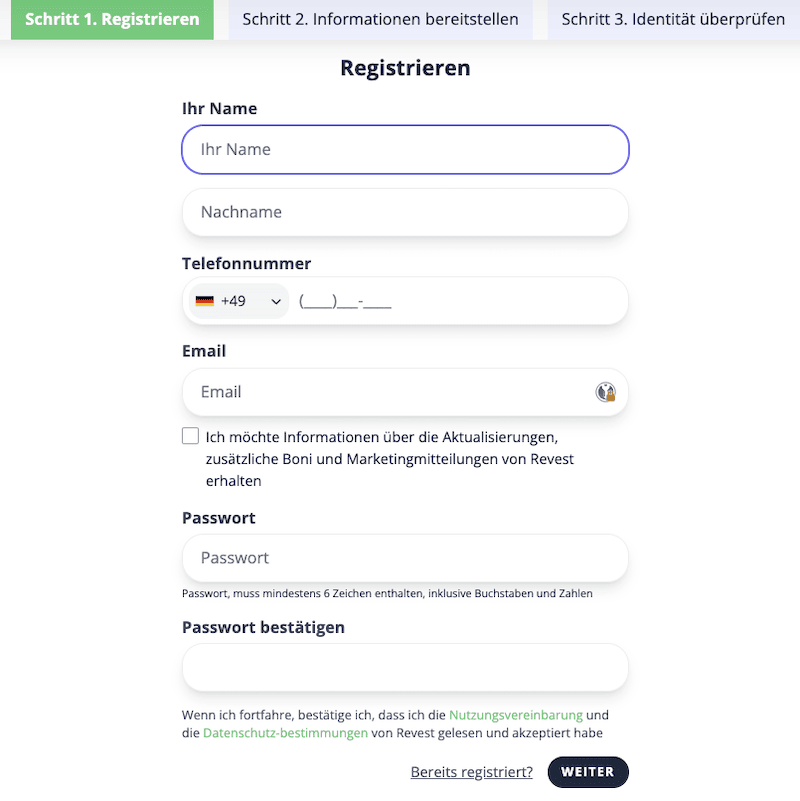
Registering with Revest is generally straightforward and done in a few steps:
Create an account
Enter your email address and password, which takes less than a minute.
Verify your identity
Upload your ID card or passport and go through the online verification. Revest uses the service provider Sumsub for this. You need an identity document with an electronic security feature and you take a selfie.
Pay in money
By SEPA transfer in euros to the account shown in your dashboard, with your user ID as the payment reference. The recipient is FINTECH PLATFORM d.o.o., and the account is held with the London-based Multipass Platforms Ltd, which according to its own statement is an e-money institution authorised by the British financial regulator FCA. The deposit must come from a personal bank account, which is then also used for later payouts. You can pay in up to 25,000 euros per calendar month.
From my own experience: the sign-up was quick, but the document check took several days in my case. My second deposit was even more unpleasant, as I had to wait much longer for it than expected. Things only moved forward after I contacted support, which, incidentally, responded very kindly. In the spring, similar reports of lengthy AML checks and delayed incoming funds were circulating in the community. This needs to improve.
According to Revest, deposits are usually credited within 1 to 3 working days, and for the first transfer Revest may additionally ask for a bank statement. Payouts are possible from 50 euros, are free of charge and normally take place within two banking days.
The Revest bonus and past cashback promotions
Through my Revest link, new customers get a permanent 1% cashback on all investments in the first 90 days, on both consumer and business loan claims. There is also the public Refer-a-Friend programme: the referrer and the person referred each receive 0.5% of the amount the referred person invests in their first 30 days.
Since March there have also been time-limited cashback promotions almost continuously, with a pause only in early July 2026. So that you can see the order of magnitude they have reached so far:
| Period | Promotion | Conditions |
|---|---|---|
| 06.03. to 30.04.2026 | 1 / 2 / 3% on the amount deposited | new customers only, via partner links |
| 11.05. to 30.06.2026 | 1% up to €1,000 · 2% up to €5,000 · 3% above that | new and existing customers, only freshly deposited and invested funds |
| 17.07. to 09.08.2026 | 2% on business loan claims | at least €500, at most €1,000 cashback, ended early |
| 10.08. to 30.09.2026 | Term-based scale from 0.25% (25 days) to 6% (24 months) | calculated per allocation, payout made in one go after the campaign ends, holding requirement from 23.09. until the campaign ends |
The pattern is clear: Revest grows in spurts, and precisely when a promotion is running. In July 2026, without a campaign, the outstanding volume even fell slightly. For such a young platform, I therefore expect further promotions. They cannot be planned for, however, because according to the terms and conditions, promotions are not a guaranteed return and can be changed at any time. When a new promotion starts, it appears at the top of the box and on my bonus page.
Interest and cashback do not simply add up. Interest runs annually, while the cashback is paid once on the amount invested. With a three-month loan with 1.5% cashback, the bonus is earned within a quarter, while with a 24-month claim with 6% it is spread over two years.
Investing with Revest
If you know Robocash, you will find your way around immediately. The interface, the way it works and even the look of the Auto Invest are suspiciously similar to the Robocash interface.
The Revest Auto Invest
On Revest there is only automatic investing; manually investing in individual loans is not possible. You create a portfolio, configure the Auto Invest and allocate a certain amount to it. From that moment, your capital is distributed automatically depending on loan availability.
The settings you can make in the Auto Invest portfolio :
- Choice of loan product:
Consumer Loan Claims or Business Loan Claims with different terms - Choice of lender:
GMoney (UNICREDO), MoneyPlus or GMoney Group - Setting the total investment amount:
The amount must not exceed your available balance in the account. - Minimum and maximum amount per individual claim:
This lets you control the diversification of your portfolio. - Secondary market purchase:
Determines whether your portfolio also buys receivables from other investors. - Strategy for repayments:
Automatically reinvest principal and interest, or have repayments paid out to the wallet. - Partial investing:
Allows co-investments with other investors.
What you need to know:
The interest rate is fixed for each term and cannot be set individually. MoneyPlus is also not active automatically; you have to add this lender deliberately. Business Loan Claims are likewise not added automatically to existing portfolios.
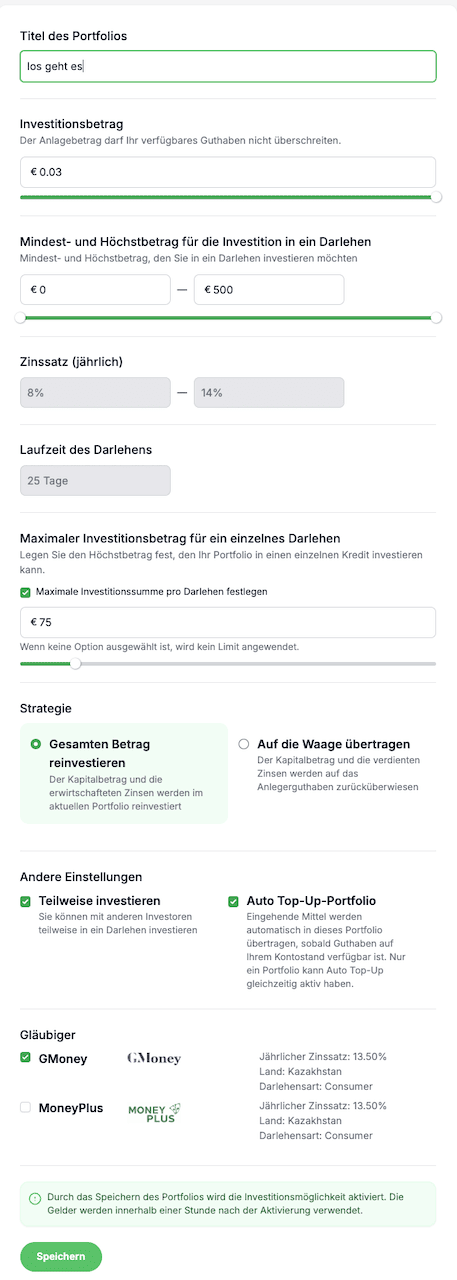
You can set up several portfolios in parallel, each with its own strategy. You can take part from 10 euros per claim. The whole thing is really simple: create a portfolio, allocate money, done.
The Revest secondary market
Yes, there has been a secondary market since 3 September 2026. This is probably the most important change of recent months, because it makes an early exit possible for the first time. However, some restrictions apply:
- You can buy only through the Auto Invest, not manually.
- Claims are sold at the remaining value of your receivable, with no premium and no discount. Accrued interest stays with you as the seller.
- Partial sales are not possible, and you cannot offer overdue claims at all.
- For existing portfolios the function is off by default, for new ones it is on.
- The term filter in Auto Invest applies to the original term: a 24-month claim with only three months left to run ends up only in portfolios that allow 24 months.
For the 25-day loans, the secondary market is fairly irrelevant, as you simply wait. It becomes interesting for the 24-month claims, where it at least theoretically eases the liquidity problem.

Whether it actually works in a stress scenario, when many people want to sell at the same time, remains to be seen. The terms and conditions are clear on this: Revest states that it does not operate a trading venue and promises neither a buyer nor a price.
The Revest fees
For investors, Revest charges no fees, whether for account maintenance, deposits or investing itself. Payouts and sales on the secondary market are also free of charge. According to the terms and conditions, Revest may introduce servicing fees in future, but only with 30 days' advance notice.
Tax at Revest
Revest withholds no withholding tax, so your interest income reaches you gross, the same as net. That is a clear advantage over Lithuanian platforms, which usually deduct 15% automatically.
Of course, you still have to declare the income in your German tax return, Anlage KAP. Revest does not issue a separate tax certificate, but you can download an account statement with all relevant data. According to the terms and conditions, Revest may transmit data to tax authorities under the EU reporting obligations (DAC7/DAC8).
The Revest loan products and the lenders behind them
At Revest, we now invest in two product classes from Kazakhstan. The distinction matters because terms, maturities and lenders differ. After about ten months of platform operation, the outstanding volume is split as follows: just over 68% Consumer Loans and just under 32% Business Loans (as of 26.09.2026), even though the latter have only existed since July. The Business Loans are entirely attributable to GM Group Limited.
Consumer Loan Claims (13.5%)
The classic Revest product from the early days. Here you invest in short-term consumer loans, typical payday loans, issued by UNICREDO (GMoney) or by MoneyPlus. The loan data at a glance:
- Loan type: consumer loans (payday loans, Kazakhstan)
- Lender: UNICREDO MFO LLP (GMoney brand) or MoneyPlus MFO LLP
- Term: 25 days, buyback obligation of the lender on the 31st day of delay
- Interest rate: 13.5% p. a.
- Loan currency: KZT (Kazakhstani tenge), you invest in euros. According to the Revest FAQ, how the currency risk is allocated is governed by the respective Assignment Agreement. It is not publicly available.
UNICREDO is the established main lender, with bonds listed on the stock exchange and audited figures. MoneyPlus was registered in 2023 and, according to Revest, only licensed in 2025; its loan portfolio is around 993 million KZT (about €1.8 million). Here too, interest income is collapsing, from 472.3 to 136.9 million KZT in the first half-year. The reported profit of 53.9 million KZT also stems largely from released provisions and currency effects. The pattern is identical at both lenders.
Notably, MoneyPlus received a loan from UNICREDO itself at 30% interest, so money also flows back and forth within the group.
Business Loan Claims (up to 16%)
The new Revest product since July 2026. The lender is GM Group Limited (GMoney Group brand), a holding company registered in September 2025 in the Astana International Financial Centre, and the parent company of the two consumer lenders. The loan data:
- Loan type: Business Loan Claims
- Lender: GM Group Limited (Kazakhstan)
- Term: 25 days, 1, 3, 6, 12 or 24 months
- Interest rate: 13.5 to 16% depending on term, monthly interest payment
- Nominal value: 1,000 euros per claim, investable from 10 euros
- Currency: according to the Revest FAQ issued in euros, whereas the lender side of Revest names tenge
The higher interest promise compensates for the longer lock-up of capital. What bothers me here: GM Group Limited is the only one of the three lenders that discloses no financial figures. There is a presentation, nothing more. No annual report, no bonds on the stock exchange. Revest names the purpose as financing group companies and developing the loan originator. With a 24-month lock-up, you are therefore financing the group's expansion without knowing its figures.
In addition: GM Group Limited also finances itself through its own bond programme for institutional investors (12 months, 23% in tenge or 13% in US dollars). According to the group presentation, it is secured by a pledge on the group's loan portfolio and receivables, plus guarantees from the subsidiaries and an interest reserve account. Whether the receivables assigned to us are excluded from this pledge pool, Revest does not disclose. In the worst case, the bondholders could therefore rank ahead of us.
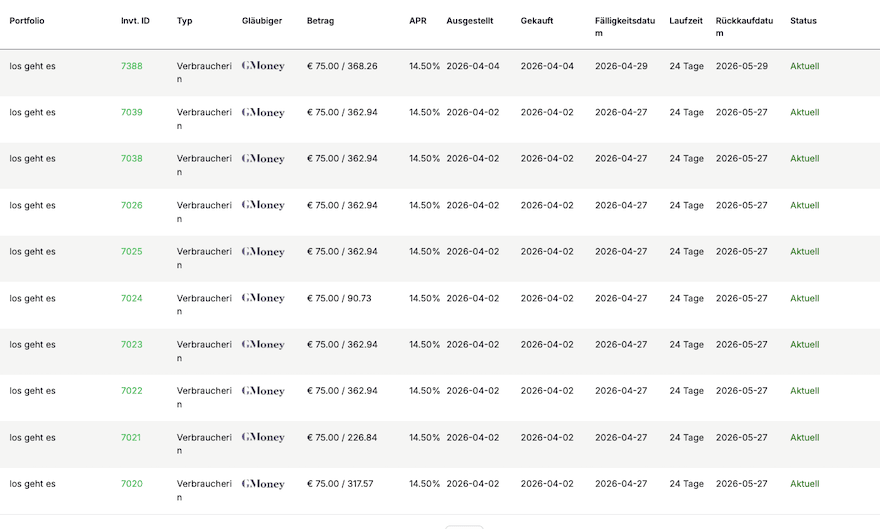
Ownership structure: Three lender names appear on Revest. That sounds like diversification, but behind them stands a single owner:
| Company | Role | Owners |
|---|---|---|
| GM Group Limited (GMoney Group) | Holding company, lender of the Business Loan Claims | 100% Yuriy Kan |
| UNICREDO MFO LLP (GMoney) | Lender of the Consumer Loan Claims | 95% GM Group Limited |
| MoneyPlus MFO LLP | Lender of the Consumer Loan Claims | 95% GM Group Limited |
| FINTECH PLATFORM d.o.o. (Revest) | Platform, listed in the UNICREDO presentation of July 2026 as the group's "International P2P Channel" | Founder according to the team page: Yuriy Kan |
According to the audited financial statements, UNICREDO has also granted its shareholder a loan at 0.1% interest per year. For us investors, this means one thing above all: If the group tips over, everything tips over at the same time.
The country risk of Kazakhstan
Kazakhstan is unfamiliar territory for most P2P investors. A look at the country ratings of the major agencies, however, shows a surprising picture:
| Country | S&P | Moody's | Fitch |
|---|---|---|---|
| Kazakhstan | BBB (Stable) | Baa1 (Stable) | BBB (Stable) |
| Croatia (location of the platform) | A (Stable) | A3 (Stable) | A- (Stable) |
| Romania | BBB- (Negative) | Baa3 (Negative) | BBB- (Negative) |
| Latvia | A (Stable) | A3 (Stable) | A- (Stable) |
| Poland | A- (Stable) | A2 (Negative) | A- |
| Albania (IuteCredit, Mintos) | BB (Stable) | Ba3 (Stable) | – |
| Moldova (Nectaro) | BB- (Stable) | B2 (Stable) | B+ (Stable) |
For context: investment grade starts at BBB- (S&P and Fitch) or Baa3 (Moody's). Anything below is considered speculative, i.e. junk status. Kazakhstan sits solidly in the investment grade area at all three agencies. On 21 August 2026, S&P upgraded the country from BBB- to BBB, and the outlook is now stable.
The comparison with Romania is revealing. Through platforms such as Mintos, Nectaro or Viainvest, many P2P investors put money into Romanian lenders, and Romania is at the lowest investment grade level at all three agencies, with a negative outlook. A single downgrade would push the country into the junk area. Moody's rates Kazakhstan at Baa1, which is two levels higher. Albania and Moldova, where I also invest via IuteCredit or Nectaro, are even clearly below the threshold.
The macroeconomic situation has also improved. Since June, the national bank has cut the key interest rate three times, from 18% to 17% (5 June), 16.75% (24 July) and most recently 16.25% (4 September). Inflation fell to 9.8% in August 2026, for the eleventh month in a row, and is thus back in single digits for the first time. The central bank attributes this to its tight monetary policy, the stable tenge, a normalisation of consumer demand and joint measures with the government.
For my lenders, this is still not a tailwind. Unsecured consumer loans did still grow by 8.2% year on year in July, but the financial regulator ARDFM is tightening the rules step by step for exactly the business of GMoney and MoneyPlus. Whether this alone explains the collapse in interest income cannot be read from the reports. It does fit the picture, though.
What the ARDFM has set so far:
- Since June 2025, the maximum effective interest rate for unsecured loans has been 46% per year.
- For microloans of up to 45 days, a cap of 0.3% per day applies.
- From 12 October 2026, borrowers can withdraw from unsecured loans free of charge for 14 days.
What risks remain? The economy is still heavily dependent on the oil price, and there are geopolitical risks from the proximity to Russia. In addition, the loans are issued in tenge. In 2026 the tenge has appreciated by around 15% against the euro, which gave lenders currency gains in the first half of the year. If that reverses, the effect works the other way: I do invest in euros, but if the local currency depreciates sharply, the default risk at the lender rises.
Defaults compared with the Kazakh market
Revest's statistics page shows two figures worth knowing. Of all repaid claims, 20.71% went through the buyback, which is 16,382 claims worth €1.84 million, so around 23% by value. And of the current portfolio, 8.16% is currently between 1 and 30 days overdue (as of 26.09.2026). Claims overdue for longer do not appear, because the buyback applies on day 31.
That sounds like a lot at first, but in this business it is rather normal, and the market comparison helps put it in context. The Kazakh microfinance sector had a weak year in 2025: profits almost halved, and overdue loans rose by more than a quarter to 14.7% of the sector portfolio.
| Lenders in Kazakhstan | Overdue loans (30+ days) |
|---|---|
| Fintech Finance (MoneyMan) | 74.7% |
| Robocash Kazakhstan | 47.2% |
| Lending and Finance Technologies | 32.1% |
| Solva (IDF Eurasia) | 23.1% |
| Sector average | 14.7% |
| GMoney/UNICREDO * | 13.5% |
| Toyota Financial Services | 3.4% |
To understand this, you need to know how the model works in the first place. According to Unicredo's own presentation, the end customer in Kazakhstan typically pays 0.3% interest per day over a term of 25 days. We receive 13.5% a year. What lies in between is not profit, but covers defaults, collection and operations. Defaults are firmly built into this business, and the group even runs its own debt collection for it.
For the lender, the buyback is therefore more of a credit line through which it refinances itself with us than an emergency commitment. According to the terms and conditions, only the respective lender owes it, expressly without a guarantee, and Revest itself does not stand behind it. What matters is therefore not the rate, but whether the balance sheet can support it. And with equity of around €2.3 million at GMoney, one should put this into realistic perspective.
What are the advantages and disadvantages of Revest?
The pros and cons of Revest at a glance
Advantages of Revest
- High interest: 13.5% on short-term loans, up to 16% with a 24-month lock-in
- Two product classes: a choice between fast rotation and higher returns
- Secondary market since September 2026, so an early exit is possible for the first time
- Statistics page: arrears, buyback rate and lender mix can be viewed up to date daily
- No withholding tax: gross equals net, no form needed
- Audited figures: 2025 annual financial statements with an audit opinion, plus half-year reports from both consumer lenders
- Lender on the bond market: UNICREDO bonds on the KASE, four series fully repaid, quarterly figures available
- Segregated client funds: since the terms and conditions of 18.09.2026, via pass-through accounts at the payment service provider, no longer a claim against Revest
- Open communication: Revest itself names the one-off effects in the profit
- Easy to use: Robocash veterans feel at home straight away
Disadvantages of Revest
- Not regulated: no ECSP licence, Revest does not see its model as a crowdfunding service
- Buyback without a guarantee: owed only by the respective lender, Revest is not liable
- Interest income collapsing: a decline of over 40% at both consumer lenders, extrapolated to a full year
- Profit from one-off effects: without the release of loss provisions and currency gains, GMoney would have been in the red in 2024 and in the first half of 2026
- Everything is one group: three lender names, one owner, no real diversification
- GMoney Group without figures: the very lender behind the 24-month claims presents no financial report
- Pledge for bondholders: the group has pledged its loan portfolio and receivables for its own bonds, and the ranking relative to our claims is unclear
- Interconnections: related parties owe UNICREDO more than its entire equity
- Thin liquid funds: at GMoney, down from 298 to 36 million KZT
- Location in Kazakhstan: dependence on the oil price, geopolitical risks, lending in tenge, stricter rules for unsecured loans
- Secondary market without a guarantee: whether a buyer can be found is uncertain
- No investor numbers or annual reports from the platform itself
- Lengthy AML checks and delayed incoming payments, in my case too
- CEO change after seven months of platform operation
Sign up with Revest: 1.0% cashback for 90 days (on consumer loans 0.25%)*
The Revest risk FAQ
A young, unregulated platform with lenders in Kazakhstan: this raises a number of questions about risk.
How does Revest make money?
No fees are charged to investors. According to the terms and conditions, the respective lender keeps the difference between the borrowers' interest and our interest. For the typical payday loan, the Unicredo presentation gives 0.3 per cent per day for the end customer, against 13.5 per cent a year for us investors. Defaults, collection and operations are paid from this margin. How Revest itself is remunerated has not been published. The group describes the platform as its European funding channel.
Is the lender behind Revest profitable?
On paper, yes, but on closer inspection it looks thinner. GMoney/UNICREDO reports a net profit of 431.5 million KZT for the first half of 2026. This includes 493 million KZT of other income, mainly released loss provisions and currency gains. Without it, there would be a loss of around 61 million KZT, and 2024 looked similar. Extrapolated, interest income falls by a good 45 per cent, and MoneyPlus shows the same pattern. There are no public figures for the GMoney Group as lender of the Business Loan Claims.
Is Revest reputable?
A final verdict is not possible for such a young platform. In its favour: UNICREDO has bonds on the KASE exchange, there are audited annual financial statements for 2025, Revest itself discloses the one-off effects in the profit, and since September client funds have been running through segregated pass-through accounts. Against it: no regulation, no annual reports of its own, hardly any data on the GMoney Group, one owner for all lenders and a CEO change after seven months. I therefore continue to treat Revest as a satellite position and am watching how it develops.
Are there loan defaults at Revest?
No defaults for investors have been reported so far, and the buyback by the lenders has worked. However, it often steps in: according to the statistics page, 20.71 per cent of the repaid claims went through the buyback, around 23 per cent by value. Of the current portfolio, 8.16 per cent is overdue by between 1 and 30 days (as of 26.09.2026). Compared with the Kazakh market, this is unremarkable. What matters is the lender's balance sheet, because the buyback is not a guarantee. GMoney had around 2.3 million euros of equity in mid-2026.
What happens if Revest becomes insolvent?
According to the terms and conditions, if Revest becomes insolvent, no new claim purchases are concluded. Free balances are returned to users via the payment service provider, if necessary coordinated by the insolvency administrator. The existing assignment agreements remain effective and continue to be administered by the respective lender or an appointed third party, normally a sister company. The real risk is a group insolvency, in which case the buyback would also be worthless. In addition there are three jurisdictions: the platform in Croatia, the lenders in Kazakhstan, and the money with a British e-money institution.
Does Revest have deposit protection?
No. Revest is not a bank, and according to its own FAQ the claims are covered neither by deposit protection nor by insurance or a statutory compensation scheme. As the platform is not regulated, no EU investor compensation scheme applies either. Funds not yet invested are held at the e-money institution Multipass in London and, according to the terms and conditions, are protected only by segregation from the company's own assets. For the invested claims, there is only the buyback obligation of the respective lender, with no guarantee from Revest and no state protection.
Is Revest an alternative to Robocash or Swaper?
Revest*, Robocash* and Swaper* all three belong in the category of platforms with a buyback by the lender and automatic investing. The basic principle is identical: we buy claims through which a lending group refinances itself from investors. The differences lie in return, terms, lender structure and track record.
| Criterion | Revest* | Robocash* | Swaper* |
|---|---|---|---|
| Founded | online since Dec. 2025 | 2017 | 2016 |
| Volume acquired | ~€12.5m | ~€1.32bn | >€1.13bn |
| Registered office / regulation | Croatia, not regulated | Croatia, not regulated | Estonia, not regulated |
| Lender | GMoney, MoneyPlus, GMoney Group (all one group, Kazakhstan) | UnaFinancial group, around 96% via the group company RC Bucharest | Wandoo Finance Group, SW Finance, Wandoo Peru, One Leasing, Fidemio since 09/2026 |
| Return on short-term loans | 13.5% | 8 to 10.5% (+ up to 0.8% loyalty) | 10% (12% with loyalty from €25,000) |
| Return, long-term loans | up to 16% (24 months) | 10.5% (3 years) | 14% at 12 and 24 months (16% with loyalty) |
| Minimum investment | €10 | €10 (shares from around €1) | €10 |
| Buyback | on day 31 of delay, by the lender | after 30 days, by the lender | after 60 days, by Swaper or lenders |
| Terms | 25 days to 24 months | 7 days to 3 years | 7 days to 24 months (Fidemio up to 36) |
| Secondary market | yes (since 09/2026, at nominal value) | yes (at nominal value) | resale to users, buyback by Swaper only at its discretion |
| Withholding tax | none | none | none |
| Lending countries | Kazakhstan | Philippines, group financing via Romania (Kazakhstan, Singapore) | Spain, Peru, Poland, Latvia, Romania, North Macedonia |
| Track record | around 10 months, too short for a judgement | since 2017, no investor losses according to its own statement | since October 2016 |
None of the three is a short-term loans platform in the strict sense any more. Robocash now mainly offers terms of one to three years, at Swaper around 89% of the offering consisted of 24-month loans in July 2026, and Revest has followed suit with the Business Loan Claims.
Revest vs. Robocash*: Revest pays noticeably more interest on short-term loans. In terms of diversification, the two now differ little: on Robocash too, around 96% of the volume goes to a single group company, the Romanian RC Bucharest, which passes the money on within the UnaFinancial group. The difference lies in the track record. Robocash has been running since February 2017 and, by its own statement, reports no investor losses to date, while Revest has existed for ten months.
Revest vs. Swaper*: Swaper currently pays 14% on business loans with 12 or 24 months, and 16% with the loyalty bonus from an account value of €25,000. Revest reaches 16% on 24 months with no minimum amount. With the longer terms on both, you mainly finance the group itself: at Swaper via the subsidiary SW Finance, at Revest via GM Group Limited, which discloses no figures.
Bottom line: All three platforms are now refinancing channels of a single lending group. Robocash has the longest history, Swaper has audited group figures from the Wandoo group (although the platform's own 2025 annual report is still missing), and Revest has the highest interest rate and, with UNICREDO, a lender with bonds listed on the stock exchange. For me, Revest remains a minor addition to my portfolio because of its short history and the Kazakhstan risk.
Revest in the BaFin check: the six questions and Revest's answers
Following BaFin's action against Ventus Energy, six questions needed clarifying: licence and timetable, deposit business under § 1 KWG, segregation of funds, dependence on banks, the consequences drawn from the Ventus case, and a message to investors. Revest answered all six questions. These are the platform's own statements, which have not been independently verified. My assessment is AI-assisted and is neither a legal assessment nor one that would stand up in court.
Show all questions and the original answers
- Preliminary remark from Revest.
We understand why the situation around Ventus Energy has raised questions in the market. Even though we cannot comment on another company's legal or operational set-up, we can explain how Revest is structured and how we approach this topic. - Are you planning to obtain a licence or be placed under supervision (e.g. ECSP licence, MiFID regulation or payment institution status)? If so, which one and by when? If not, why not?
Revest is operated by FINTECH PLATFORM d.o.o., a company registered in Croatia. Our model is based on the purchase and assignment of existing loan receivables. On the basis of our current structure, Revest does not act as a crowdfunding service provider, investment firm or payment institution. We continuously assess the applicable regulatory framework and obtain additional legal advice where necessary.
Revest offers no investment advice, no personalised recommendations and no portfolio management. Users choose their portfolio settings themselves. Incoming transfers and available user balances are processed through an electronic money institution (Electronic Money Institution). Revest itself does not hold any client funds, and users do not provide financing to Revest.
As the platform develops, we continuously assess the regulatory framework applicable to our business model, including whether an additional licence, a supervised structure or a regulated partnership would be necessary or advantageous. We do not want to announce any specific licence application or timetable before this has been properly reviewed and approved. - How is your contract structure set up for German investors, and do you see a risk under § 1 KWG (Einlagengeschäft, i.e. deposit-taking business, as with Ventus)? Have you had this checked legally?
Revest's contract structure is based on Assignment Agreements (Abtretungsverträge). Users buy claims arising from underlying loan agreements issued by a Loan Originator. Revest acts as a platform and servicing intermediary for these transactions.
As we understand it, this differs from a structure in which users of the platform provide funds directly and the platform itself has an unconditional repayment obligation towards them.
We understand that the German regulatory interpretation is an important issue, especially after the Ventus case. We are reviewing this from a legal and regulatory perspective and will seek additional advice where necessary. At the same time, we do not want to make blanket statements about how BaFin might interpret a particular structure as long as no legal review focused on this has been completed. - Are deposited funds and wallet balances legally segregated from company assets (e.g. via a licensed payment institution or a trust/escrow arrangement)?
We would clarify the terminology here: Revest does not treat these as deposits. They are incoming transfers and available user balances that are used for claim purchases, repayments received or payout requests.
Incoming user transfers and available user balances are not held by Revest. They are processed through an electronic money institution (E-Geld-Institut) and held in a segregated account structure for client funds. This means that client funds are separate from Revest's own operating funds. Revest does not use these funds for its own business activities.
The user balances shown on the platform reflect funds available for claim purchases, repayments received or payout requests, but they should not be understood as funds held by Revest itself. - How dependent are you on individual banks and payment service providers, and what would happen if a banking relationship were lost?
Like most platforms, Revest depends on banks and payment service providers to process incoming and outgoing transfers. To reduce operational dependence on a single provider, Revest has set up a backup service provider that supports service continuity if the primary payment channel is disrupted.
If a payment service provider relationship were affected, our priority would be to maintain clear communication with users, keep accurate user-related records and continue processing transfers through available alternative channels. Such an operational disruption would not, in itself, change the contractual rights to loan claims already purchased. - Have you drawn any concrete consequences from the Ventus case (contracts, structures, communication)?
Yes. The Ventus case underlined the importance of a clear legal structure, clear user communication and careful wording around balances, repayments and claim purchases.
As a result, we are reviewing our public communication, our contract documentation and the wording on the platform to ensure that users clearly understand that they are buying loan claims and that they are not providing financing to Revest. We are also examining whether additional legal, operational or payment-flow improvements should be implemented as the platform develops. - Is there anything you would like to tell your investors right now?
Our message is simple: we understand the concerns and take them seriously. Revest's model is based on the purchase and assignment of existing loan claims. Revest is not structured as a crowdfunding service provider, investment firm or payment institution. Users do not provide financing to Revest. Incoming user funds are not held by Revest and are processed through an electronic money institution with a segregated account structure for client funds.
We are focused on keeping the platform transparent, operationally stable and legally sound. We will not dismiss market concerns, and we will not give unsubstantiated guarantees. Where improvements are needed in structure, documentation, payment set-up or communication, we will work on them.
Users should also bear in mind that buying loan claims carries risks, including borrower default risk, loan originator risk, operational risk and liquidity risk.
My assessment: 47 out of 100 points for Revest
On the § 1 KWG question, Revest explains the claim assignment structure correctly, in my view. I buy assigned receivables from loan agreements of a Loan Originator, I do not give the platform money that is unconditionally repayable, and that is precisely what speaks against deposit-taking business under § 1 KWG. The legal review is expressly not yet complete, and no legal opinion or law firm is named, but at least this is framed honestly.
On the licence roadmap, Revest deliberately does not want to announce anything, and there is no date. On segregation of funds, things look better: an e-money institution plus a segregated account structure. In the reply itself, however, Revest does not name the institution, and the backup provider remains unnamed to this day. What strikes me positively is the tone, because Revest explicitly promises no guarantees and names the real risks. With 47 out of 100 points, I therefore place Revest in the middle of the field: open and honest, but thinly evidenced.
Since the reply, two things have changed:
- Terms and conditions revised: In the first version dated 28.10.2025, users still received a claim against Revest equal to their balance (clause 4.13), which is exactly the arrangement Revest distances itself from in its reply. Since 18.09.2026, the funds have been held in separate pass-through accounts with the payment service provider, and Revest is no longer the economic owner.
- Institution named: On the deposit side, Multipass in London is now named (see registration). The money is therefore held at a British institution, which means outside the EU.
How Revest compares with all the others and how the regulation score is calculated can be found in the overall evaluation: The big BaFin check at a glance.
My Revest Review and My Revest Conclusion
My first investment at Revest was a good 5,000 euros in Consumer Loan Claims. After about three months, this had turned into roughly 300 euros in the account, interest and cashback combined. That is just under 6% on the amount invested in this short period, and the position was pleasantly low-maintenance. The investing itself works smoothly. At the end of June I then withdrew the position completely, and all payouts arrived.
Since the end of August I have been back in with just under 5,000 euros, split up. 1,000 euros are in the 24-month claims with 16% interest and 6% cashback, and just under 4,000 euros in shorter terms, of which over 3,000 euros are in the three-month loans with 14.5% and 1.5% cashback.
From October, the repayments from the shorter terms go back into the 25-day consumer loans. The cashback from the summer campaign is still outstanding, and I expect it in December. The reason for the split is simple: I want Revest to be more than a one-off for me, but I do not want to tie up all my capital for two years.
My Revest return
My own investment since 30 Mar 2026 · figures from Portfolio Performance
- €5,139
- net paid in
- €5,768
- Portfolio value
- Net paid in
- Net earnings (up to portfolio value)
- Portfolio value

And now the point that I have to let myself be reproached for. The 24-month claims come from GM Group Limited, of all lenders the one about which one knows the least. So I am tying myself for two years to the entity that discloses the least, and in the very article in which I write about collapsing interest income.
Why do it anyway? Because the 6% cashback on 16% interest is, for me, exactly the premium for the fact that I see less here than with the other two. The 1,000 euros are locked in for two years, and I will stay in for that long. I see the secondary market only as an emergency exit: I only want to use it once I notice real deterioration. Otherwise I collect the interest until the end of the term. The shorter terms tie me up for a quarter at most anyway.
| Year | Paid in | Paid out | Net earnings | Return p. a. (XIRR) |
|---|---|---|---|---|
| 2026 (30 Mar to 03 Nov) | €10,475 | €5,336 | +€629 | – (part year) |
| total | €10,475 | €5,336 | +€629 | – |
What has positively surprised me despite all the criticism: Revest discloses the one-off effects itself, now provides audited annual financial statements and has improved the terms and conditions. For an unregulated platform, this is unusual.
My Revest return expectation
For the current position, my return expectation looks like this, split by term:
| Position | Amount | Interest p.a. | Cashback |
|---|---|---|---|
| 24-month claims | €1,000 | 16.0% | 6.0% one-off |
| Shorter terms (mostly 3 months) | just under €4,000 | up to 14.5% | up to 1.5% one-off |
| Repayments from October (Consumer Loan Claims, 25 days) | ongoing | 13.5% | no cashback |
With the 24-month position, I am set until 2028. Whether Revest will permanently get more from me than this 1,000 euros and the short terms remains to be seen. I will mainly be watching three things:
- Will interest income return at GMoney and MoneyPlus, or will the profit continue to come from one-off effects?
- Will the buyback rate by value stay at around 23%?
- Will the GMoney Group disclose its own figures at some point?
For me, Revest is therefore a return satellite in the portfolio, no more and no less. I will decide on topping up after the next half-year figures.
You can see how my Revest* position is developing compared with my other platforms in my return ranking, which I update on an ongoing basis.
My Revest position (as of 03 Nov 2026)
- Invested since
- 30 Mar 2026
- Invested (net, rounded up)
- €5,200
- Interest received (rounded up)
- €630
All figures for Revest My P2P investing in numbers
My own money, shared for transparency. Not a recommendation. Past returns do not guarantee future results.
Sign up with Revest: 1.0% cashback for 90 days (on consumer loans 0.25%)*
Editorial note: This review reflects my personal experience as an investor. Commissions from affiliate links do not influence my assessment or the platform rating.