Profitus Review 2026: The Better Estateguru Alternative from Lithuania?
Translated from the German original, last updated 11 Nov 2026. Read the original (German)
Anyone looking for a regulated real estate P2P platform where every project is secured by a real mortgage will quickly come across Profitus. The Lithuanian crowdfunding platform is under the supervision of the Bank of Lithuania, holds an ECSP licence and offers target returns of 9 to 14% p.a., with an average loan-to-value ratio of only 66%. Since its launch in 2018, Profitus has financed more than 339 million euros of real estate projects and is regarded as one of the most interesting Estateguru alternatives in the Baltics.
Before I share my personal Profitus review, my return so far and what I plan to do next, here is the complete overview of the platform.
- New customers get EUR 25 bonus on all investments via my Profitus link*.
This item describes a promotion by the provider, such as a bonus or cashback. It reproduces the provider's statements and is not a recommendation. The provider's terms apply.
Profitus: data at a glanceAs of 12 Nov 2026
- My platform rating
- 72 out of 100, rank 8 of 46
- My return (XIRR)
- 8.53%
- Outstanding portfolio
- 104.3m EUR
The Key Profitus Data at a Glance
Before going into detail, here is an overview of the most important and relevant data on the P2P lending platform Profitus (platform figures as of 2026-11-10):

| Founded | Registered 11.07.2017; first financings Q3 2018 |
| CEO | Viktorija Čijunskytė, founder, managing director since 02.05.2025 |
| Regulated | ECSP licence Lietuvos bankas, valid from 10.11.2023; passporting EE, ES, DE, LV (Quelle) |
| Investors | 57,345 registered (2026-11-10) |
| Headquarters | Vilnius, Lithuania (Lvivo g. 101, LT-08104); share capital €683,000 |
| Collateral | Mortgage on property; 456 of 495 projects first-ranking; personal guarantee |
| Return | Platform XIRR 10.53%; Ø yearly interest 10.16% according to the platform |
| Buyback guarantee | No; protection only via collateral, Profitus is not liable for defaults |
| Secondary market | Legally available; 2% seller fee; currently closed technically |
| Liquidity | Locked until project end (Ø 11.7 months); no early payout option |
| Loan types | Real estate development, refinancing, working capital, real estate acquisition; bonds |
| Financed loan volume | 423.71m € loans issued, 423.71m € invested by investors (2026-10-12) |
| Active portfolio | 104.31m € (2026-11-10) |
| Minimum investment | €100 per project; bonds from €500 |
| Investment strategies | Manual; RoboInvest (since 24.09.2024, up to 5 strategies) |
| Rating | P2P Rating: 72/100 (rank 8 of 46) |
| Platform risk rating | internal project rating (A+ to D) |
| Loyalty program | No interest bonus; VIP Club from €100,000, Ambassador programme |
| Withholding tax | 15% on interest for non-residents; reducible to 10% via DAS-1 |
| Annual report | Not on website; financial years 2021-2025 in register, audit status unknown (Quelle) |
| New customer bonus | none |
Figures from the platform's website, its reports and public registers, as of 11 Nov 2026. Not every figure can be independently verified.
The last two Profitus news items
Profitus regularly informs its investors via its own news area. Here are the two most important Profitus news items for you:
- Profitus October review: EUR 16,991,699 raised for 56 business loans
In October the Profitus investor community raised EUR 16,991,699 across 56 business loans, and EUR 584,767 in interest was paid out. The platform also reports a completed debt recovery in Kaunas and several events.Telegram - Profitus economist: Hormuz crisis lifts diesel prices; Lithuanian rates and property stay high
Jokūbas Markevičius, head of capital markets and analysis at Profitus, comments on the seven-month Strait of Hormuz crisis. Oil did not reach USD 200 a barrel, but diesel costs about EUR 200 a barrel. He expects Lithuanian property prices to stabilise rather than fall.Telegram
Let us take a somewhat closer look at the real estate crowdfunding platform and the people behind it, before I report on my own Profitus experience.
What is Profitus?
Profitus is a Lithuanian crowdfunding platform, operating since August 2018, on which you invest in business loans secured by real estate. Unlike with Vault-based platforms, you choose individual projects here, or you let RoboInvest work for you. The platform is under the supervision of the Bank of Lithuania and has also held the European ECSP licence since November 2023, which puts it among the strictly regulated providers in the Baltics.
The focus is on real estate development projects and commercial loans, which are always secured by a mortgage. For each project you see the exact location, the loan-to-value ratio (LTV), the internal rating, the interest rate and the term, so considerably more transparency than with pool-based models. The average LTV is around 66%, and there are projects secured with both first and second ranking.
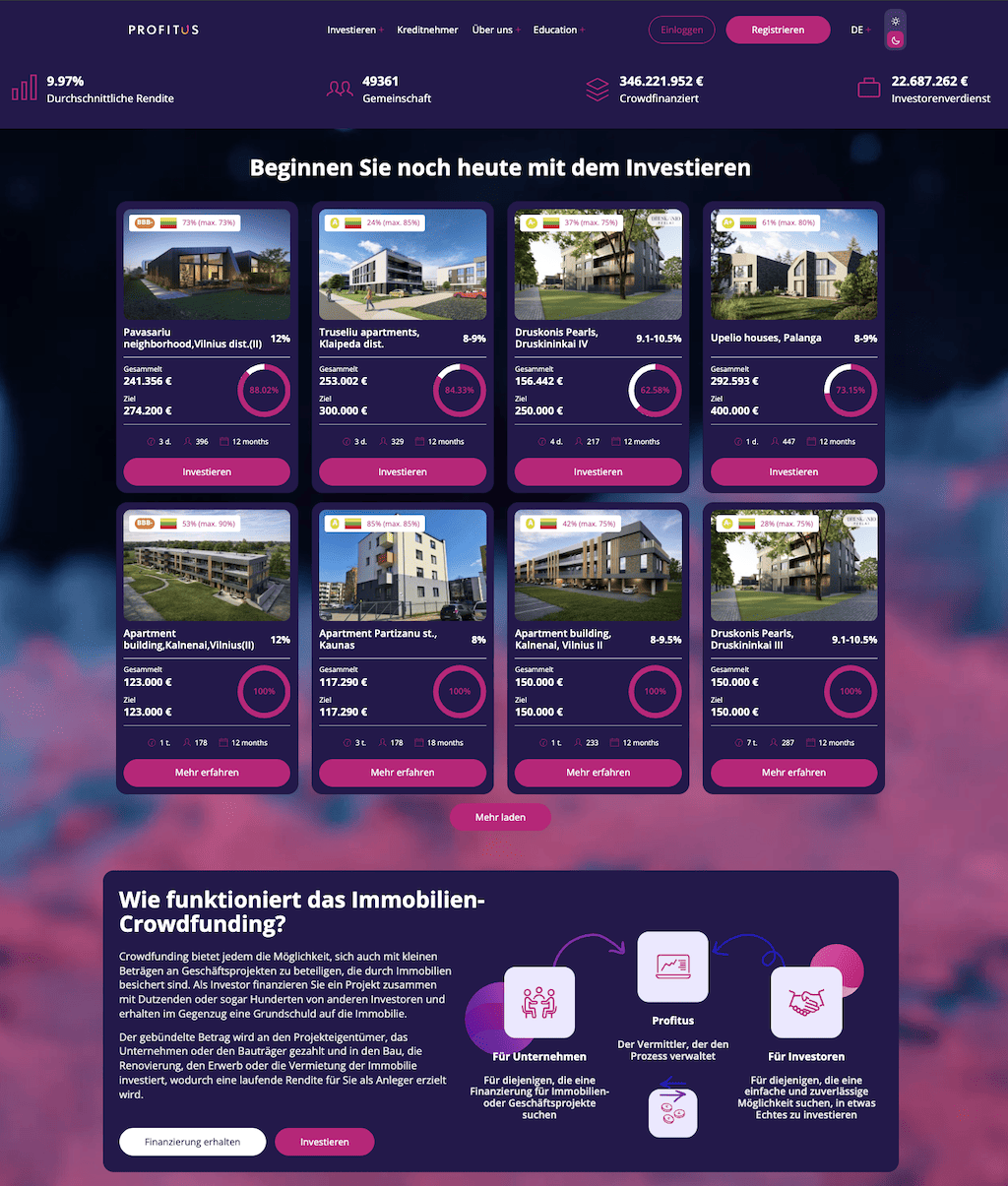
There is no classic buyback guarantee at Profitus. Instead, the real estate mortgage serves as security: if a project defaults, the property pledged can be realised. However, you should bear in mind that such a realisation can take months or even years, so in a worst case it is unlikely to be quick.
Investing starts from 100 euros per project, and you can choose between manual investing, the secondary market and the automatic RoboInvest. For investors, Profitus thus offers a transparent and regulated way to invest specifically in Baltic real estate loans, with returns of up to 14% p.a. and the advantage that the projects are backed by real assets.
Profitus facts & figures as of 2025
Since its operational start in 2018, Profitus has financed real estate projects with a total volume of over 339 million euros. The assets currently managed by investors stand at around 92 million euros, spread across more than 1,600 financed projects. The platform has about 49,000 registered users, of whom almost 14,000 are actively invested.
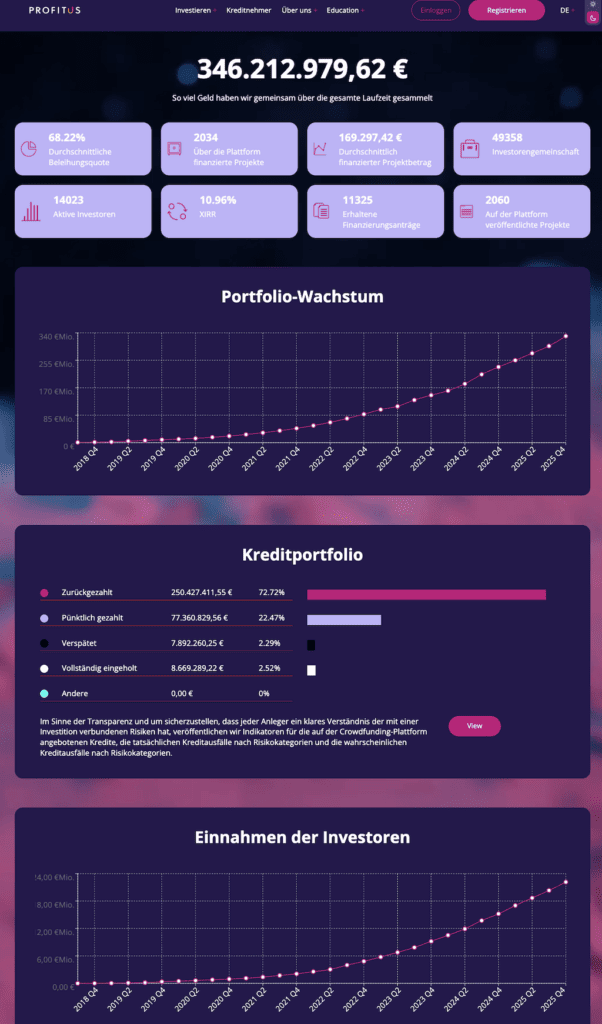
The active portfolio is split geographically into around 61 million euros in Lithuania, 8.5 million in Latvia, almost 6 million in Estonia and a good 1 million in Spain. The statistics can be viewed publicly on the platform at any time.
Who runs Profitus?
Profitus was founded in 2017 by Viktorija Cijunskyte together with her business partner Mindaugas Vanagas, who each hold 50% of the company shares. Viktorija brings more than ten years of experience in the real estate sector, starting as an estate agent, then founding the real estate agency Citus, and finally the crowdfunding start-up.
In August 2024, Lina Maskoliūnė first took over the CEO role to drive the platform's international expansion. Since June 2025, Viktorija Cijunskyte has taken over operational leadership as CEO again, while Lina remains part of the management team.
Viktorija Cijunskyte is the founder and CEO of Profitus in Vilnius. She built the company from an idea in 2017 into a regulated crowdfunding platform with an ECSP licence, over 339 million euros in financed volume and expansion into several countries.
Previously she founded the real estate agency Citus and the real estate development company Citus Constructions, as well as the investment company Victory Funds. She is a co-founder of the PropTech Lithuania initiative and was named by Sifted/Financial Times as one of the 15 most influential women in the European fintech sector.

Of course she is not alone in charge of the platform, but works with a team of around 33 employees who develop the platform further and ensure day-to-day operations. You can find more about the team on the Profitus team page.

The company has traded since August 2024 as Profitus Crowdfunding UAB (formerly UAB Sutelktinio finansavimo platforma Profitus) and is based in Vilnius at Lvivo g. 101.
Profitus business figures
How is Profitus doing financially? As the platform does not publish full annual reports, it is worth looking at the Lithuanian company register, where the most important basic key figures can be viewed.
| Year | Revenue | Result | Employees |
|---|---|---|---|
| 2021 | ~1.1 million € | profitable | ~15 |
| 2022 | ~1.6m € | profitable | ~20 |
| 2023 | 2.37m € (+48%) | -401k € | ~24 |
| 2024 | 3.3m € (+39%) | -562k € | ~30 |
What stands out: revenue is growing steadily and significantly. In 2024 it was 3.3 million euros, an increase of around 39% on the previous year. However, the company is investing heavily in growth: headcount and salaries are also rising sharply, which is why Profitus recorded losses in both 2023 and 2024, after two profitable years before that.
At the end of 2023, a funding round of around 440,000 euros strengthened the equity base. For a fast-growing fintech, such growth losses are not unusual. Still, as an investor you should keep in mind that continually rising losses are of course also a risk. The market leadership in Lithuania, with a market share of around 33% of the entire crowdfunding market, does show that the growth strategy is paying off.
Profitus registration and the welcome bonus
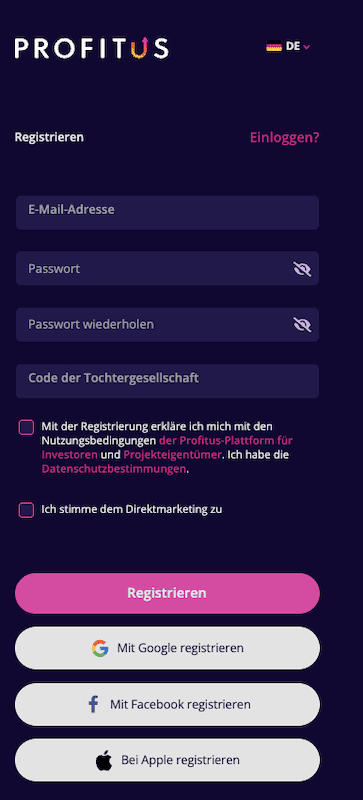
Registering with Profitus is straightforward and done in a few minutes. The platform is also available in German and guides you through the process step by step:
Start registration
Click "Konto erstellen" (create account) on the Profitus home page. You can sign up as an individual or as a company.
Enter personal details
Enter your email address and create a secure password. Single sign-on via Google or Facebook also works as an alternative.
Complete identification
Carry out the online identification via Ondato by uploading a valid ID card or passport.
Suitability test (KYC)
Because of the requirements of the Lithuanian central bank, you have to fill in a short questionnaire on investor suitability.
Pay in and invest
After verification you can pay in money by SEPA transfer or even by credit card. Profitus uses the payment service provider Lemonway, where you get your own account number, so investor funds are clearly separated from the company's assets.
It is enough to use my Profitus link* to receive the 25 euro welcome bonus!
To invest with Profitus, you must be at least 18 years old and have a bank account. In my experience, SEPA payments arrive in 1-2 working days. If you use a service such as Revolut, it can often be even faster. Once the money has arrived, it is available for investments immediately.
One plus point: Profitus is one of the few platforms where you can also pay in by credit card. That is quite practical for a quick start.
An additional bonus for new investors
When you register for the first time via my blog, you receive a welcome bonus of 25 euros, which is credited against your first investment, if you use my Profitus bonus link*.
Investing with Profitus
How do you invest in real estate loans with Profitus, what should you bear in mind and what options do you have? Unlike pool-based platforms such as Bondora or Monefit, with Profitus you choose individual projects, or leave the selection to the automatic RoboInvest.
I am currently invested with a good 900 euros on Profitus.
Investing on the primary market at Profitus
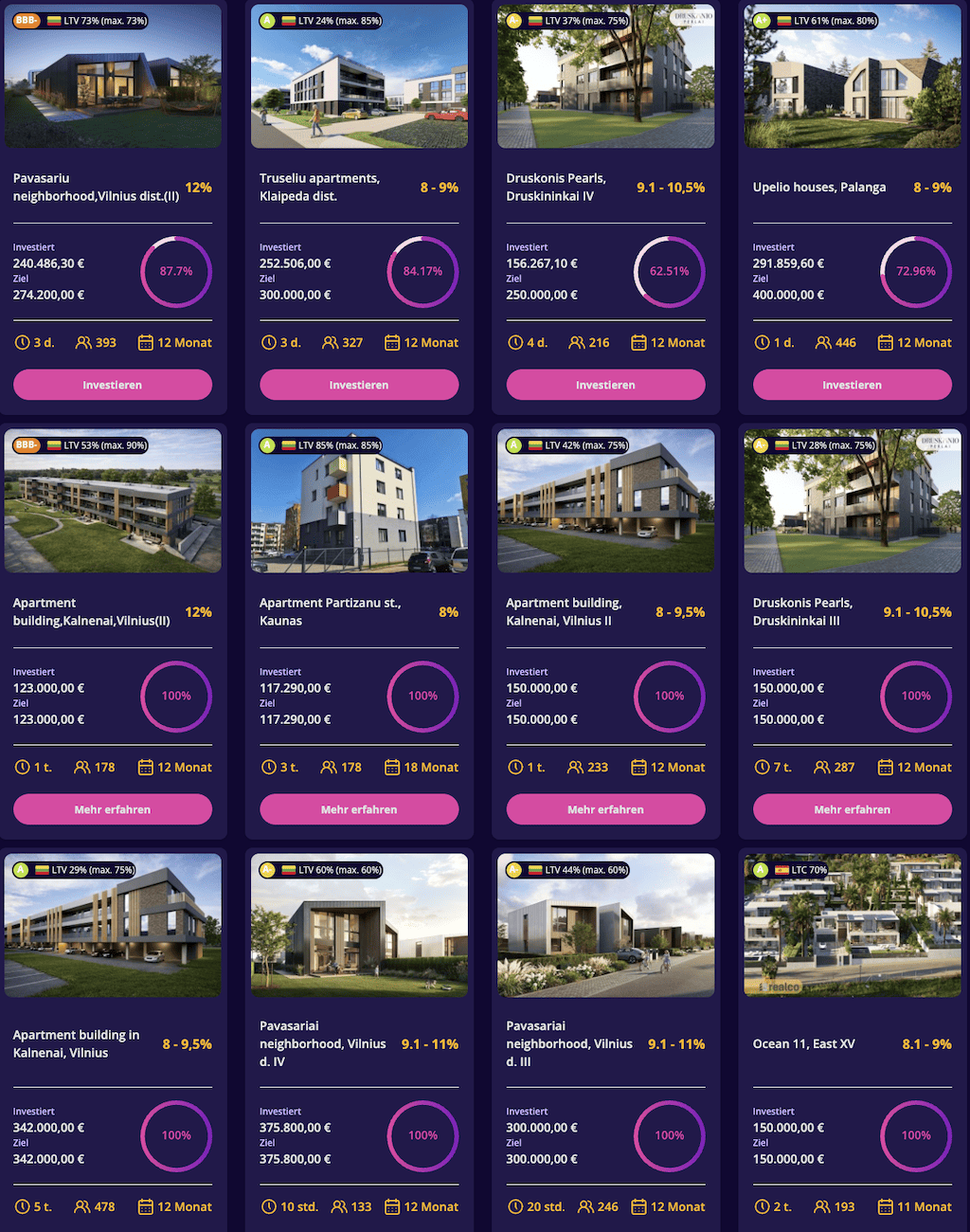
The direct route is the primary market: here you see all projects currently open for funding and can get in from 100 euros per project. For each project you get extensive details:
- Exact location of the property
- Expected return and interest payment frequency
- Details of the security (first or second ranking mortgage)
- The loan-to-value ratio (LTV)
- Internal project rating (A+ to D)
- Term (typically 3 to 24 months)
This is what I like most: you can decide for yourself which projects you invest in and which risk profile suits you. If you prefer defensive projects with a low LTV and a first ranking mortgage, you can choose them specifically. If you want higher returns, you take projects with a higher rating risk.
Profitus Auto Invest (RoboInvest)
For investors who prefer a more passive approach, there is RoboInvest, the automatic investment assistant. It offers three levels, depending on the minimum investment amount:
- RoboInvest Start (from €100)
You can set the investment amount, loan term, interest rate and risk category. - RoboInvest Grow (from €300)
Additionally selectable: project rating and borrower country. - RoboInvest Pro (from €700)
Extended by: the purpose of the loan and the type of security.
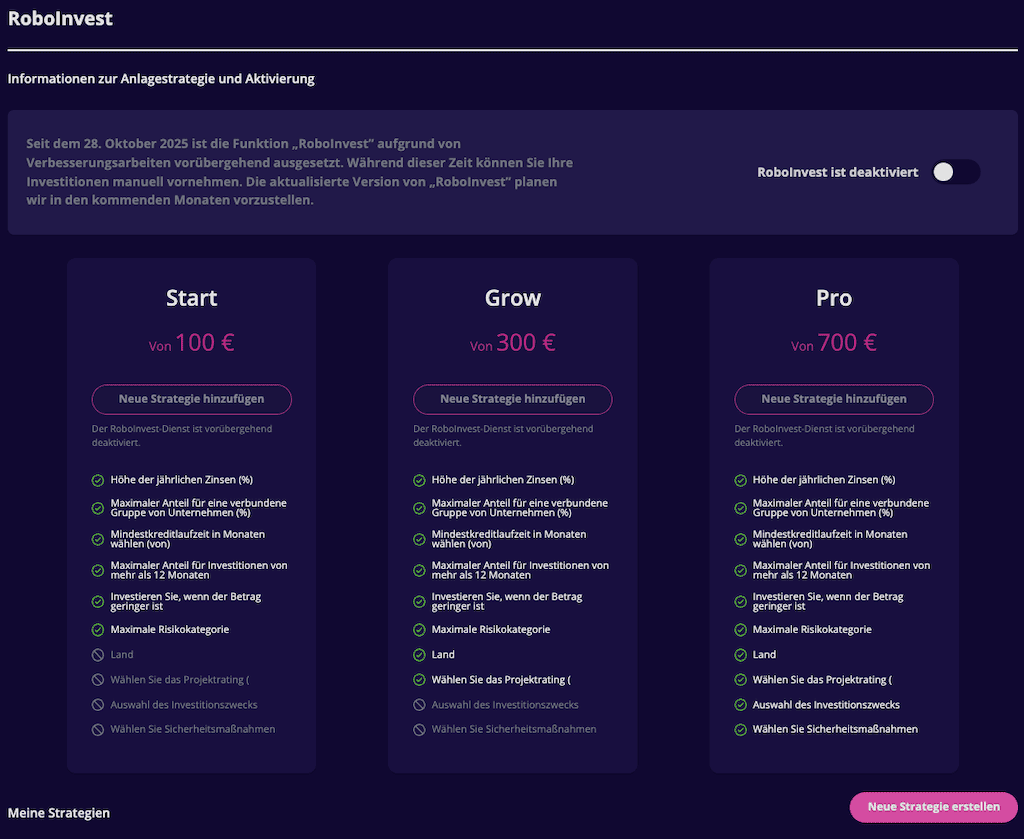
RoboInvest is a nice feature, but note that the higher the minimum amount, the finer the filter options. Anyone who, like me, prefers to spread widely and work with smaller amounts per project will tend to invest manually, because with a minimum of 100 euros and wide diversification the capital otherwise runs out quickly.
The secondary market at Profitus
In principle, Profitus offers a secondary market on which you could buy projects that are already running or sell your own early. That would be an important liquidity component, since loan terms are typically 12 to 18 months.
Important note: The secondary market is still closed. Since the platform relaunch in 2023, the secondary market has not been active, and a reactivation is still pending. For me, this is one of the biggest current drawbacks: once you have invested, you are tied to the term of the respective project, and an early exit is currently not possible.
The Profitus fees
In principle, investors at Profitus pay no fees for account maintenance, deposits or investing on the primary market. There are only two possible costs:
- Secondary market sale: 2% transaction fee on the sale amount
- Second payout in a month: a fee of 1.88 euros (the first payout per month is free of charge)
You can find the complete fee overview on the Profitus fees page.
The tax issue at Profitus
Unlike many Estonian platforms, Profitus, as a Lithuanian platform, automatically withholds a withholding tax of 15% on your interest income. You can reduce this to 10% by filling in the so-called DAS‑1 form and sending it to Profitus support.
Since a double taxation agreement exists between Germany and Lithuania, the withholding tax deducted can be credited against German Kapitalertragsteuer (capital gains tax) in your tax return, so you do not pay twice.
Profitus does not issue a separate tax certificate, but in the dashboard you can download a complete account statement with all the relevant figures for the tax office.
The Profitus loan portfolio: what do you actually invest in?
Let us look at which projects are offered on Profitus and what sets them apart.
The big difference from pool-based platforms: on Profitus you select individual property projects yourself. You can see exactly which property your money goes into, where it is located, what the loan-to-value is and what rating the project has received. The borrowers are exclusively commercial players: property developers and companies, not private individuals.

The different loan types on Profitus include:
- Property development loans: for new-build or refurbishment projects
- Business loans secured by property: for working capital, expansion or acquisition
- Rental property projects: existing rental properties as collateral
The focus is clearly on Lithuania (approx. 87% of the portfolio), complemented by Latvia, Estonia and, since 2024, occasionally Spain. Interest is usually paid out quarterly, and the terms range between 3 and 24 months.
Each project receives an internal rating from A+ to D, based on the risk assessment by the Profitus team. The developer's business plan, their experience, the location and the property value are assessed. According to Profitus, only around three out of ten submitted projects make it onto the platform, so the selection rate is quite strict.
| Risk category | Current rating scale | Previous rating scale |
|---|---|---|
| Lowest risk | AAA | A+ |
| Low risk | AA+ | A |
| AA | A- | |
| AA- | B+ | |
| Lower medium risk | A+ | B |
| A | B- | |
| A- | C+ | |
| Higher medium risk | BBB+ | C |
| BBB | C- | |
| BBB- | D | |
| High risk (not financed by Profitus) | BB+ | |
| BB | ||
| BB- | ||
| B+ | ||
| B | ||
| B- | ||
| CCC | ||
| CC | ||
| C | ||
| D |
Around half of the borrowers are existing customers who repeatedly finance projects through Profitus, which is an indicator of a functioning business relationship.
The return level is 9 to 14%, depending on project risk, although the advertised average return of about 11% in practice tends to end up at 9-10%, at least if you opt for lower-risk projects and spread smaller amounts widely, as I do.
The Profitus risk FAQ
Despite the regulation and the mortgage backing, you should keep the risks at Profitus in mind. I have put together the most important questions on risk as a short FAQ before I get to my experience with Profitus and the conclusion.
How does Profitus make money?
Profitus is financed mainly through an arrangement fee charged to borrowers when a project is successfully funded. This commission can be between 2 and 5 per cent of the amount financed. In addition, a monthly administration fee of 0.1 to 0.2 per cent is charged. Income also comes from the secondary market, where sellers pay a 2 per cent transaction fee.
Is Profitus profitable?
Not sustainably yet. After two profitable years (2021 and 2022), Profitus reported a loss of around 401,000 euros in 2023 and about 562,000 euros in 2024, while revenue grew strongly to 3.3 million euros (+39%). The losses stem from disproportionate investment in growth, staff and expansion. At the end of 2023, a funding round of around 440,000 euros strengthened the equity position. Unfortunately, Profitus does not publish detailed annual reports, but basic key figures can be found in the Lithuanian company register.
Is Profitus trustworthy?
I assume so. Profitus is under the supervision of the Bank of Lithuania and also holds a European ECSP crowdfunding licence. The founding team around Viktorija Cijunskyte brings more than a decade of experience in the real estate area. Several German P2P bloggers have visited the company in Vilnius and confirmed a professional impression. Of course, this does not guarantee that the platform will be profitable in the long term or that our investments will remain safe permanently.
Are there loan defaults at Profitus?
Yes, there are projects that fall into arrears or into recovery. According to the statistics page, the share of late loans is below 1 per cent of the portfolio, and the share in the recovery process is around 2.5 to 3.5 per cent. According to Profitus, however, there has so far been no actual capital loss for investors. That said, realising a defaulted property can take months to years, so in the worst case it will not be quick.
What would be the effect of a Profitus insolvency?
Since the loan agreement is directly between you as investor and the borrower, this agreement would in principle continue even without Profitus. The investor funds are also held separately with the payment service provider Lemonway, not in Profitus accounts. In the event of insolvency, an administrator would presumably wind down the running contracts. That sounds clean in theory, but in practice it depends on how smoothly such a wind-down actually works. You should only invest money whose loss you can afford, both financially and emotionally.
Is there deposit protection at Profitus?
No, there is no deposit protection. Profitus is not a bank and therefore does not fall under the European deposit guarantee of up to 100,000 euros. All invested funds are subject to a risk of loss. The only protection comes from the mortgages on the financed properties, which is not the same as a government guarantee.
Is Profitus an alternative to Inrento or Estateguru?
Profitus, Inrento and Estateguru all three belong to the category of property-backed P2P platforms, but they differ in several important respects. Anyone looking for alternatives within this segment should know the details.
| Criterion | Profitus* | Inrento* | Estateg*uru |
|---|---|---|---|
| Registered office / regulation | Lithuania, central bank + ECSP | Lithuania, central bank + ECSP | Estonia, ECSP |
| Loan type | Property development, business loans | Rental properties (Rental Loans) | Bridge financing, development, business loans |
| Security | Mortgage (average LTV 66%) | Mortgage + rent guarantee | Mortgage (average LTV 60-70%) |
| Return | approx. 9-14% | approx. 7-10% | approx. 10-12% |
| Minimum investment | €100 | €50 | €50 |
| Term | 3-24 months | 18-48 months | 6-60 months |
| Auto Invest | yes (RoboInvest) | yes | yes |
| Secondary market | no (closed) | yes (active) | yes (active) |
| Withholding tax | 15% (can be reduced to 10%) | 15% (can be reduced to 10%) | none (Estonia) |
| Geography | Lithuania, Baltics, Spain | Lithuania | Europe (broad) |
| Track record | since 2018, no losses so far | since 2020, no losses so far | since 2014, defaults have occurred |
Profitus* offers the highest return in the comparison at up to 14% p.a. nominal, and relies on property development and secured business loans. The project details are very transparent, and the internal rating makes it easier to assess risk. However, there is currently no secondary market as a liquidity option, and the 15% withholding tax is a disadvantage compared with Estonian platforms. For investors who want to invest specifically in Baltic property projects and choose individual projects themselves, Profitus is a solid choice.
Inrento* follows a more conservative model focused on rental properties, where a rent guarantee applies in addition to the mortgage. The return is somewhat lower at 7-10%, but you get more stable, more predictable cash flows. The big drawback in my view: the platform is often oversubscribed. New projects are fully funded in no time, and you have to be really quick to get in at all. That was exactly my reason for looking at alternatives such as Profitus.
Estateguru is the top dog in the European property P2P segment, with the broadest geographical offering and the longest track record, since 2014. Returns are attractive at 10-12%, and the active secondary market provides liquidity. On the downside, Estateguru has had clearly noticeable loan defaults in the past, particularly in the German and Finnish portfolio. Anyone investing here should be aware of the higher default rate, something Profitus has so far managed clearly better.
Bottom line: If you prioritise maximum security and proven regulation and are looking for a manageable Baltic investment, Profitus and Inrento are two strong options: Profitus with a higher return and more choice of projects, Inrento with a more conservative rental focus but an availability problem. If you want broad diversification across many countries, it is hard to get around Estateguru despite its default history.
In the end, as an investor, you decide, as always, which criteria weigh more heavily: return and project selection (Profitus), a conservative approach and stable cash flows (Inrento), or broad diversification and a long track record (Estateguru).
My experience with Profitus and my Profitus conclusion
I had been looking for some time for another alternative to Inrento, not because I no longer like Inrento, but because the platform is regularly oversubscribed and you have to be extremely quick on new projects to get in at all. With Profitus I thought I had found a suitable complement: a regulated platform that, at the time I joined, had not yet seen a single default.
So I got started in mid-2024, straight away with just under 1,000 euros, which I spread manually across lots of different projects. Exactly the way I like it: broad diversification rather than concentration risk, preferably more projects with smaller amounts than a few large positions.
By the end of Q3 2025 the portfolio had grown to just under 1,900 euros. Then came the first setbacks: some projects fell into arrears, and there was the occasional unpleasant notification as well. That cooled my enthusiasm, and I began to withdraw capital step by step.
In the meantime the portfolio has recovered well. Currently one project is delayed and one is still in recovery, a flat in a high-rise complex. Depending on how cleanly this is resolved, I will reconsider my decision and may top up again.
What I really like: the platform's communication is excellent. Projects are well kept, and the appearance is thoroughly professional. Profitus stays on my list and I will keep watching it, and possibly top up again, we will see.
Profitus Review: my account
I currently still have a good 900 euros invested with Profitus, spread across various individual projects. Most of it is in projects with a first-ranking mortgage and a moderate LTV.
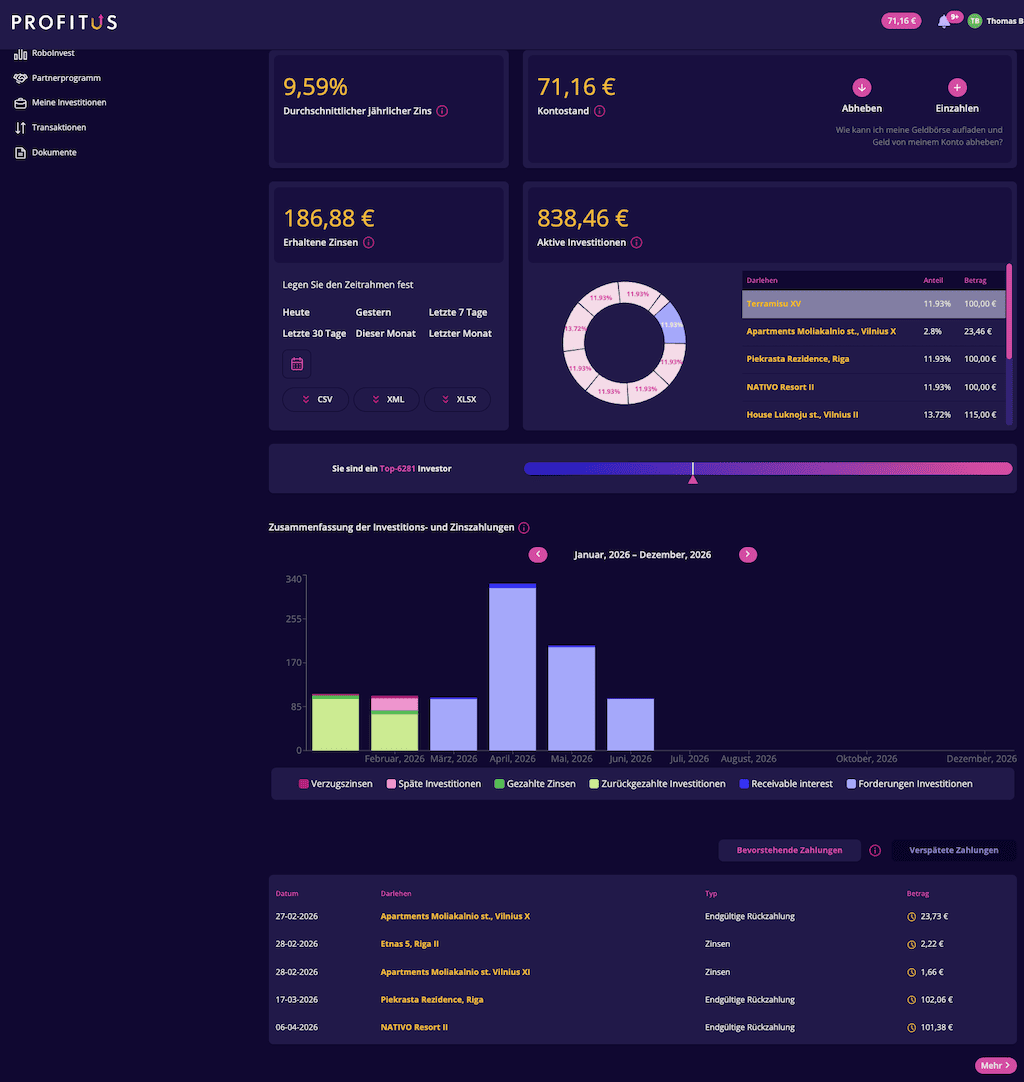
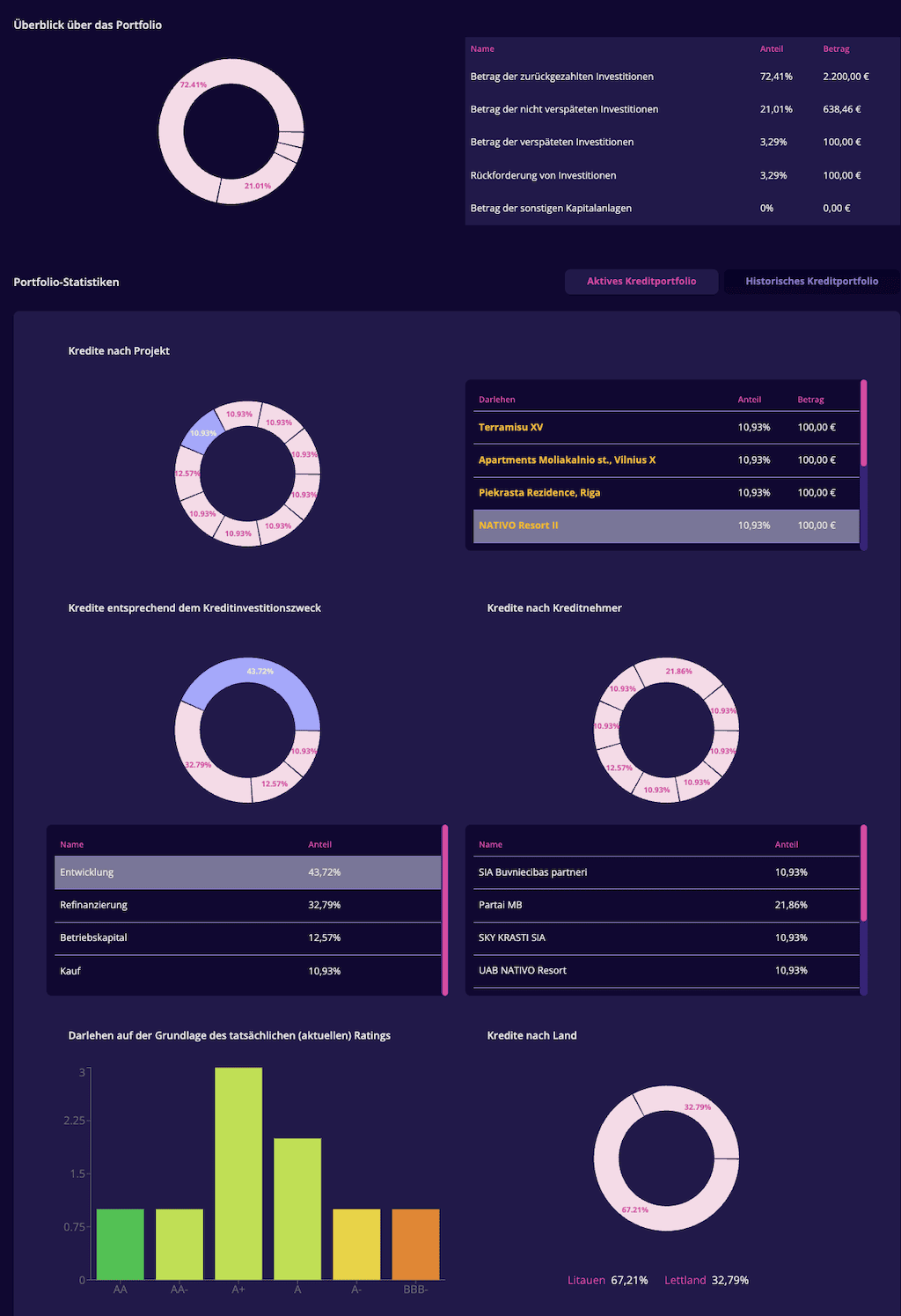
With 7.2% IRR since the start and a total of 170 euros in interest, the return is rather below average compared with what the platform states as its average. There is a simple reason for this: the higher interest rates are mainly paid on larger individual investments in riskier projects, and that is exactly what I deliberately do not do. I would rather have more projects in my portfolio instead of a cluster risk, and I accept a somewhat lower return for that.
My Profitus return 2026
Profitus has been in my portfolio since mid-2024 and has delivered around 170 euros in interest since then.
| Year | Paid in | Paid out | Net earnings | Return p. a. (XIRR) |
|---|---|---|---|---|
| 2024 (from 26 Jun) | €1,534 | €0 | +€31 | – (part year) |
| 2025 | €472 | €751 | +€124 | 7.4% |
| 2026 (to 03 Nov) | €0 | €1,390 | +€80 | 19.3% |
| total | €2,006 | €2,141 | +€235 | 8.5% |
The overall return as IRR is 7.2% since I started investing. That is not a spectacular figure, but it reflects my deliberately conservative strategy: broad diversification, small amounts, focus on lower risk. For a regulated real estate platform with mortgage security, though, it is a solid figure, especially considering that there has so far not been a single capital loss.
My Profitus return
My own investment since 26 Jun 2024 · figures from Portfolio Performance
- -€135
- net paid in
- +€235
- Net earnings
- €100
- Portfolio value
- Net paid in
- Net earnings (up to portfolio value)
- Portfolio value
My plan for the coming months: watch how the one project in collection is handled. If that goes smoothly, I will cautiously top up the portfolio again. The platform has certainly earned my trust through its professional communication and its polished appearance.
And what about you, do you find Profitus* interesting? Is it an InRento alternative for you, or do you prefer to invest via Estateguru with its broader spread across countries?
My Profitus position (as of 03 Nov 2026)
- Invested since
- 26 Jun 2024
- Invested (net, rounded up)
- €-100
- Interest received (rounded up)
- €240
- Return (XIRR) since start
- 8.5%
All figures for Profitus My P2P investing in numbers
My own money, shared for transparency. Not a recommendation. Past returns do not guarantee future results.
Editorial note: This review reflects my personal experience as an investor. Commissions from affiliate links do not influence my assessment or the platform rating.