My P2P story: from game to asset class
Translated from the German original, last updated 10 Nov 2026. Read the original (German)
In 2017, P2P loans were a game for me. Not as a figure of speech, but quite literally. Alongside the boring buy-and-hold approach with ETFs, I wanted somewhere to "play" with money, without simply burning it as you do with poker or the lottery. Hence the name of this blog.
Almost ten years later, just under 200,000 euros sit in P2P loans and bring in a good 1,800 euros a month in interest, before tax. None of this was foreseeable in 2017. When exactly does a game stop being one? That is precisely what this is about: my path from playground to asset class, with all the lessons paid for along the way.
Getting started in 2017: a playground that could pass as an investment
The starting point was unspectacular. My ETF portfolio ran almost by the textbook (loosely following Gerd Kommer), did its job dutifully and was about as exciting as a roll of bank statements. I wanted something to tinker with. Something where I could calculate, compare and adjust, but which I could still, with a reasonably clear conscience, pass off to myself as an investment.
I then got stuck on crowdinvesting, or more precisely on crowdlending. Double-digit interest rates, a marketplace full of lenders from the Baltics, auto-invest rules that could be tweaked endlessly. For someone working in IT with an affinity for Excel, it was the right mix of number-crunching and urge to play. And unlike the lottery, at the end there was at least a claim against someone who was supposed to pay it back.
Right at the start of the blog, I let myself be carried away into writing a sentence that still stands today:
In my eyes, P2P is playing with fire, that is, risk, and I really do not recommend anyone use it as a sole investment. Rather, it should be run on the side as an interesting additional income. For me, a share of around 10% of my total assets is the upper limit!
Thomas Butz, p2p-game.com 2017
Today I see this in a more nuanced way, but at its core the sentence has mostly held up. I started with less than a thousand euros per provider and around 5% of my total assets, simply to get a feel for the thing. The rest was curiosity and quite a lot of naivety.
A brief note on scope: I have written down what P2P loans actually are, how the platforms earn money and how getting started works in practice in the P2P basics. This page is only about my own story.
Disillusionment: when the game turned serious
The bill came in 2019 and 2020. Kuetzal, Envestio, Monecera, Grupeer. Platforms that I partly held in my own portfolio were history within weeks, along with the investors' money. What had previously looked like a competition for the best interest rates turned out, in parts, to be the Wild West with very well-made websites.
I lost money in the process. It was not life-threatening, because my self-imposed 10 per cent limit held. It hurt all the same, and my average return slipped from around 11% to just under 8% per year.
More than the loss itself, something else preoccupied me. I had certainly seen individual warning signs and still relied on the assumption that a platform would surely not be so brazen. It was. The complete case chronology with names, sums and timelines is on the P2P risk hub; here I will stick to my personal view of it.
From this point on, the game was over. Not the investing, but the lightness.
Professionalisation: criteria instead of gut feeling
What came out of this phase now makes up the largest part of this blog. I started to check platforms against fixed criteria, instead of by interest rate and gut feeling.
One of the first steps was an Excel decision matrix with 37 candidates. Business model, regulation, ownership structure, skin in the game, published annual reports, payment behaviour in times of crisis. Much of that is now part of the P2P loans rating, which I use myself when I look at a platform.
The second step was tracking. Until then, I had read my returns off the platform dashboards. As is well known, those like to calculate generously.
This is how I do it: I record every deposit, every payout and every interest payment in Portfolio Performance and have it calculate the return as XIRR across all platforms. Only since then have I known what is actually left over, rather than what a dashboard claims. I have collected the other tools I use in the P2P toolbox.
The third step was the least spectacular and brought the most: letting time pass. Some of the platforms that advertised particularly aggressively in 2020 no longer exist. Others quietly published their annual reports year after year and are now the heavyweights in my portfolio. You do not see this difference in a snapshot, only over the years.
Nine years of P2P in six lines
| Period | What happened in my portfolio |
|---|---|
| 2017 | Started with under 1,000 euros per platform, around 5% of total assets. The blog gets its name. |
| 2018 to 2019 | Expansion to a good dozen platforms, average return of around 11%. |
| 2019 and 2020 | Kuetzal, Envestio, Monecera, Grupeer. First real losses, return falls to just under 8%. |
| 2020 to 2022 | Decision matrix, rating, tracking with Portfolio Performance. Criteria instead of chasing interest. |
| 2023 | The 10 per cent limit I had set myself falls away, and around 50,000 euros are in P2P loans. |
| today | Just under 200,000 euros invested, a good 1,800 euros of interest a month before tax. |
Today: an asset class with cash flow that I never planned
If I had told someone in 2017 that this playground would, more than nine years later, deliver monthly interest income in the four-figure range, I would not have taken myself seriously. There was no plan behind it, and no point at which I decided to go in big.
The position grew slowly and always in the same rhythm: first came knowledge of a platform, then a small test amount, then sometimes several years of watching how it behaves in bad phases. Only after that did more money follow (in theory, at least). Every top-up was the result of an experience, not of an interest rate, or so one would think.
Where I stand at the moment: just under 200,000 euros in P2P loans, and a good 1,800 euros in interest per month (before tax). The reliable figures, including XIRR, platform split and defaults, are always in the latest P2P Portfolio Report (German), not on this page. You can find out which platforms I have looked at in detail in the reviews.
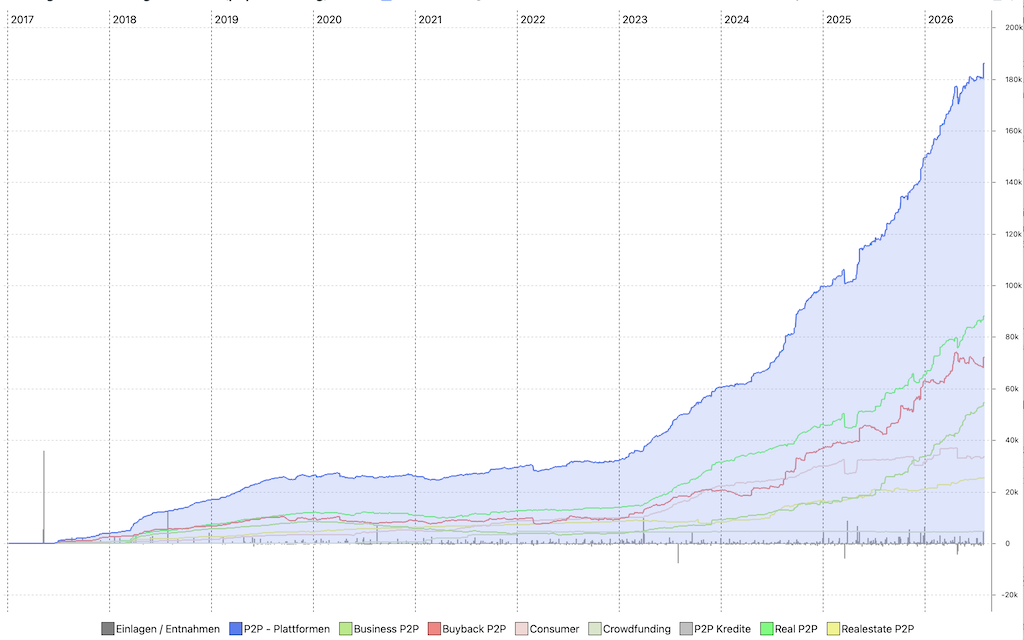
I deliberately exceeded my original 10 per cent limit in 2023. Not because P2P had become safe, but because my picture of the individual platforms had sharpened considerably after years of annual reports, crises and payment behaviour. However, the opposite also applies here: the larger the position, the more expensive a mistake becomes. Anyone who knows my list of losses from 2020 knows that I am not speaking about this in theory.
What to bear in mind: for me, P2P is still only one building block and it will not get any bigger. The larger part of my assets remains in ETFs, plus accounts for other purposes. A total loss in the P2P part would be bitter and a serious setback. But it would not be a catastrophe for my retirement provision, and that is precisely the condition under which I hold this position at all.
What has changed in my view, and what has not
Above all, the market has changed. Some of the platforms are now licensed and under supervision, publish audited financial statements and disclose their lenders. That is a completely different starting point from 2017, when I had to believe a website and a few forum posts.
The basic risk has not changed. I lend money, unsecured or weakly secured, to countries and lenders that I will never check in person. There is no deposit protection. In a real crisis, borrowers, lenders and the platform do not fail one after another, but quite possibly all at once.
And then there is the moral side, which I discussed much more loudly in the early years than I do today. Interest rates above 100% for the end customer remain an uncomfortable part of this business, even if the regulated markets are now considerably stricter. I have not found a clean answer to this. I am invested anyway, and that is part of the honest version of this story. I always feel better about non-consumer loans.
My conclusion after almost ten years of P2P loans
The P2P game has become the P2P asset class, and for me that is beyond question. It is just not the success story that today's figures would make it sound like. The real gain of the last nine years is not the 1,800 euros a month, but the ability to look at a platform and fairly quickly see what is missing. And unfortunately I do not yet see at a glance everything that goes well and what can go wrong, but I hope to get better at that too, bit by bit.
And the longer I do this, the less inclined I am to keep increasing my percentage share, even if I do get itchy fingers at the odd cashback promotion. Perhaps precisely because of the experience I have gathered. You simply know very well by then what can go wrong…