Modena Review (€14,000 Test): Bondora Alternative with up to 11% & Monthly Payout
Translated from the German original, last updated 11 Nov 2026. Read the original (German)
Modena is a P2P platform from Estonia on which you invest in receivables of the Estonian lender Modena Estonia OÜ. Only the lending business itself is regulated: Modena Estonia holds a lender licence from the Estonian Financial Supervision Authority (No. 4.1-1/100), whereas the investor platform is not licensed and there is no deposit protection. You invest via a vault model in a pool of mostly Estonian consumer loans, credit lines, BNPL receivables, refinancing and business loans. Since its launch in November 2024, Modena has presented itself as a lean, highly automated solution, according to the platform with up to 8.5% p.a. in the flexible Dynamic Vault and up to 11% p.a. in the Growth Vault with a twelve-month lock-in, aimed at rather passive investors. So is Modena the Bondora alternative with the better Monefit Vault concept, and does it join the group of P2P "call money" alternatives, a label that is often wrongly applied?
Before we go deeper into the questions and I cover my personal experience with Modena after one year, my impressions of the returns and what I plan to do next, let us look at the platform and the most important questions about Modena.
- New customers get 1% cashback on all investments via my Modena link*.
This item describes a promotion by the provider, such as a bonus or cashback. It reproduces the provider's statements and is not a recommendation. The provider's terms apply.
Modena: data at a glanceAs of 12 Nov 2026
- My platform rating
- 47 out of 100, rank 25 of 46
- My return (XIRR)
- 9.97%
- Outstanding portfolio
- 8.7m EUR
The most important Modena data at a glance
Before going into detail, here is an overview of the most important and relevant data on the P2P lending platform Modena (platform figures as of 2026-10-28):

| Founded | Platform 11/2024; lender 2019, operational since 2020 |
| CEO | Oliver Matt, Board member of Modena Estonia since 20.04.2021 (Quelle) |
| Regulated | Platform/investor side: no; sister company Modena Payments OÜ: PIS/AIS licence (Quelle) (Quelle) (Quelle) (Quelle) |
| Investors | 7,068 registered (2026-10-28) |
| Headquarters | Tallinn, Estonia (Modena Estonia OÜ and Modena Payments OÜ) |
| Collateral | Dynamic/Growth: none (only buyback by Modena); Secure+ not launched |
| Return | Platform average 8.83% according to the platform (3 months); Growth 9.5 to 11% according to the homepage |
| Buyback guarantee | Buyback in case of 35 to 90 days in arrears according to the platform; at Modena’s discretion |
| Secondary market | No |
| Liquidity | Dynamic: Instant or Gradual (30 days according to the platform); Growth: only at maturity |
| Loan types | Estonia: BNPL, instalment purchases, small loans, credit lines, SME loans, factoring, mortgages |
| Financed loan volume | €43,303,280 cumulative invested (23.10.2026); €8,663,359 outstanding |
| Minimum investment | €50 per Vault; max. Dynamic €20,000 |
| Investment strategies | Vaults: Dynamic (liquid), Growth (12 months); Secure+ announced |
| Rating | P2P Rating: 47/100 (rank 25 of 46) · BaFin check: 81/100 |
| Loyalty program | no (announced for Q1/2026, not implemented) |
| Withholding tax | 0% |
| Annual report | FY 2025 audited by Audit Advisory OÜ, unqualified (Quelle) (Quelle) |
| New customer bonus | none |
Figures from the platform's website, its reports and public registers, as of 11 Nov 2026. Not every figure can be independently verified.
The two latest Modena news items
Modena keeps us investors informed in an exemplary way via its own blog as well. Here are the two most important Modena news items for you:
- Modena Plans MiFID II Investment Firm Licence Application to Estonian Regulator
Modena, the P2P lending platform, has announced plans to seek a MiFID II investment firm licence. The full application is expected to be filed with the Estonian Financial Supervision Authority in about 2.5 months, followed by a standard six-month review. The company says the licence would bring it under direct regulatory oversight, with stricter capital and governance requirements.Telegram - Modena Reports Audited 2025 Financial Results
Modena has published its audited financial results for 2025, reporting total revenue of EUR 1,786k and a net profit of EUR 231k. The company cites growth in its corporate segment, the launch of a claims trading portal and a rebranding as key developments of the year. The full annual report is available in Estonian.Telegram
Let us take a somewhat closer look at the P2P lending platform for consumer loans and who is behind it, before I report on my own experience with Modena.
What is Modena?
Modena is an Estonian P2P platform belonging to the Modena group. It launched in November 2024 with a fairly simple concept based on vaults. You do not invest in individual loans here. Instead, you put your money into a "vault", which in turn buys shares in a broad loan portfolio. The platform, lender and servicer are one and the same company, Modena Estonia OÜ. What is regulated is not the platform itself, but the lending business of Modena Estonia OÜ as a lender, by the Estonian financial supervisory authority.
Behind it is a mix of different credit products: credit lines ("Modena Flex", a kind of virtual credit card), classic consumer loans, refinancing loans, BNPL receivables from online retail and business loans, currently exclusively in Estonia. Modena does not disclose in detail how the allocation within the pool looks, so you are buying the overall package of the portfolio rather than individual loans.
There is no buyback guarantee, but there is a buyback at portfolio level: according to the platform, receivables are bought back after 35 to 90 days of delay, depending on the underlying contract. CEO Oliver Matt specifically names 35 days for BNPL contracts and 85 days for loan contracts. According to Modena, these periods result from the statutory notice periods. Credit risk therefore remains with the investor, but is partly cushioned by the broad diversification in the vault and the buyback by Modena, as long as Modena is able to pay.
Important to know: as a non-bank, Modena may not contractually guarantee the buyback. Under EU law, a firm buyback commitment with a guaranteed return would count as deposit-taking, which would require a banking licence. The homepage therefore says that receivables can be bought back, and the CEO speaks of a buyback at Modena's discretion. The texts are not entirely consistent, though: the portal says Modena is obliged to buy back, and the earlier wording "buyback guarantee" has since disappeared from the homepage. The investor contract ("vault contract") is only available after logging in. In practice, Modena will offer the buyback as long as the company is financially healthy, since suspending it would immediately destroy investors' trust, as CEO Oliver Matt confirmed in the interview.
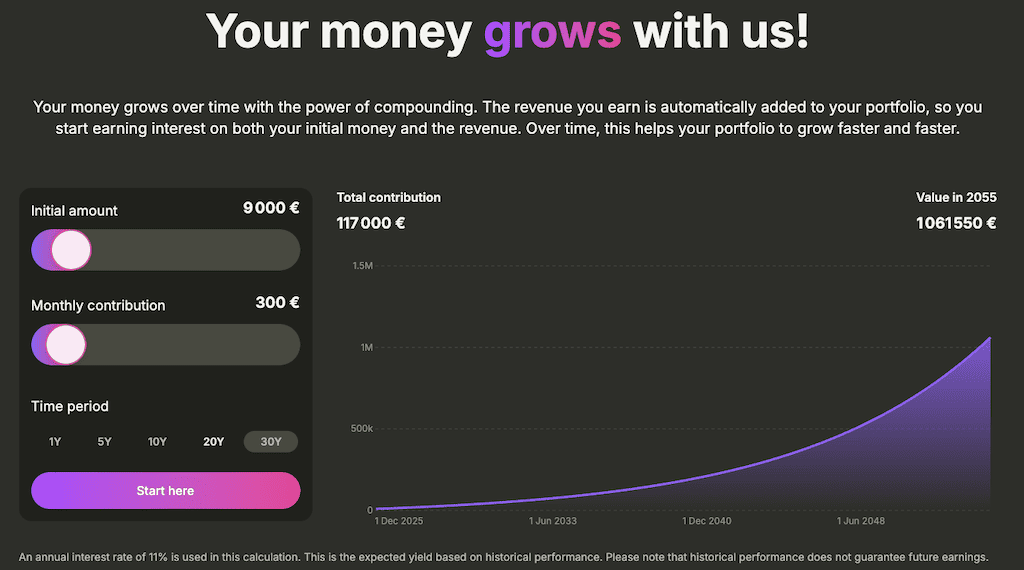
The platform is deliberately kept lean: you can invest from 50 euros, you have only a few, but simple products to choose from with the Dynamic and Growth Vault, and you do not need auto-invest, because everything flows into the pool automatically. For investors, Modena thus offers an uncomplicated but still very young way to invest in Estonian loan portfolios of the Modena group, according to the platform with up to 8.5% p.a. in the Dynamic Vault and up to 11% p.a. in the Growth Vault, with the particular feature that you can have the returns paid out monthly to your current account.
Modena figures & facts as of 2026
By the end of September 2026, investors had cumulatively invested around 40.7 million euros via Modena (including reinvestments). The average annualised return of all vaults over the last three months was 9.22% on 25.09.2026, compared with 11.26% in April 2026. So far, around 400,900 euros in returns have been paid out to investors. The currently outstanding investment volume is around 8.3 million euros, and the average buyback rate over the last 12 months is a low 1.78%. This is a sign that most receivables are being serviced as scheduled, although the buyback only applies after 35 to 90 days, so the most recent months still say little.
Modena's statistics page counts around 6,900 users (as of 25.09.2026). In April 2026 it was still around 1,900. However, Modena does not disclose what exactly is counted as a "user".
Statistics and lender reports are published regularly, which provides transparency. The statistics are even updated daily and show not only volume and return but also the buyback and default rates.
Who runs Modena?
Modena is led by CEO Oliver Matt, who has been on the management board since 2021 and has driven the development of the P2P platform within the Modena group. Under his leadership, Modena Estonia OÜ received its lender licence from the Estonian financial supervisory authority in 2021, before the investor platform with the vault model launched in November 2024.
Organisationally, Modena Capital operates as its own brand within the group, but remains closely tied to the existing payment and financing business. The group has been active in lending since 2020, has more than 100,000 customers and publishes audited annual financial statements, most recently for 2025 (unqualified audit opinion from June 2026).
Modena has been granting mortgage-backed loans to business customers since 2025. Insurance brokerage is announced on the website. I have not found a leasing product there so far, and according to the CEO it is planned for 2026. The mortgage loans are likely to also feed the announced Secure+ Vault, which is meant to work exclusively with real estate-backed loans.
Oliver Matt is CEO of Modena in Tallinn and has led the company since 2021 from a 3-person start-up to a regulated credit and payment provider with licences and its own lending IT. The sister company Modena Payments also has a cross-border permit for Latvia and Lithuania, but only for payment initiation services. So far, Modena grants loans exclusively in Estonia.
Before that, he was responsible for product strategy in consumer lending and open banking solutions as Chief Product Officer at ESTO AS, and he also spent several years in senior roles at IPF Digital, working on credit, risk and core lending systems in Europe, Mexico and Australia.

Of course, he is not alone in running the platform: a whole team keeps developing it and keeps it running:

In addition, other people in the Modena group are involved in the actual lending business. According to the 2025 annual financial statements, Modena Estonia has 14 employees (full-time equivalents), and you can find some of them on LinkedIn as well.
Modena registration and the welcome bonus
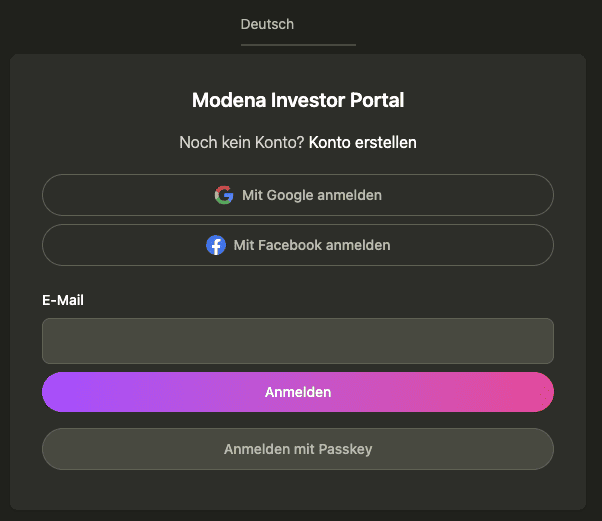
Registering with Modena is simple and structured much like on other well-known P2P platforms. The platform guides you through the registration process step by step, and it is currently also available in German:
- Start registration
Click on "Create account" on the Modena homepage. - Enter personal details
Enter your email address and set a secure password. Or use single sign-on with Facebook and Google. - Email confirmation
Check your inbox and confirm the verification email from Modena to continue. - Complete the identification process
Carry out the final identification by uploading a valid identity card or passport to fully activate your account. - KYC and AML
You may have to provide additional specific information (Know Your Customer) to meet regulatory requirements, like a product suitability test.
You may also have to prove the origin of the funds you pay in (anti-money laundering, AML).
It is enough to use my Modena link*to receive the referral bonus!
To invest with Modena, you should meet a few requirements. First, you must be at least 18 years old to register. According to the terms of use, you also need citizenship of an EEA state or a right of residence in the EEA. Only natural persons can register, with one account per person.
Once you have registered successfully and made a deposit, you can invest in the vaults on the platform. Paying in money is straightforward , in the account dashboard you will find a button called "Add money", where you get all the necessary SEPA details and can then simply make a transfer.
Your first deposit must come from a personal bank account in your name, as this account is verified for payouts via the payment service provider. Card payments are not currently possible, even though the homepage suggests otherwise. In my experience, credits take a few hours with instant transfers and up to two banking days with regular transfers.
It is important that the deposit comes from an EU account in your name and that you enter the payment reference (description), so that your deposit can be matched to you.
An additional bonus for new investors
When you register for the first time via my blog, you receive a welcome bonus in the form of 1% cashback on your investments during the first 120 days (maximum €1,000 cashback) if you use my Modena bonus link*. The cashback is paid proportionally, based on your average invested amount. There is also a €25 welcome bonus, which Modena pays out after 90 days, provided you have invested at least €200. You can find all current promotions from the platforms on my bonus page.
Investing with Modena
How do you invest in P2P loans with Modena, what should you bear in mind and what options do you have? With Modena you do not invest directly in individual consumer loans, but in a so-called vault, which contains shares in many hundreds, if not thousands, of different receivables.
I am currently invested with a five-figure amount on Modena myself.
Investing in the vaults at Modena
Since you can only invest in the vaults and not in individual loans, there is no auto-invest.
Modena currently has two different vaults:
- The dynamic vault (Dynamic Vault)
Here you can pay money in and withdraw it at any time, normally with a 30-day notice period according to the platform (a maximum of 31 days according to the CEO), or immediately by giving up the accrued returns. According to the portal, the maximum is €20,000 per investor, and the return according to the platform is up to 8.5% p.a. - Growth Vault (until the end of 2025 "Fixed Term Vault")
Your money is locked in for 12 months and is reinvested diligently for as long as it runs. According to the platform, this earns 9.5 to 11% p. a., so roughly 25% more than in the Dynamic Vault. You can set up several Growth Vaults, temporarily up to 5,000 € according to the portal.
With the Dynamic Vault, the returns can be paid out monthly if you wish, even straight to your bank account. With the Growth Vault, everything is reinvested until maturity, after which you can optionally have the amount reinvested automatically.
The returns can fluctuate slightly here: with BNPL contracts (30 days term), the whole remuneration is credited on the first day, whereas with loan contracts it is credited evenly every day. Faster or slower customer repayments also have an effect. According to Modena, however, there is a compensation mechanism (booked in the portal as "Vault revenue compensation") which, according to the CEO, is meant to ensure that the communicated minimum return is met, even in the case of cash drag or other unforeseen events. The exact rules for this are not public.
You can withdraw from the Dynamic Vault at any time. According to the platform, the regular mode ("Gradual") cashes out your investment within 30 days (a maximum of 31 days according to the CEO), with all interest and at no cost. In my test, the 400 euros I wanted were already available after one day!
In Instant mode, Modena buys back your claims at midday. According to the portal this takes one to two hours, and the balance is usually available the following day. In return, you have to forgo all returns accrued so far and not yet paid out.
In principle, the whole thing is quite comparable to Bondora or the Monefit SmartSaver, where in both cases you also invest in a huge loan pool.
A third Vault has been announced:
Secure+ Vault (announced)
New and particularly interesting is the Secure+ Vault, which Modena announced on 30.12.2025, with the launch planned for January 2026. However, as of the end of September 2026 Secure+ has still not launched, and I cannot select it in the portal so far.
Secure+ is meant to be aimed at investors for whom capital protection is the top priority, for example for long-term reserves or retirement goals.
What sets Secure+ apart from the other Vaults, according to the announcement:
- 130% property collateral:
Every loan is meant to be secured by property whose value is well above the loan volume. - Clear legal separation:
According to Modena, the Secure+ assets are meant to be completely separated from the operating business of Modena Capital. - Independent security agent:
In the worst case, an external security trustee is meant to take control and realise the properties in order to repay investors. - Strong legal set-up:
According to Modena, developed with a leading law firm in order to safeguard the investor's position even in crisis scenarios.
Secure+ deliberately forgoes maximum return in favour of a risk profile that is as stable and predictable as possible. Modena has not yet published who the security agent is, which law firm is involved or on what terms Secure+ will launch.
Automatic interest payout at Modena
The option of having accumulated returns paid out to your account automatically every month was for a long time a unique selling point of Modena. Since January 2026, Monefit has also offered something similar with its Passive Income Mode.
At Modena you choose a percentage: this share of the returns paid in the previous month goes to your current account on the first banking day of the month, and the rest is reinvested. All of this is simple, variable (as a percentage) and at no further cost to you.
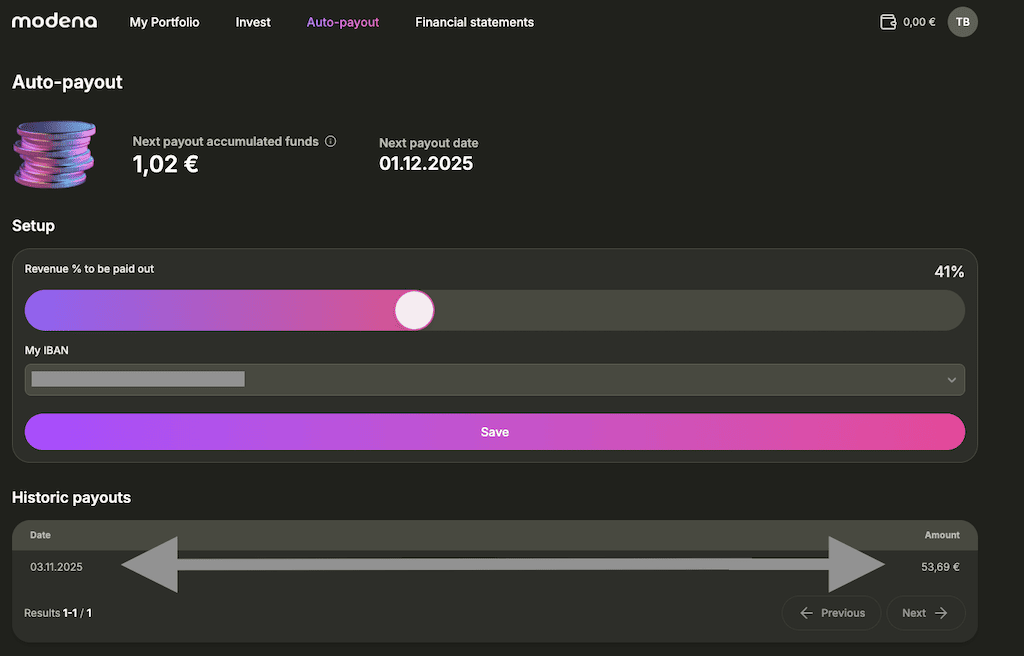
Modena fees
In principle, investors pay no fees, neither for account maintenance nor for deposits and withdrawals or the regular cash-out (30 days in the Dynamic Vault). Modena states no fee for the "Instant Payout", but you forgo the accrued returns that have not yet been paid out. At around 8.5% p. a. and up to one month of accrued returns, that is up to about 0.7% of the amount.
The tax issue at Modena
Modena withholds no withholding tax on the interest income (0%), so you have to take care of taxing the interest in Germany yourself. However, there is no written confirmation from the platform regarding withholding tax.
You can find the documents for the tax office (Finanzamt) under Financial Statements. Besides the Income Statement, there is now a separate Tax report: you choose the tax year and export it as a PDF or Excel file.
The Modena loan portfolio: what are you actually investing in?
Let's look at which loans Modena offers and what sets them apart.
Modena doesn't give you the option of investing directly in individual consumer loans.
Instead, you invest in their large loan pool and therefore in many loans. You can also see this for yourself when you look into your Vault. However, it is all the more important to understand who is working behind Modena and whether they run a profitable business.
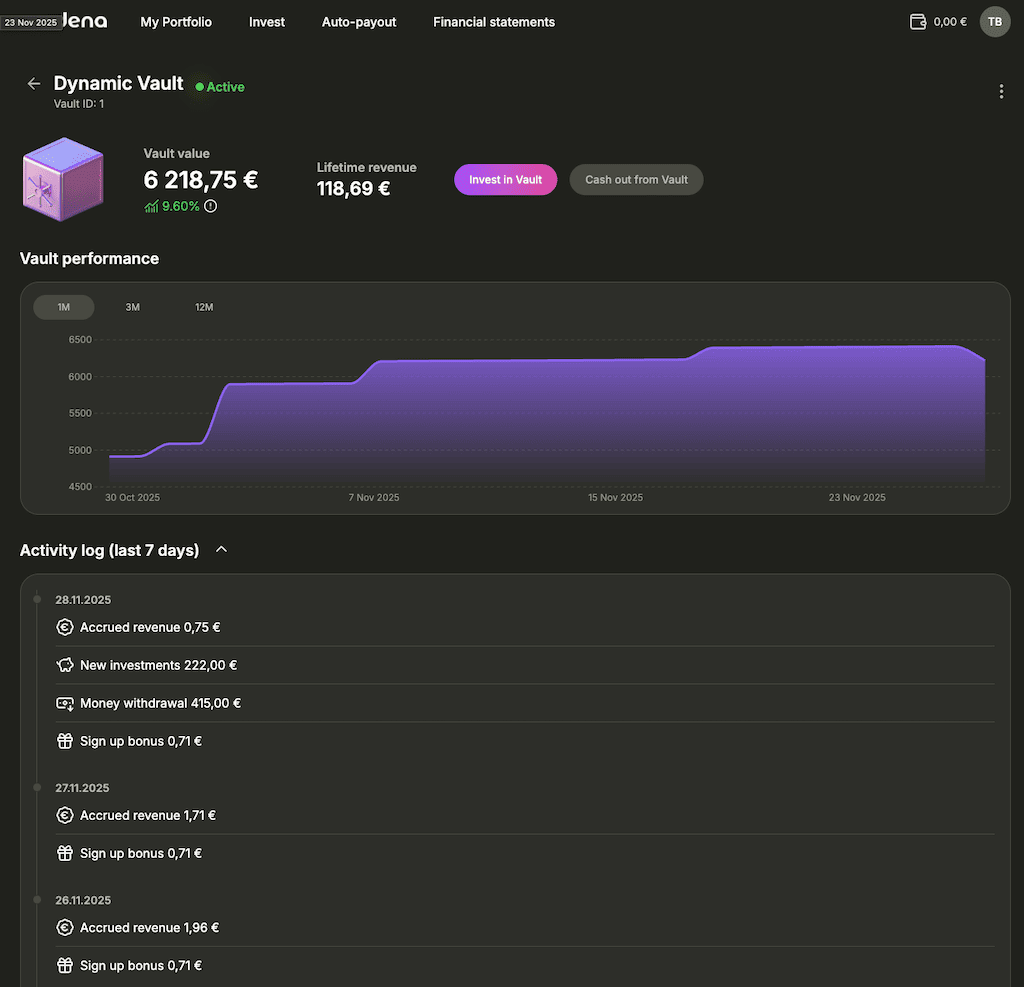
In the pool you could find the most varied types of loans that Modena offers its borrowers.
- Credit lines ("Modena Flex", a virtual credit card of up to €5,000)
- Classic consumer loans (small loans of up to €15,000)
- Refinancing loans
- BNPL and instalment purchases (factoring: Modena buys the receivable from the merchant)
- Business loans (SME loans of up to €50,000, and since 2025 also mortgage loans for business customers)
Interestingly, we don't earn interest over time. Instead, we buy the receivable at a discount and receive the amount at the end of the term, or proportionally with each repayment, ideally the full outstanding amount. Or the loan is bought back in full by Modena after a certain period.
According to the 2025 annual financial statements, the loan interest that Modena charges borrowers is 8.9 to 38.5% p.a. (CEO Oliver Matt quoted 12 to 38%, depending on risk). Merchant fees in the BNPL business come on top. The operating costs are deducted from this, and the rest is passed on to investors as return. There are two categories of terms: BNPL contracts run for up to 90 days, loan contracts between 6 and 60 months, and only in rare cases (1 to 2% of the portfolio) longer.
In fact, it is not entirely clear what exactly you are investing in, or in whom. You do see the loan type, in my case CREDIT and FACTORING (the portal also knows MANUAL and DEBT_COLLECTION), as well as a contract number, the borrower's abbreviation and the loan amount, but no more details than that.
Other platforms such as Finbee show you considerably more.
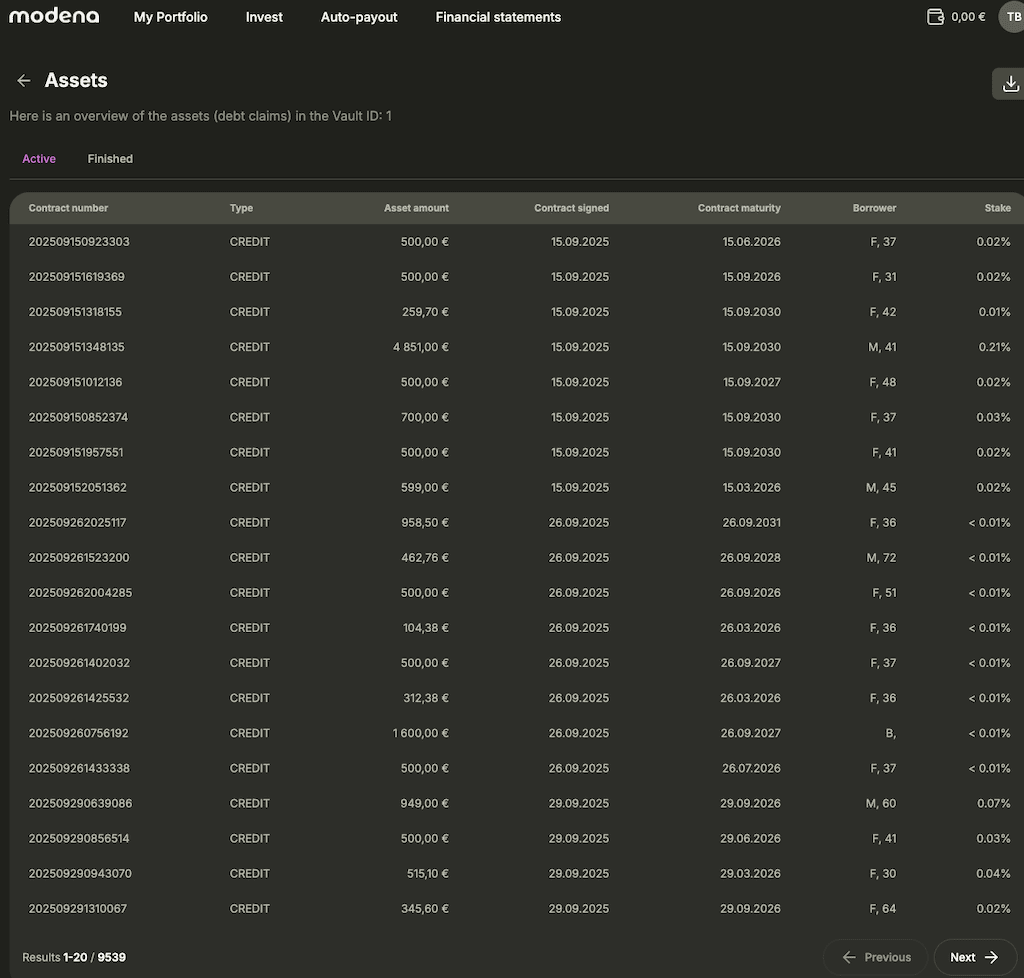
Whether this matters to you is open to debate anyway, since according to the platform Modena buys back receivables after 35 to 90 days of arrears, depending on the loan type. However, this buyback is not a guarantee (see above).
This means the individual loan plays a smaller role for you, and what matters is the company itself: how does Modena run its business?
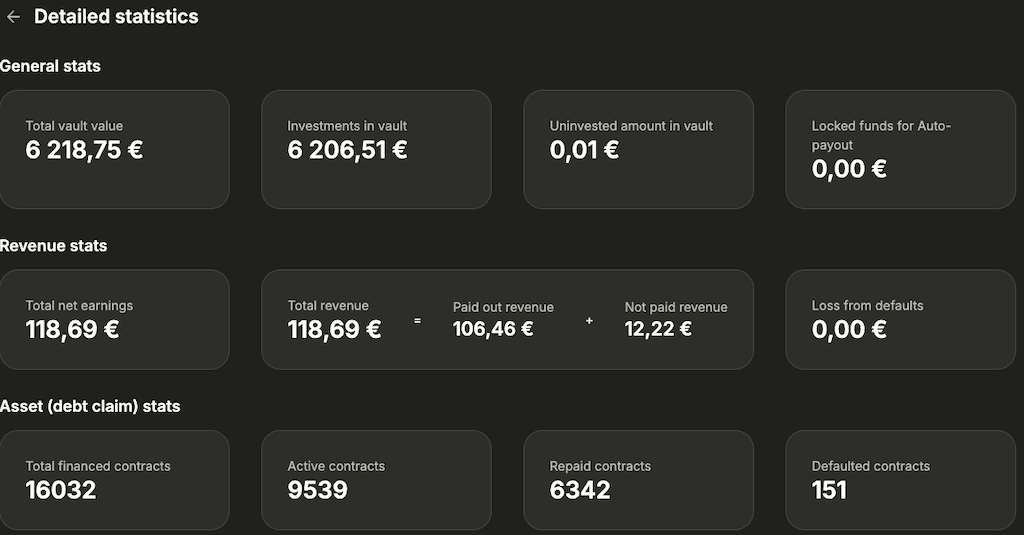
Modena Estonia OÜ, which is responsible for consumer loans and also operates the platform, publishes its annual financial statements, all of which you can view online. After losses in the start-up years, it was profitable for the first time in 2024 (€253,097 after retroactive adjustment in the 2025 statements, originally €368,085) and again in 2025 (€231,943), in each case with an unqualified audit opinion.
Its sister company Modena Payments also publishes its annual reports but does not issue loans: it is a payment institution for payment initiation and account information services and was slightly in the red in 2025 at −€3,410.
According to the platform, the return level is up to 8.5% in the Dynamic Vault and 9.5 to 11% in the Growth Vault, and the average across all Vaults was most recently 9.22%.
At least in the first year, the new customer bonus and cashback should make it a good bit more.
The Modena risk FAQ
Despite high liquidity and attractive interest, you should keep the risks at Modena in mind. I have summarised the main P2P platform risks for Modena in a short FAQ beforehand, before moving on to my experience with Modena and my conclusion.
How does Modena make money?
Modena generates its revenue primarily through fees charged to borrowers and merchants. These include the interest on the loans granted (between 8.9 and 38.5% p.a. according to the 2025 annual financial statements), merchant fees in the BNPL business (for example 2.9% plus €0.20 per purchase for the instalment model "Maksa 3 osas", where the customer themselves pays 0%) and late payment charges. Modena sells the receivables to us investors at a discount and keeps the spread between the borrowers' interest and the investors' return.
Is Modena profitable?
Yes, the lender and platform operator Modena Estonia OÜ is profitable: in 2024 with a profit of €253,097 (retrospectively adjusted in the 2025 financial statements, originally €368,085) and in 2025 with €231,943, in each case with an unqualified audit opinion. Before that there were several loss-making years. The sister company Modena Payments does not grant loans but is a payment institution for payment initiation and account information services. It was narrowly in the black in 2023 and 2024 and narrowly in the red in 2025 at −€3,410. All financial statements can be viewed online in the Estonian commercial register.
Is Modena legitimate?
I assume so. Lending at Modena is regulated and under state supervision: Modena Estonia has held lender licence 4.1-1/100 from the Estonian financial supervisory authority since 2021, the annual financial statements for 2023 to 2025 have unqualified audit opinions, and in the BaFin check Modena leads with 81 out of 100 points. However, the investor platform itself is not licensed, and the investor agreement is only available after logging in. Of course, this does not guarantee that the company will be run successfully or that we can keep earning money with it in future.
Are there loan defaults at Modena?
Yes, there are defaults at borrower level: Modena itself states a default rate over the term of up to 9% for loan agreements, with around 75% recovery, and around 0.7% for BNPL. For us investors, according to the platform, Modena buys back receivables after 35 to 90 days of arrears, and the buyback rate over the last 12 months was 1.78%. This works as long as Modena manages the portfolio successfully overall and is able to pay. The buyback is not a guarantee, and the portal also shows a "Loss from defaults" line for each Vault. The credit risk therefore shifts largely to Modena itself.
What would be the impact of an insolvency of Modena?
According to Modena CEO Oliver Matt, investors acquire the receivables (debt claims) of the underlying loans. After the sale, these receivables no longer belong to Modena. In the event of insolvency, an insolvency administrator could therefore not use these receivables to settle other debts: the loan receivables and the payment flows arising from them remain the property of the investors. Buybacks would, however, be discontinued.
Three further points apply: Balance not yet invested in the Vault appears on Modena's balance sheet as a liability (around €338,000 at the end of 2025) and would be an unsecured claim in the event of insolvency. According to the 2025 annual financial statements, Modena's customer receivables are pledged as security for loans from a lender, and it is unclear whether shares sold to investors are affected. And Modena has not named a backup servicer to keep collecting the loans in a worst-case scenario.
Even so, a bankruptcy of Modena remains a substantial risk: whether and how quickly an insolvency administrator actually organises the payout to investors is unclear. Anyone investing here should only use money whose complete loss they could cope with, both financially and emotionally. There is no deposit protection, and the process can take a long time.
What happens in a bank run on Modena?
CEO Oliver Matt openly admits that a simultaneous mass withdrawal by all investors would be problematic for Modena too. As a safeguard, according to the CEO, Modena keeps alternative sources of funding available: active credit lines, shareholder loans and around 1 million euros of equity reserves. According to the annual financial statements, at the end of 2025 equity stood at €1.08 million, cash at around €120,000 and shareholder loans at €112,000, set against around €8.3 million of outstanding investor money (September 2026). Until 2025, Modena was financed exclusively through personal and business loans, so an investor base exists that is not tied to the modena.capital platform. In addition, the Growth Vault with its 12-month lock-in is meant to provide more predictable cash flows. Still, there is no contractual guarantee of immediate payout in times of crisis, and as a non-bank there cannot be one.
Is there deposit protection at Modena?
No, there is no deposit protection. Your money is invested in an interest-bearing product with a high risk. Modena is not a bank and no safety funds step in if the company gets into difficulties. The portal states explicitly that the money paid in is not a deposit and is not covered by the Estonian deposit guarantee act. There is also no group guarantee.
An investment in P2P loans always carries a high risk.
Modena in the BaFin check: the six questions and Modena's answers
After BaFin's action against Ventus Energy, five urgent questions needed answering: deposit-taking business under § 1 KWG (German Banking Act), legal safeguards, segregation of funds, dependence on banks and the consequences drawn from the Ventus case. A sixth question asks for a message to investors. Modena answered all six questions via Oliver Matt. The answers below are the platform's own statements, not independently verified by me. My assessment is AI-assisted and is neither a legal opinion nor an assessment that would hold up in court.
Show all questions and the original answers
- Are you planning a licence or supervision (e.g. ECSP licence, MiFID regulation or payment institution status)? If so, which one and by when? If not, why not?
Modena Estonia OÜ (the operator of the platform) is already under the supervision of the Estonian financial supervisory authority because it holds a consumer credit licence. This means that day-to-day operations are monitored and that a financial audit and an internal audit are mandatory every year. The mere sale of loan receivables is not in itself considered an investment service and therefore does not require a separate licence.
Modena is very aware of the potential legal risk of being classified as deposit-taking business, which is why this was the central focus with the lawyers when the platform was set up. About two years before the launch of the platform, Modena began discussions with the Estonian financial supervisory authority and submitted an in-depth legal analysis to it; the authority saw no problems and gave no indication that the approach was illegal. A few weeks after the launch (early spring 2025), the Estonian financial supervisory authority approached Modena again with additional questions; after further data was handed over, the matter was closed without further queries.
Modena has decided to apply for an investment brokerage licence under MiFID and plans to submit the application by the end of summer. The second group company, Modena Payments, holds the European payment institution licence and is likewise under the supervision of the financial supervisory authority there. - How is your contract structure set up for German investors, and do you see a § 1 KWG risk (deposit-taking business as with Ventus)? Have you had this checked legally?
Whether something counts as deposit-taking business depends on how money is accepted. Anyone who borrows money from the public, pays interest on it and allows repayment at any time is, on this reading, conducting deposit-taking business.
Modena's structure is as follows: First, Modena does not borrow money from investors but sells assets (loan receivables).
Second, the return the investor earns technically does not come from Modena but from the end customer whose loan receivable was bought.
Third, the buyback (Buyback) is an option for investors named in the contract, but it is at Modena's discretion; Modena tries to honour it as far as possible, but legally may not guarantee it 100 per cent at all times.
Yes, this was checked legally and discussed twice with the Estonian financial supervisory authority. The set-up is simple: Modena sells its loan receivables to investors and shares the income from these receivables with the investors as a form of return. There is a legal memorandum from one of the leading Estonian law firms (Widen), but it is in Estonian. - Are deposited funds and wallet balances legally separated from the company's assets (e.g. via a licensed payment institution or a trust/escrow arrangement)?
Modena does not hold substantial balances of investor money. Investors' deposits are converted immediately into receivable purchases; any cash balance counts as a prepayment for the receivables.
Legally, all assets that belong to the investors are naturally not on Modena's books and are held separately. All money movements are audited every year by an official external auditor. Payments to and from the platform are handled on the technical side by Modena Payments, a licensed European payment institution. - How dependent are you on individual banks and payment service providers, and what would happen if a bank connection were lost?
What makes it easier for Modena: Modena Payments OÜ (a company within the group) is a licensed European payment institution, so Modena does not need to worry about losing a payment partnership. Even so, Modena still relies on banking infrastructure, which is very important for Modena as for any other company.
If all bank accounts were suddenly closed, that would be a serious problem. However, Modena points out that under EU law there would have to be serious breaches before a bank closes accounts, and it asks whether the BaFin announcement alone is a sufficient reason for closing an account; Modena would not be surprised if AML-related problems had been the real trigger in the Ventus case. To reduce the risks, Modena maintains two different bank connections, one of them as a backup. - Have you drawn any concrete consequences from the Ventus case (contracts, structures, communication)?
Ventus Energy set up the legal side in such a way that it could only be read as deposit-taking business; loans were taken out with an option for early repayment.
A very important difference from Modena is that the money paid in at Modena is not a loan but is used for the purchase of assets (loan receivables). The risk of deposit-taking business is not new for Modena and has been addressed from day one. As mentioned, Modena has already decided internally to acquire the investment brokerage licence in order to build trust in the industry; the Ventus case is accelerating this step. - Is there anything you would like to tell your investors right now?
The message is clear: even though Modena has taken precautions and built things with care (at times even too conservatively), trust is everything in this sector. A licensed platform conveys a deeper and different kind of trust, and that is exactly why Modena will acquire the European investment brokerage licence.
My assessment: 81 out of 100 points for Modena
For me, Modena is the best-evidenced answer in the field here. The core lies in § 1 KWG (German Banking Act): my money does not flow to the platform as an unconditionally repayable loan but buys receivables, and the buyback is expressly a goodwill gesture, not a guarantee, which takes the leverage out of the construction on which Ventus failed. Legally, Modena backs this up not just with a "we review continuously", but with a named legal memorandum from the law firm Widen and a regulator that has looked at it twice, and in the roadmap, a scheduled MiFID application (end of summer) comes on top of the existing Estonian licence. As of the end of September 2026, however, no Modena company is yet entered as an investment firm in the register of the Estonian financial supervisory authority.
The openly stated bank worst case and the clear distinction from Ventus round off the picture. On segregation of funds I looked more closely: Modena Payments only holds a licence for payment initiation and account information services and does not keep client money accounts, and investor money not yet invested (around €338,000 at the end of 2025) appears as a liability on the balance sheet of Modena Estonia. According to Modena and the balance sheet, what is segregated is therefore the purchased receivables, but not the balance still waiting for its investment. The overall score of 81 out of 100 points is the highest in the field, but I keep in mind that supervision and the legal opinion are Estonian, that they do not cover the German § 1 KWG one to one, that the MiFID licence is so far only an announced application, and that all of this rests on Modena's own account.
How Modena compares with all the others and how the regulation score is calculated can be found in the overall evaluation: The big BaFin check at a glance.
Is Modena an alternative to Bondora or Monefit SmartSaver?
Modena, Monefit SmartSaver (including Vaults) and Bondora Go & Grow all play in the same league: simple, reasonably "passive" products aimed at investors who have no desire to pick loans manually but still want clearly more than an instant-access savings account. With all three, only the lender is supervised, not the investor product. When you look at the details, though, the differences become clearer.
Modena* offers, with "up to 11% p.a." in the Growth Vault, nominally the highest return in the comparison field (Dynamic Vault up to 8.5%) and can pay the earnings out to you monthly directly to your current account.
For a long time that was an important difference from other solutions, where the interest is only credited within the product itself; since January 2026 Monefit has offered something similar with the Passive Income Mode. Availability, at 30 days (31 at most according to the CEO), is reasonably flexible, but not "daily", unless you are willing to forgo accrued earnings and use the instant cash-out.
There is no traditional deposit protection, as with all P2P-related products in this comparison. The minimum investment is 50 euros, and at the upper end the portal caps the Dynamic Vault at €20,000 and the Growth Vault temporarily at €5,000. The big drawback: Modena is new. The platform has been on the market only since November 2024, so the track record is very short and therefore harder to assess from a risk perspective.
Monefit SmartSaver*is the more "conservative" middle option. At 7.5% p.a., the return is below Modena and below the SmartSaver Vaults, but interest is credited daily. Up to €1,000 a month is available immediately, above that it takes up to 10 working days. For investors who want a kind of P2P "overnight money account" with P2P risk, this is relatively attractive. Minimum investment: 10 euros. A maximum of 500,000 euros can be invested, which is practically not a real limit for private investors. The product launched in November 2022, so there is at least a few years of history, but not yet a full interest rate cycle history spanning many years.
The Monefit SmartSaver Vaults* are in turn the "higher-return" variant in the Monefit universe: 9.42-10.52% p.a., so not far from the Modena Growth Vault. In return, there is a fixed term, so no real flexibility: anyone who commits here gives up daily availability. Interest is paid once the respective term has ended. The minimum investment is somewhat higher (100 euros), and the maximum amount per investor is likewise 500,000 euros. Here too, there is no classic deposit protection at all.
Bondora Go & Grow*on the other hand is the old hand in the field. Return: clearly the lowest at up to 6% p.a., but extremely simple in structure and available daily: payouts are made immediately for a fee of €1, although in the stress period of 2020 there were only partial payouts. Interest is credited daily, the minimum investment is just 1 euro, and there is no maximum amount. Perhaps the most important point: Go & Grow has had a track record since 2018 and has therefore been on the market clearly longer than the other three variants. Bondora itself certainly has, but since April 2026 Go & Grow has been running through the spun-off Go&Grow OÜ.
From the point of view of many investors, this longer track record offsets part of the return disadvantage.
All in all, the conclusion is: Bondora Go & Grow* remains the most well-rounded "one-click" product when you look at the overall package of simplicity, history, daily liquidity and handling, even if the return of up to 6% p.a. is clearly behind Modena and the Monefit SmartSaver*products. Anyone who puts more weight on return and accepts a bit more complexity or commitment can get clearly higher with Modena* and the Monefit SmartSaver Vaults, but pays for it with less flexibility and a shorter product history.
In the end, as an investor, you decide as always which criteria weigh more: maximum simplicity, a long history and daily availability (Bondora), a higher return with a moderate delay in availability (Modena Dynamic Vault and Monefit SmartSaver), or maximum return with a fixed term commitment (Modena Growth Vault and SmartSaver Vaults).
My Experience with Modena and My Modena Conclusion
I did not join Modena right at the start, but only at the end of September 2025, which was still fairly early..
Actually, an interest level of around 10% is not really my kind of thing, although the interest rate scenario has changed in general and 10% is becoming more attractive again than it was last year.
In addition, I found the idea of automatic interest payouts interesting and wanted to take a look at it.
And that worked very well. The interest arrived in my account at the start of the month and I did not have to take care of anything. After a break, I switched the automatic payout back on at the end of August 2026, the first 15 euros arrived in September, and from October it will be more.
Anyone who knows my article on the topic of liquidity with P2P loans (German) knows that I definitely appreciate a P2P platform with high liquidity. And that is the case here.
In a test at the end of November 2025, I was able to have an amount paid out to me within 24 hours and did not have to wait. Admittedly, that was only 400 euros from the 6000 euro dynamic vault. But with the instant payout option, you could speed this up even further, which I like.
On top of that came the quite attractive new customer offer, at the time with 1% cashback for the first 90 days and a fixed 25 euros after 90 days (today the cashback even applies for 120 days). That made it quickly clear: this way I would probably reach at least 10% in the first year and could look at the platform at my leisure, to see whether it is actually a liquidity alternative to Bondora or Monefit for me.
And thanks to the cashback, the platform has already performed really well in the first year.
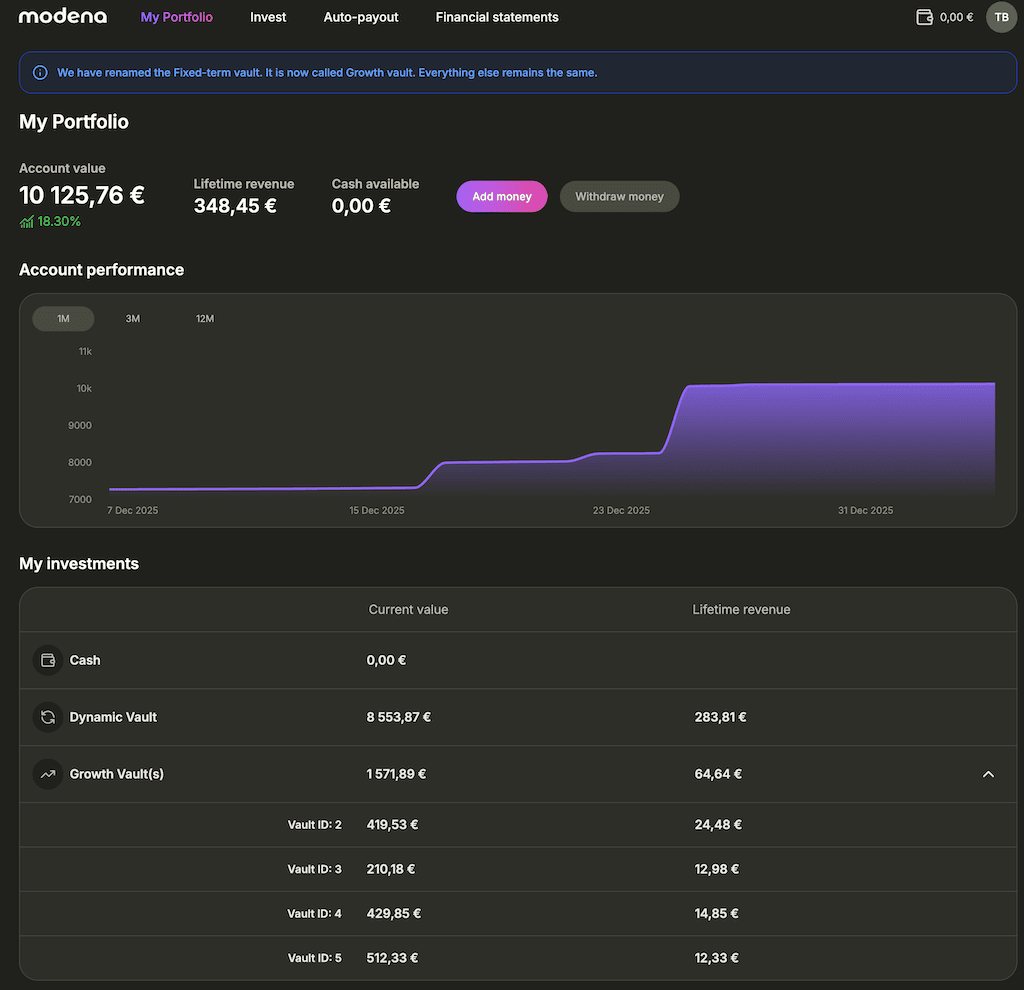
Modena Review - My Account
So I invested a noticeable amount in Modena right from the start, and after two top-ups in summer 2026, there are now around 14,200 euros there. Around 10,000 euros of that is in the dynamic vault, and the rest is spread across ten 12-month vaults (Growth) at the moment.
The dynamic one serves as a liquidity buffer, and the 12-month vaults were first allowed to work for three months, to see how far the return differs from the dynamic one.
The difference is clearly noticeable, so I decided to build an interest ladder. That means putting a few hundred euros a month into a fixed vault and then continuing this on a rolling basis.
I have just paused this interest ladder, and perhaps I will restart it next month. On that basis I want to collect a year of interest before I decide how the interest ladder continues in the long term.
My Modena return 2026
Modena has been in my portfolio since the end of September 2025, with a five-figure amount since October 2025, and has paid interest reliably since then.
Around 983 euros have accumulated since then (including cashback).
| Year | Paid in | Paid out | Net earnings | Return p. a. (XIRR) |
|---|---|---|---|---|
| 2025 (from 29 Sep) | €9,832 | €54 | +€336 | – (part year) |
| 2026 (to 03 Nov) | €6,100 | €2,727 | +€647 | 7.6% |
| total | €15,932 | €2,780 | +€983 | 10.0% |
So I have an overall return of 10.2% (IZF/XIRR), which will of course tend to fall further, as the cashback phase ended for me some time ago: so far in 2026 I am at 7.6% p.a. The platform quotes up to 8.5% for the Dynamic Vault and up to 11% for the Growth Vault.
My Modena return
My own investment since 29 Sep 2025 · figures from Portfolio Performance
- €13,152
- net paid in
- +€983
- Net earnings
- €14,134
- Portfolio value
- Net paid in
- Net earnings (up to portfolio value)
- Portfolio value
My aim is to use the portfolio as a buffer for opportunities that come up. Alternatively, it is also one of the pots reserved for possible back payments of tax.
Liquidity can quite often be needed, and I get on well with a 30 day waiting period (31 at most, according to the CEO), especially since, as my tests showed, it is not even used in full.
And if things really need to be quick, there is also the option of an instant cashout.
My interim conclusion after a year of Modena*: the platform delivers reliably, pays out and gave the best-evidenced answers in my BaFin check. The risks lie elsewhere: a single lender in a single country, a buyback without a guarantee, an investor agreement only available in the login and around €1.1 million in equity against just over €8 million of investor money. For me, Modena therefore remains a liquidity buffer with P2P risk and not a substitute for a genuine overnight deposit account. Whether it suits better as a Bondora Go & Grow alternative or as a counterpart to the Monefit SmartSaver depends on how much lock-in and how much single-lender risk one is willing to bear.
My Modena position (as of 03 Nov 2026)
- Invested since
- 29 Sep 2025
- Invested (net, rounded up)
- €13,200
- Interest received (rounded up)
- €990
- Return (XIRR) since start
- 10.0%
All figures for Modena My P2P investing in numbers
My own money, shared for transparency. Not a recommendation. Past returns do not guarantee future results.
Editorial note: This review reflects my personal experience as an investor. Commissions from affiliate links do not influence my assessment or the platform rating.