My InRento Review: Returns, Risks and the Complete Platform Guide
Translated from the German original, last updated 11 Nov 2026. Read the original (German)
Anyone looking for a regulated real estate crowdfunding platform with first-ranking mortgage security will find it hard to ignore InRento. The Lithuanian platform is under the supervision of the Bank of Lithuania, holds an ECSP licence and offers target returns of 9 to 12% p.a. in fixed interest, plus additional capital gains when a project is sold. Since its launch in 2020, InRento has financed around 129 million euros of real estate projects in what are now eight European countries. According to the platform's statistics, the default rate remains at 0%. Since 1 October 2026, however, the first loan has been terminated, with enforcement of the mortgage under way.
InRento started in 2020 as a buy-to-let specialist, but has visibly broadened its product since then. Today the platform finances not only classic rental properties but also hotel, tourism and conversion projects, that is, loans whose cash flow depends on the project owner's operating business. What they all have in common is first-ranking mortgage security. Before I share my personal InRento review, my returns so far and how I plan to proceed, I will first give a complete overview of the platform, including the first problem loan, which now has to show what the collateral is worth.
- For whom: Investors
- Bonus: €20 for an investment of €500, €50 for an investment of €1,000
- Tiers:
- €20 for an investment of €500
- €50 for an investment of €1,000
- Important: An investment of €1,000 can be spread across 1 or 2 projects, as the minimum amount is €500 per project. The promotion runs until 30 November 2026.
This item describes a promotion by the provider, such as a bonus or cashback. It reproduces the provider's statements and is not a recommendation. The provider's terms apply.
InRento: data at a glanceAs of 12 Nov 2026
- My platform rating
- 80 out of 100, rank 2 of 46
- My return (XIRR)
- 8.98%
- Investors
- 5,644
The key InRento data at a glance
Before going into detail, here is an overview of the most important and relevant data on the P2P lending platform InRento (platform figures as of 2026-11-09):

| Founded | 2020 (operational since end of 2020) |
| CEO | Bernardas Preikšaitis (since 15.09.2026), previously COO |
| Regulated | Yes, ECSP licence from Lietuvos bankas since 10.11.2023 (Quelle) (Quelle) |
| Investors | 5,644 active (2026-10-12) |
| Headquarters | Vilnius, Lithuania (offices in Warsaw and Bucharest) |
| Collateral | First-ranking mortgage, usually plus guarantees |
| Return | Ø 11.56% according to the platform (gross before withholding tax) |
| Buyback guarantee | No (the platform is not liable for non-performance) |
| Secondary market | Yes (bulletin board), fee-based, few offers |
| Liquidity | Repayment after project end; exit only via secondary market without guarantee |
| Loan types | Secured project loans to companies, mainly residential and hotel |
| Financed loan volume | 137.52m € invested by investors (2026-11-09) |
| Interest paid out | 13.27m € (2026-11-09) |
| Defaults | 0% according to statistics, since 01.10.2026 first terminated loan in recovery (Harfowa 10) |
| Minimum investment | €500 per project |
| Investment strategies | Manual, secondary market (no auto-invest) |
| Rating | P2P Rating: 80/100 (rank 2 of 46) |
| Platform risk rating | internal project rating (A to D) |
| Loyalty program | Premium status from 50,000 € (reduced secondary market fee, early access) |
| Withholding tax | 15% for non-Lithuanians; 10% for Germany with DAS-1 and proof of residence |
| Annual report | audited annually, financial statements 2020-2025 only after login (Quelle) |
| New customer bonus | €20 after the first investment (via this link*) |
Figures from the platform's website, its reports and public registers, as of 11 Nov 2026. Not every figure can be independently verified.
The two latest InRento news items
InRento regularly informs its investors via its own news area. Here are the two most important InRento news items for you:
- InRento Q3 2026: EUR 23.49 million funded, two Polish projects with delayed payments
Investors funded EUR 23.49 million of real estate projects via InRento in Q3 2026, up 76.4% on the prior-year quarter. The new CEO names better execution as the priority. Two Polish projects have delayed interest payments.Telegram - InRento appoints Bernardas Preikšaitis as CEO, founder moves to credit committee chair
From 15 Sep 2026, Bernardas Preikšaitis takes over as CEO of the Lithuanian real estate investment platform InRento. He previously served as COO. Founder Gustas Germanavičius remains with the company as Chairman of the Credit Committee.Telegram
Let us take a somewhat closer look at the real estate crowdfunding platform and who is behind it, before I report on my own experience with InRento.
What is InRento?
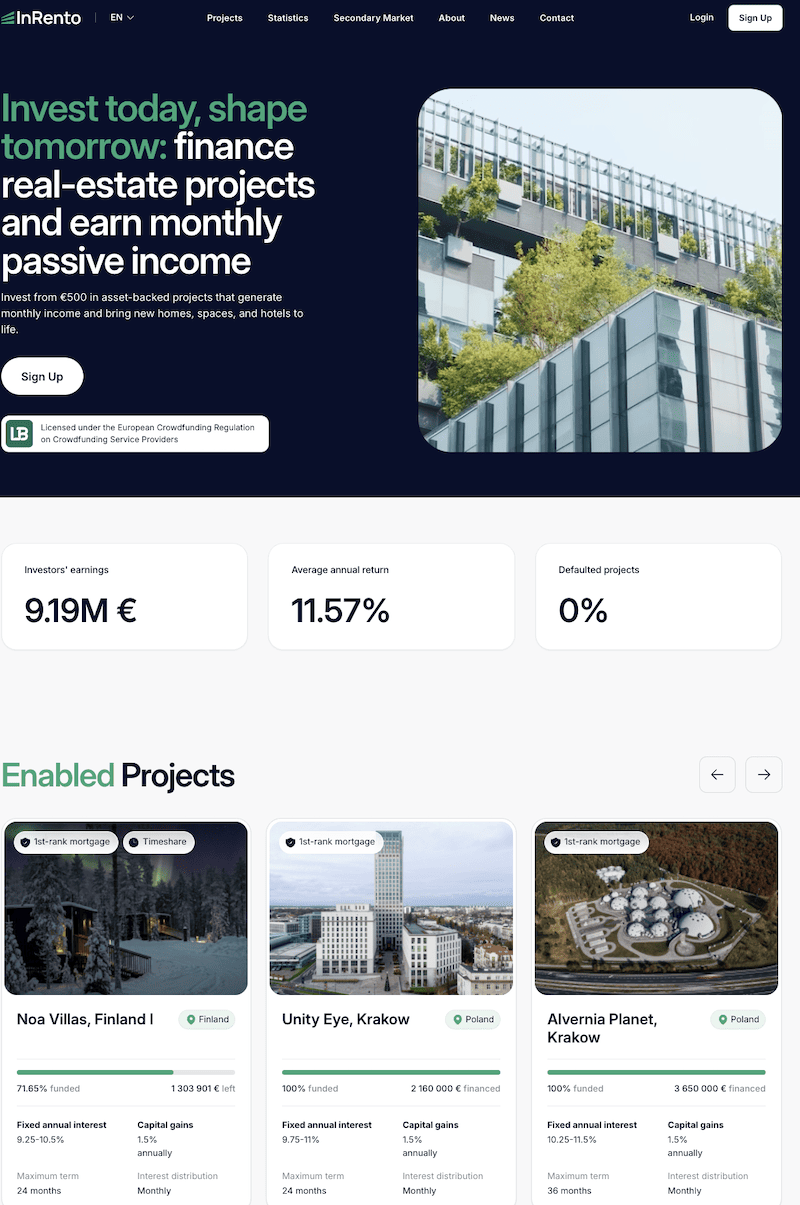
InRento is a Lithuanian crowdfunding platform focused on so-called buy-to-let loans, that is, loans to finance rental properties. It has been operating since the end of 2020. With the expansion into Poland, Spain, Italy, Ireland, Finland, Latvia and Romania, the range has now become broader. Besides classic rental properties, the platform now also finances hotel and tourism resorts, conversion projects and commercial properties with operating cash flow. What all projects have in common is the first-ranking mortgage security and the fixed monthly interest. The platform is under the supervision of the Bank of Lithuania and has held the European ECSP licence since November 2023, which puts it among the strictly regulated providers in the segment.
What is special about the InRento model: as an investor you receive two sources of return. First, fixed monthly interest payments, which the borrower pays from the project's operating cash flow, that is, from rental income, hotel stays, catering or comparable revenue sources. Second, a capital appreciation (capital gains) that falls due on repayment, either as a fixed percentage (typically 1.5% p.a.) or as a profit share (up to 30% of the sale profit). All projects are secured by a first-ranking mortgage registered in the country where the property is located. Only after registration does the money go to the project owner.
InRento is not a classic P2P platform where thousands of small loans are financed through a pool. You invest specifically in individual real estate projects and see exactly where your money goes. There is no Auto Invest, though; investing is done manually. The advantage is that you look at each project deliberately before committing money. Given the platform's current range (from quiet residential rental projects in Vilnius to tourist hotel projects in Poland or Lapland), this is really important.
Investing starts from 500 euros per project, and you can choose between the primary market and the secondary market. For investors, InRento thus offers the opportunity to invest in secured European real estate projects, regulated, with first-ranking security and an average return on completed projects of 11.56% p.a. according to the platform's statistics.
InRento facts & figures as of 2026
Since the operational start at the end of 2020, InRento has financed real estate projects with a total volume of around 129.4 million euros (as of October 2026). According to the home page, that is 140 financed projects; the statistics count the individual tranches separately and arrive at 199 loans. Investors have earned 12.5 million euros in returns together. The platform has around 5,600 active investors and has already repaid 36.6 million euros in capital from completed projects. 99% of the realised projects were repaid before the end of the term, after 21 months on average.
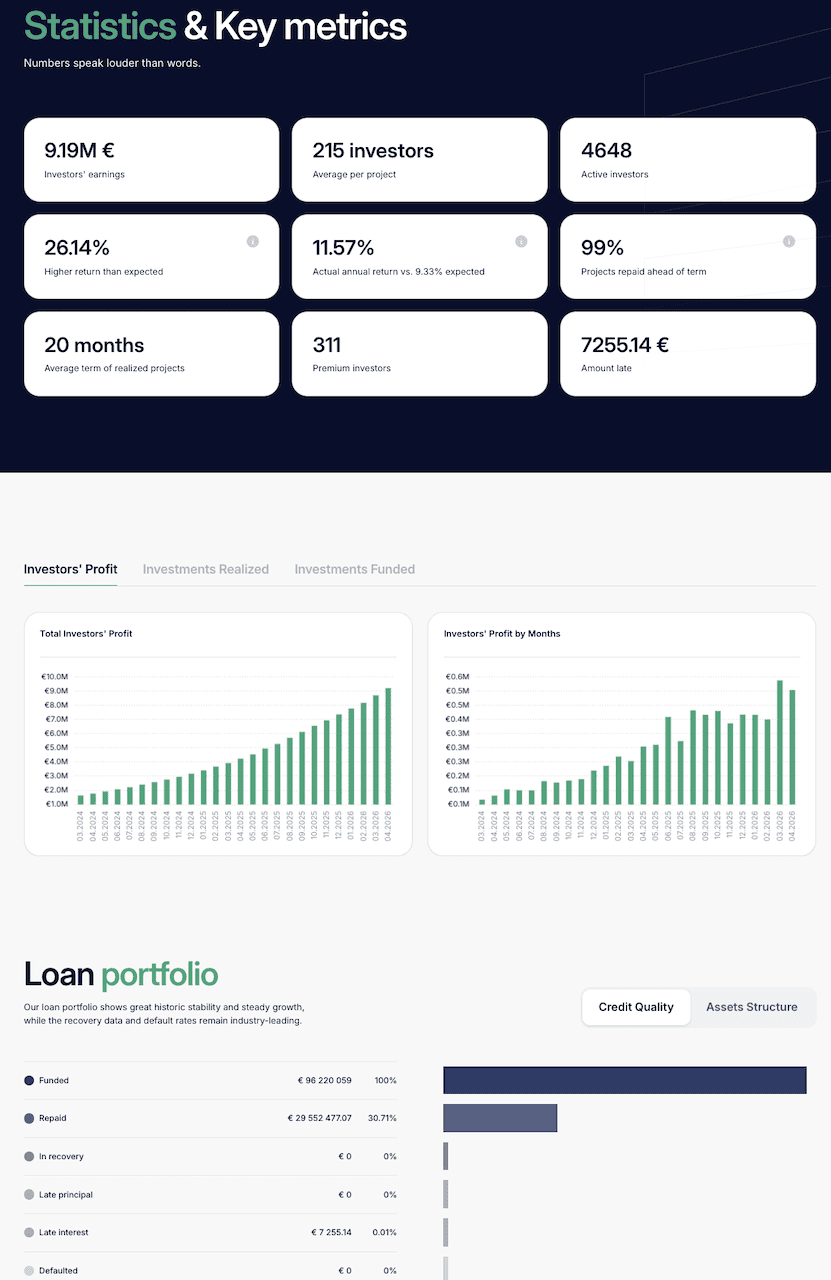
The pace is remarkable: at the end of 2025 the financed volume was still 72.5 million euros, and in the first nine months of 2026 over 56 million euros were added. In July 2026 alone, almost 11 million euros were newly financed. Then there is the geographical expansion: having started as a purely Lithuanian platform, InRento is now active in eight European markets: besides Lithuania also Poland, Spain, Italy, Ireland, Finland, Latvia and, since April 2026, Romania.
Cumulatively over all years, Lithuania is still ahead with 46% of the financed volume, followed by Poland with 36%. For the still open portfolio, however, the picture has changed: according to my analysis of all project pages (as of the end of September 2026), around 45% of the outstanding volume is in Poland, 32% in Lithuania, 10% in Romania, 7% in Finland, 4% in Italy and 2% in Latvia. Of the good 62 million euros newly financed in 2026, only about a quarter went to Lithuania. The statistics are publicly viewable on the platform at any time, including late interest, defaults and capital in recovery. The audited annual financial statements are also available there, but only for logged-in investors.
Who runs InRento?
InRento was founded in 2020 by Gustas Germanavičius, a serial entrepreneur with a background in FinTech and real estate crowdfunding. Gustas had previously co-founded EvoEstate, a European aggregator platform for P2P real estate investments, which merged with InRento in 2022. So besides theoretical know-how, he also brings direct prior experience in the segment.
Since 15 September 2026, Bernardas Preikšaitis has been CEO of InRento. He was previously COO and spent his career at the law firm Ellex Valiunas, as well as at Revolut and Airwallex, in compliance and risk management. Gustas Germanavičius remains on board as founder and continues to lead the Credit Committee, which decides on the admission of new projects. The third member of the trio is Mindaugas Kniukšta as CFO (previously in finance at Capitalica Asset Management and Northern Horizon). For a platform of this size, that is a fairly experienced team with a relevant track record from the regulated financial world.

The company operates as InRento UAB (commercial register number 305519977) and is based in Vilnius at Kauno g. 22-501. There are also offices in Warsaw and, since 2026, in Bucharest, a clear sign that the international expansion is meant seriously. Institutional investors such as the Lithuanian Business Angel Fund and Startup Wise Guys (who have also supported Estateguru) are on board as well.
What strikes me: according to social insurance data, InRento reports only around six employees in Lithuania (as of September 2026). For almost 200 current loans in six countries, that is a lean team, even if part of the work probably lies with Warsaw and Bucharest and with external appraisers and law firms. Especially with problem loans in Poland, it remains to be seen whether the capacity is sufficient.
InRento's business figures
What is InRento's financial position? The platform provides the audited annual financial statements on its statistics page, but only for registered and logged-in investors. The key figures themselves are also filed in the Lithuanian company register and can therefore be checked by anyone. That is more transparency than I know from many other platforms.
| Year | Revenue | Result |
|---|---|---|
| 2021 | €132k | -€256k |
| 2022 | €323k | -€247k (going-concern note) |
| 2023 | €758k | +€171k (profitable for the first time) |
| 2024 | €1.16m (+53%) | +€63k |
| 2025 | €3.0m (+159%) | +€958k |
The development is impressive. In 2022, InRento still posted a loss of 247,000 euros, and the auditor had even included a going-concern note, in other words a warning about the company's ability to continue as a going concern. Cumulative losses at that point stood at over 514,000 euros.
In 2023 came the turnaround: profitable for the first time, with a net profit of around 171,000 euros. In 2024, despite heavy investment in international expansion, a profit of 63,000 euros was still recorded, and in 2025 revenue then jumped to almost 3 million euros with a net profit of nearly one million. Equity thus rose to 1.37 million euros. The auditor confirmed the 2024 annual financial statements without qualification, so the going-concern note from 2022 is a thing of the past.
What one should keep in mind: a single strong year does not yet make a long-term success story. In 2025, revenue corresponds to around 8.5% of the newly financed volume, so InRento earns mainly from arrangement fees on new business. The strong growth therefore feeds directly into profit. Whether credit quality keeps pace at this speed will only become clear over the next vintages. And measured against roughly 93 million euros of outstanding investor loans, equity of 1.37 million euros is of course modest. Even so, the move from an "insolvency warning" to "almost one million in profit" in just three years shows that the business model does work, and that InRento has made the transition from a loss-making start-up to a profitable company.
InRento registration and the welcome bonus
Registering with InRento is somewhat more involved than with most P2P platforms. This is due to the regulated structure and the fact that your money is not held in an InRento account, but in a separate account with a licensed payment service provider. Step by step:
Start registration
Click "Sign Up" on the InRento homepage. You can register as a natural person or as a company.
Open a Paysera or Mangopay account
InRento does not manage your money itself. Instead, you get your own account with Paysera (the better choice for private investors, as it is integrated into the Paysera banking app) or with Mangopay (integrated directly into the InRento dashboard). The account is in your name, so your money is never held by InRento itself.
Complete identification
The online identification runs via the service Ondato. For this you need a valid identity card or passport.

Appropriateness test
Because of the ECSP regulation, before your first investment you have to fill in a short questionnaire on your knowledge and your ability to bear losses. This is a requirement of the European crowdfunding regulation.
Paying in and investing
After verification, you pay in by SEPA transfer to your Paysera or Mangopay account. If you use a service such as Revolut, the money is often credited the same day. As soon as the money has arrived, it is immediately available for investments.
It is enough to use my InRento link* to receive the 20 euro welcome bonus!
To invest with InRento, you need to be at least 18 years old. The minimum investment is 500 euros per project, which is clearly higher than on most P2P platforms. The separate account structure via Paysera or Mangopay is a small extra effort at first, but it has a tangible advantage: your uninvested money sits in a licensed payment account and is therefore clearly separated from the company's assets.
An additional bonus for new investors
If you register for the first time via my blog, you receive a welcome bonus of 20 euros, which is credited after your first investment in the primary market, provided you use my InRento Bonus Link*. By the way, this is not a classic affiliate programme: InRento relies on a refer-a-friend reward, where both sides each receive 20 euros.
Investing with InRento
How do you invest in real estate projects with InRento, what should you bear in mind and what options do you have? Unlike pool-based platforms such as Bondora or Monefit, with InRento you select individual projects yourself. There is no Auto Invest here.
My account currently stands at around 9,300 euros, spread across more than 50 projects.
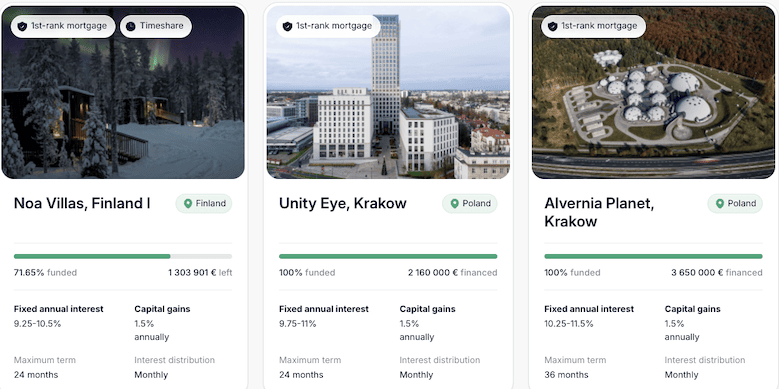
Investing in the primary market at InRento
The direct route is the primary market: here you see all projects currently open for funding and can get in from 500 euros per project. For each project you get extensive details:
- Exact location of the property and project description
- Expected return (fixed interest + capital gain) and interest payment frequency (monthly)
- Details on the security (first-ranking mortgage, appraised value and LTV, guarantees)
- The project owner with background experience and track record on the platform
- Internal project rating (A to D)
- Term (typically 12 to 36 months)
- Dated project updates and the complete payment history with every punctual or late interest payment
A nice detail is the public payment history: for each project you can see whether interest was paid on time, within the 14-day grace period or later, including the default interest. I know of hardly any other platform with this transparency at the level of the individual loan. Also worth mentioning is the interest scale: the interest range on the project page (e.g. 9.25 to 10.5%) depends on your investment amount. Up to 5,000 euros you get the lower value, above that the interest rises in levels by up to 1.25 percentage points from 100,000 euros.
What you should keep in mind: the projects on InRento are very popular and are often fully funded within a few hours, and the Baltic projects in particular go very quickly. If you do not check regularly and are not quick, you miss the more sought-after offers. The high demand shows investors' confidence, but it makes it harder to place your capital promptly. In addition, between investment and the start of interest there is the time until the mortgage is registered, during which your money is reserved but does not yet earn interest.
The secondary market at InRento
InRento offers a secondary market on which you can buy projects that are already running or sell your own early. This is an important liquidity element, since loan terms are typically 12 to 36 months.
As a seller you can offer your shares at a premium or discount, and an offer stays online for a maximum of 10 days. This can be interesting for buyers: anyone buying at a discount brings a higher effective interest rate into the portfolio. The fee is 2% of the sale amount (reduced to 1.5% for premium investors from 50,000 euros total investment). Larger positions from 50,000 euros go through the so-called "Grand Sale" on the home page.
However, trading volumes on the secondary market are modest, and InRento itself describes the number of offers as rather low. According to the terms and conditions, the secondary market is a voluntary offering, InRento can set price bands and is not liable if trading is suspended. Anyone investing with InRento should in principle plan for the term until the end of the project. With a loan in default such as Harfowa 10, I do not expect buyers at face value there anyway.
InRento fees
As a rule, investors pay no fees at InRento for account maintenance, deposits, investing or payouts. There are, however, a few possible costs worth knowing about:
- Secondary market sale: 2% of the sale amount (1.5% for Premium investors)
- Credit card deposit via Mangopay: 2% of the deposit amount
- Mangopay inactivity fee: 30 euros per year if the account is not used for more than 2 years
- "Late loans administration fee": 0.1% of the overdue amount per day, to be borne by the investor according to the price list. For delayed projects it is applied in addition to the default interest of 0.2% per day
- Accounting fee on profit participation: For projects with variable profit participation, InRento retains 10 to 40% of your share of the profit as an "accounting fee" (40% for investments up to 5,000 euros). In addition, a flat 3% selling cost is deducted from the sale price
You can find the complete fee overview on the InRento Price List. The actual fees are paid by the borrowers, between 3.5 and 9% of the financed amount as an arrangement commission. For projects with a fixed capital gain (the majority of current projects), the accounting fee does not play a role. If a mortgage is enforced, InRento deducts its costs and fees from the proceeds according to its terms and conditions before the remainder goes to the investors.
Taxes at InRento
As with Profitus and other Lithuanian platforms, InRento automatically withholds a withholding tax of 15% on your interest income and capital gains. You can reduce this to 10% by filling in and signing the so-called DAS-1 form and sending it by email to info@inrento.com together with a certificate of residence from your tax office.
Since a double taxation agreement exists between Germany and Lithuania, the withholding tax deducted can be credited against the German flat-rate withholding tax (Abgeltungsteuer) in your tax return. However, only the 10% provided for in the agreement is creditable. Without DAS-1, the remaining 5 percentage points are lost for the time being, so the form is worthwhile. Default interest that you receive on delayed projects is not taxed for foreign investors.
In the dashboard under "Taxes", InRento provides a tax certificate for the previous year, with all the figures relevant for the tax office. This is a nice detail, as not every platform provides it in such a prepared form.
The InRento loan portfolio: what are you actually investing in?
Let us look at which projects are offered on InRento and what characterises them.
Note: the InRento product is evolving
Until around 2023, InRento was almost exclusively a buy-to-let platform with Baltic rental properties. With the expansion into Poland, Italy, Finland and Romania, larger hotel, tourism and conversion loans have also been added in recent years. Their cash flow no longer comes from conventional letting, but from the operating business of the project owner (hotel stays, catering, events) or from the sale of individual flats. The risk profile of these projects is closer to conventional secured property loans (in the style of Estateguru or Profitus) than to the original rental model. Anyone reading older reviews can keep this in mind and assess the projects individually.
The historical focus of InRento is on buy-to-let projects: properties that generate rental income after purchase or renovation, whether as a flat, aparthotel or short-term accommodation. Increasingly, there are also secured hotel, tourism and commercial loans, where the cash flow is serviced from operations and the principal is repaid at the end of the term through refinancing or sale. The stated maximum term is the deadline by which the project owner must sell or refinance and repay the capital. You can see exactly which property your money goes into, where it is located, who the project owner is and what rating the project has received. The borrowers are exclusively commercial entities, as a rule dedicated project companies with guarantees from the shareholders, not private individuals.
By financed volume, according to the statistics, around 49% is residential property, 28% hotels, 17% commercial and the rest mixed-use properties and one medical practice. The different project types on InRento include:
- Short-term rental projects: aparthotels, holiday flats, co-living
- Long-term rental properties: residential properties with permanent tenants
- Flat projects for sale: conversion into individual flats, repayment gradually through the sales
- Commercial rental properties: offices, micro-offices, retail space
- Hotel, tourism and conversion projects: new-build resorts, film studio conversions, observation platforms, retail parks (increasingly in Poland, Finland, Romania and Italy, in some cases with individual loans of 5 million euros and listed or specialised project owners)
Example project 1: V50, Vilnius I
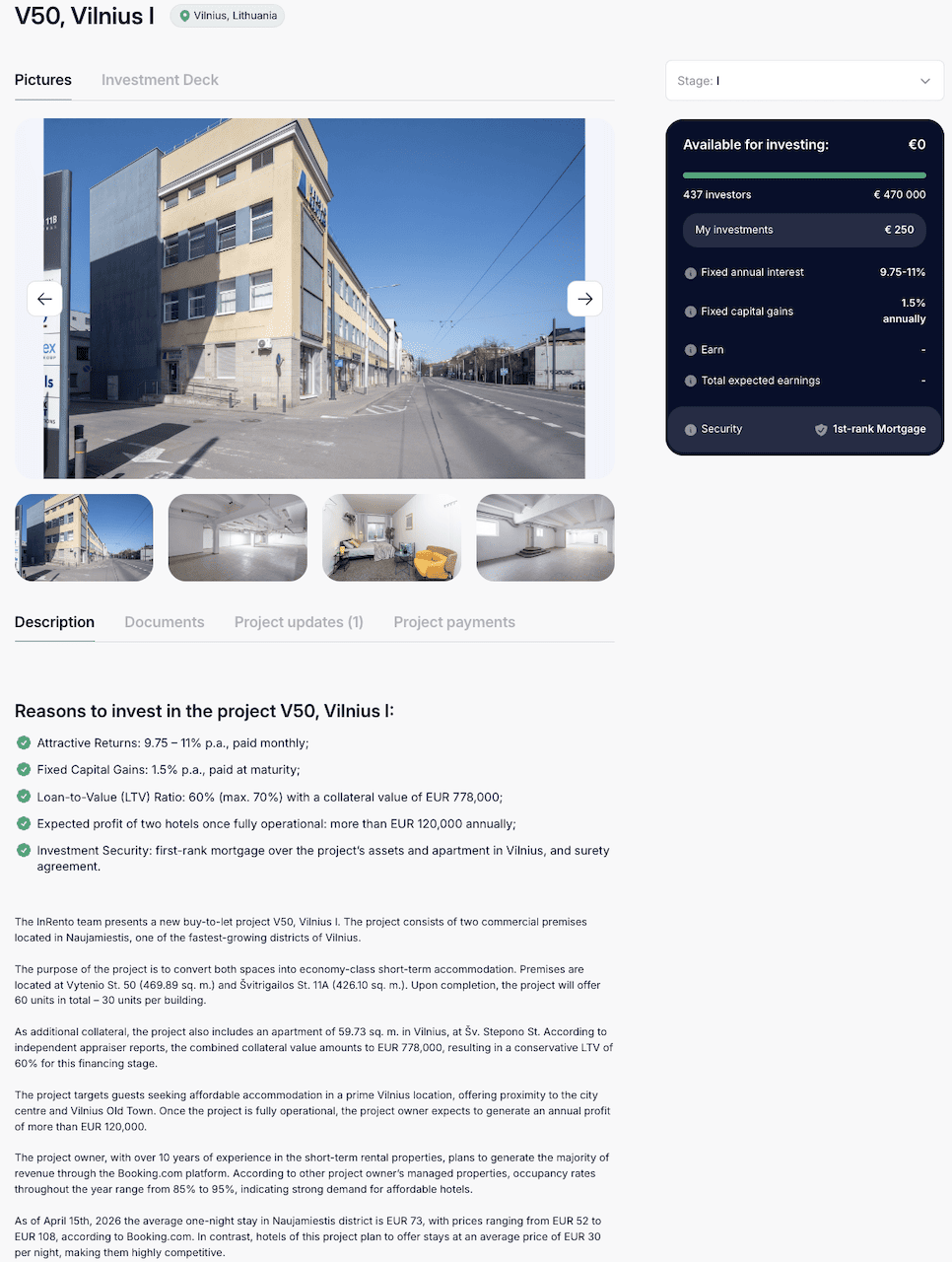
To show you what a typical project looks like: the project V50, Vilnius I consists of two commercial units in the Naujamiestis district, one of the fastest-growing neighbourhoods in Vilnius. Both spaces (around 900 m² in total) are being converted into economy-class short-stay accommodation with 60 units.
The terms: 9.75 to 11% fixed interest p.a. plus a fixed appreciation bonus of 1.5% p.a., payable on repayment. This gives a gross total return of 11.25 to 12.5%. Security is provided by a first-ranking mortgage on the project properties and an additional flat in Vilnius. The total value of the collateral is 778,000 euros, which results in a conservative LTV of 60% (maximum 70%).
The project owner Room Capital (Lina Baronaitė and Gediminas Kvedaris) brings over 10 years of experience in the short-term rental segment and already operates several properties on the platform. The planned average rate of 30 euros per night is well below the market average of 73 euros in Naujamiestis, so the concept relies on high volume rather than high prices. The maximum term is 24 months.
V50 Vilnius I is representative of InRento's classic buy-to-let track: an urban market, an established operator with a track record, a manageable project volume and comparatively stable cash flow.
However, anyone who has this profile in mind and equates it with the whole platform will be surprised by the newer, larger projects. So let us look at a second example.
Example project 2: Noa Villas, Finland I
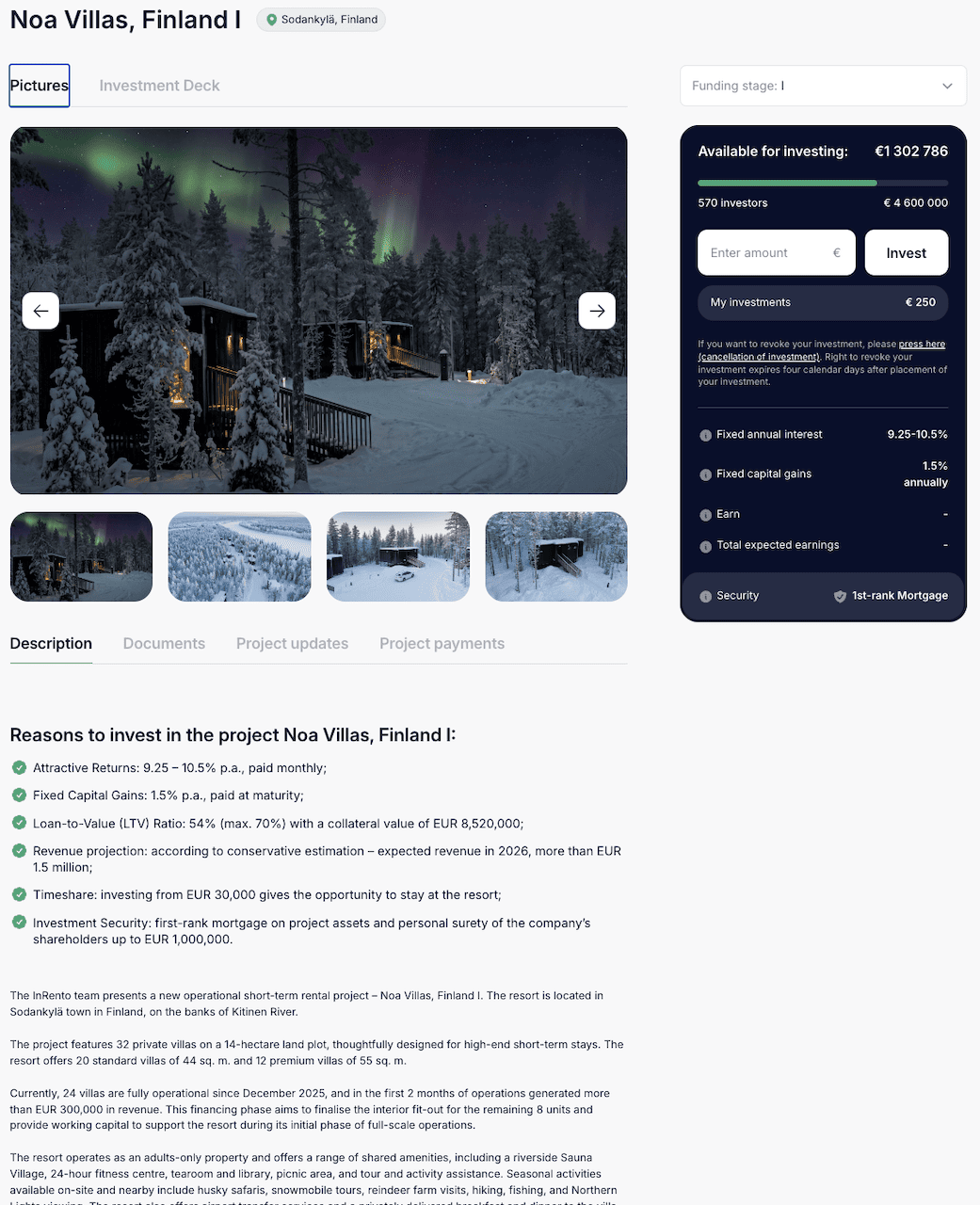
The Noa Villas, Finland I project is a good counterpart to V50, because it shows the other side of the current InRento range: a newly built tourism resort in Lapland. On a plot of 14.16 ha in Sodankylä, about 24 km south-east of the town centre, 32 modular villas are planned. 24 of them are already completed and in operation (commissioning by the Finnish building authority on 17 November 2025), and 8 more are still under construction. There are also five support buildings (reception, lounge with tearoom, shop, gym, three saunas) and a concrete civil defence bunker.
The terms for Stage I: 9.25 to 10.5% fixed interest p.a. (tiered by investment amount) plus a fixed appreciation bonus of 1.5% p.a., maximum term 24 months, minimum term 3 months. The security is a first-ranking mortgage of up to €14 million on the plot including all existing and future buildings. The project owner is Lappi Cabins Oy (Finnish subsidiary), and the guarantors are UAB Lunvio and four private individuals as well as Sofi Investments SIA. Financing is provided in two tranches (€4.6 million + €0.4 million), with payout only after the security has been registered.
What defines this project in detail and what to watch out for:
- External valuation by Newsec: The accredited Finnish property valuer Newsec Valuation valued the property at €8.52 million as of 31 December 2025 (€6,372 per lettable m²). For the full Stage I tranche of €5 million, this gives an LTV of about 58.7%, well below the maximum of 70% set in the loan agreement.
- Cash flow from operating a hotel: Debt service does not depend on stable rental income but on the resort's tourism business (overnight stays, restaurant, saunas). In its valuation model, Newsec assumes a 15-year net lease with a stable hotel operator. Currently, Lappi Cabins runs the resort itself.
- Optimistic business plan: For 2026, the Project Owner assumes 67% occupancy, a €473 ADR (Average Daily Rate) and a €273 RevPAR. By comparison, the 2025 market average in Sodankylä was 51% occupancy, a €332 ADR and a €169 RevPAR. Newsec therefore applied a conservative discount in its valuation (Year 2: 90% of planned revenue, Year 3: 95%).
- Location away from the prime ski areas: The nearest airports (Kittilä, Rovaniemi) are each about 1.5 hours away by car, and Levi is 1 h 50 min away. By Finnish tourism standards this is not a prime location. Newsec explicitly highlights this as a yield driver and therefore applies an increased cap rate of 9.0%.
- New operator without a track record: Lappi Cabins is a young Finnish company, and the resort's operation is only just starting. Newsec states verbatim: "the operations of the property have only just begun, and therefore, the business has not yet stabilized", which feeds directly into the higher yield level. So far (as of September 2026), interest has been paid on time.
- The same group of entrepreneurs as V50: The same people stand behind Lappi Cabins, Lunvio and Room Capital (Lina Baronaitė and Gediminas Kvedaris). According to my analysis, the group has 24 ongoing projects with a combined total of around 12.3 million euros, which is about 13% of InRento's open portfolio in Lithuania, Latvia, Finland and Italy.
- Timeshare component: Anyone investing at least €30,000 receives a free overnight stay at the resort during the term. That is a nice extra, but in my view it would not be a primary reason to invest.
What I take from this example: even with the larger, operations-driven projects, InRento delivers a clean structure: an external property valuation, a clearly calculable LTV, documented guarantors and a first-ranking mortgage on the entire asset. At the same time, it shows that the risk profile is different from that of a classic buy-to-let flat in Vilnius: here, the ongoing interest payment depends on the occupancy of a new tourism resort in a remote location. In the event of a default, the mortgage does apply, but in practice realising a specialised Lapland villa resort is considerably more laborious than selling a city flat in Vilnius. And anyone who spreads money across V50 and Noa Villas as opposite poles is, after all, not diversifying across project owners.
What to bear in mind:
With the larger tourism and conversion projects, the ongoing servicing depends on the project owner's operating business. The LTV and the external valuation matter, but in my view the operator's track record matters just as much.
The small Baltic buy-to-let projects are more relaxed in this respect.
The range of projects runs from modest apartments in Lithuanian cities to larger hotel and resort projects in Poland, Italy or Finland. It is worth differentiating here: a small rental property in Vilnius has a different risk profile from a tourism resort in Lapland or a conversion loan for a Polish film studio. As a rule, the interest rates reflect this: the more specialised the property and the less established the operator, the higher the interest rate offered. Size is another factor: the 24 projects of EUR 1 million or more now account for more than half of the open volume, and the five largest individual loans (EUR 4.3 to 5 million each) alone for around a quarter.
Geographically, the focus is no longer on Lithuania. Poland is the largest market in the open portfolio at around 45%, with further projects in Romania, Finland, Italy and Latvia; earlier projects in Spain and Ireland have already been repaid. According to InRento, over 53% of the volume was already financed outside Lithuania in 2025, and in 2026 it was around three quarters.
The return level is 9 to 12% fixed interest p. a. depending on the project, plus the appreciation component of typically 1.5% per year. For completed projects, the actual return according to the platform averaged 11.56%, in some cases considerably higher where projects were realised early and with a good sale price. This is a simple average per project before withholding tax; the median of the 167 realised projects is 10.6%.
Each project receives an internal rating from A to D, based on the risk assessment by the Credit Committee. Among other things, the project owner's business plan, their experience, the location and the property value are assessed. Currently, 8 loans are rated A, 181 B and 10 C.
Late payments and the first terminated loan
With the growth, payment problems have also become more visible in 2026. I evaluated the public payment histories of all roughly 370 project pages: in 2025, 7.3% of interest payments arrived late but within the 14-day grace period, and not a single one later. In 2026, up to the end of September, it was 12.9% within the grace period and 1.8% beyond it. A group of 13 projects in Kaunas (including 46 Lofts and Liberty 72B) had liquidity problems in February and March 2026, but paid all arrears including default interest at the end of March and made the first partial repayments at the end of September. For Hotel Zyndrama in Poland (EUR 4.9 million in four tranches, internal rating A), interest has been arriving regularly just within the grace period since May 2026.
It gets serious with two Polish projects. Harfowa 10 in Warsaw is a loan of EUR 930,000 from 665 investors for three luxury flats with underground parking spaces, partly refinancing and partly money for outstanding work on the outdoor areas, façade and heating. The valuation is around EUR 1.41 million, so the LTV is 66%. In July 2026 the planned sale of the whole project fell through, and no interest has been paid since June. InRento first set a deadline of 14 September for the outstanding interest and in mid-September issued a termination with a deadline of 30 September for the entire loan amount. The project owner did not pay. Since 1 October 2026, InRento has been pursuing the termination of the loan and the enforcement of the first-ranking mortgage.
With the termination, the contractual default interest of 0.2% per day ends. What has accrued up to then remains part of the claim, and court interest is added after a lawsuit is filed. In parallel, the project owner is still trying to sell the property. If this succeeds and all amounts are paid, InRento intends to adjust or discontinue the enforcement. On paper, there is a buffer of around EUR 480,000 (34%) between the valuation and the loan. However, the costs of enforcement and InRento's fees come off this first, and whether the 2025 valuation holds up in a forced sale is exactly the open question.
In the second case, J48 in Lodz (EUR 905,000, LTV 70%), two monthly instalments have been outstanding since August. Here the loan has not been terminated, but InRento initiated compulsory enforcement of the outstanding interest as of 1 October. The basis is a notarial submission by the project owner to immediate compulsory enforcement under Polish law, which only still has to be confirmed by the court. According to the project owner, the money is to come from the sale of another property, which is delayed due to formalities.
In the statistics, however, it still says 0% default and 0 euros in recovery. Only 44,007 euros of late interest is shown (as of 3 October 2026), which is exactly the outstanding instalments of Harfowa 10 and J48. This comes down to the definition: a loan only counts as a default once the project owner is more than 90 days in arrears with at least 20,000 euros or 4% of the loan. For the capital of Harfowa 10 that has been called in, that point would be reached at the end of December 2026. According to InRento's own definition, however, it also counts if a payment is unlikely without realising the collateral. I am curious to see when the statistics reflect the case.
My opinion on this: For me, the question was never whether there would be a default at InRento, but when. With around 200 running property loans and this pace of growth, anything else would have been a small miracle. Now it gets interesting: how does InRento manage its first real problem loan, how quickly does the investors' money come back, and does the collateral hold up better here than at Estateguru, where many recoveries drag on for years? I find it positive that InRento informs investors on the project page with dates, deadlines and legal basis. So far the case does not appear in the statistics or on the blog. Fortunately, I am not invested in either Harfowa 10 or J48 myself.
What are the advantages and disadvantages of InRento?
The pros & cons of InRento at a glance
Advantages of InRento
- Regulated by the Bank of Lithuania + ECSP licence
- First-rank security: all projects secured by a mortgage in the respective country, mostly with guarantees from the shareholders
- Segregated accounts: investor funds are held in a separate Paysera/Mangopay account, not with InRento
- Strong track record: 0% default according to the statistics, no capital loss so far, 167 realised projects with an average of 11.56%
- Public payment history for every single project, so delays and problems can be traced
- Two sources of return: monthly interest plus appreciation on repayment
- Audited annual financial statements available to investors every year, key figures in the register
- Profitable since 2023, three years in a row
- Secondary market available for an early exit
Disadvantages of InRento
- High minimum investment: 500 euros per project makes broad diversification challenging
- No Auto Invest: every project has to be selected manually
- Projects sell out quickly: Baltic projects in particular are fully funded within hours
- First problem cases: interest delays rose significantly in 2026, and since October 2026 there has been a first terminated loan in recovery (Harfowa 10)
- Heterogeneous risk profile: from a small Vilnius buy-to-let to a Lapland resort, each project has to be assessed individually
- Shifted focus: Poland is the largest market in the open portfolio at around 45%, plus some large concentrations in a few project owners
- Withholding tax (15%, can be reduced to 10%) is deducted automatically
- Hidden deductions: up to 40% settlement fee on variable profit shares, 0.1% per day fee on overdue amounts
- Additional Paysera/Mangopay account required (one-off effort)
- Like any investment, P2P investments are risky
Sign up with InRento: €20 after the first investment*
The InRento risk FAQ
Despite regulation and first-ranking mortgage security, it is worth keeping an eye on the risks at InRento. I have summarised the most important questions on risk for you in a short FAQ before moving on to my experience with InRento and the conclusion.
How does InRento make money?
The main source of income is the brokerage fee that borrowers pay when financing is successful, between 3.5 and 9 per cent of the financed amount according to the price list. In addition there are further fees charged to project owners (e.g. when collateral is arranged late), the secondary market fee of 2 per cent for sellers, an accounting fee ("Accounting fee") of 10 to 40 per cent on variable profit shares of investors, and the "Late loans administration fee" of 0.1 per cent per day on overdue amounts. In 2025 revenue was 3.0 million euros, which is around 8.5 per cent of the volume newly financed that year. So the business model earns mainly from new business.
Is InRento profitable?
Yes, for three years in a row. After losses of 256,000 euros (2021) and 247,000 euros (2022, including a going-concern note from the auditor), InRento made a net profit of 171,000 euros for the first time in 2023. In 2024 the result was 63,000 euros, and in 2025 the profit jumped to 958,000 euros on revenue of just under 3 million euros. Equity rose accordingly to 1.37 million euros. The audited annual financial statements are available to registered investors on the statistics page, and the key figures are also filed in the Lithuanian company register.
Is InRento legitimate?
I assume so. InRento is under the supervision of the Bank of Lithuania and holds a European ECSP crowdfunding licence (since November 2023). Founder Gustas Germanavičius brings relevant experience from the crowdfunding industry (co-founder of EvoEstate), and the CEO since September 2026 is Bernardas Preikšaitis, with a background in compliance and risk management. The platform has its annual financial statements audited, publishes daily updated statistics on arrears and defaults, and shows the complete payment history for every project. Of course, this does not guarantee that the platform will operate successfully in the long term or how well it will handle problem loans. The first practical test of that is currently Harfowa 10.
Are there loan defaults at InRento?
According to the platform statistics, the default rate is still 0 per cent (as of 3 October 2026), and there has been no loss of capital for investors so far. However, since 1 October 2026 the first loan has been terminated, Harfowa 10 in Warsaw (930,000 euros, LTV 66%), and InRento is carrying out the enforcement from the first-ranking mortgage. For J48 in Lodz, enforcement of the outstanding interest is under way in parallel. This does not yet appear in the statistics, because under InRento's definition a default only counts after 90 days of delay on at least 20,000 euros or 4 per cent of the loan. In addition, significantly more interest payments came late in 2026 than in previous years, mostly within the 14-day period. What matters now is how quickly and with what result the enforcement of Harfowa 10 proceeds.
What would be the impact of an InRento insolvency?
Since your money is held in a separate Paysera or Mangopay account, not in an InRento account, it would not form part of the insolvency estate if the platform became insolvent. The loan agreements exist directly between you as investor and the borrower and, according to the terms and conditions, remain valid even if InRento becomes insolvent. The administration of the platform can be transferred to another operator. At the end of 2024 equity was around 414,000 euros, which according to InRento is sufficient to finance an orderly wind-down by a third party in an emergency. At the end of 2025 it was already 1.37 million euros. In practice, of course, it depends on how smoothly such a wind-down really works, especially with mortgages in six different countries. I myself only ever use money whose loss I can cope with, both financially and emotionally.
Is there deposit protection at InRento?
No. There is no deposit protection and no investor compensation for your invested capital, as InRento is not a bank. Protection comes solely from the first-ranking mortgage on the respective property. Your uninvested balance is also not covered by statutory deposit protection of up to 100,000 euros: Paysera and Mangopay are e-money institutions. Your balance there is kept separate from the institution's assets and must be safeguarded separately (safeguarding), but that is not deposit protection like that of a bank account.
Is InRento an alternative to Profitus or Estateguru?
InRento, Profitus and Estateguru all belong to the category of real estate-backed P2P platforms, but they differ in some important respects. Anyone looking for alternatives within this segment should know the details.
| Criterion | InRento* | Profitus | Estateguru |
|---|---|---|---|
| Registered office / regulation | Lithuania, Bank of Lithuania + ECSP | Lithuania, central bank + ECSP | Estonia, ECSP |
| Loan type | Buy-to-let plus hotel/tourism and commercial loans | Property development, business loans | Bridge financing, development, business loans |
| Security | First-ranking mortgage (in the respective country) | Mortgage (average LTV 66%) | Mortgage (average LTV 60-70%) |
| Return | approx. 9-12% + capital gains | approx. 9-14% | approx. 10-12% |
| Minimum investment | €500 | €100 | €50 |
| Term | 12-36 months | 3-24 months | 6-60 months |
| Auto Invest | No | yes (RoboInvest) | yes |
| Secondary market | yes (few offers) | no (closed) | yes (active) |
| Withholding tax | 15% (can be reduced to 10%) | 15% (can be reduced to 10%) | none (Estonia) |
| Geography | 8 countries (LT, PL, RO, FI, IT, LV, ES, IE), open mainly in PL and LT | Lithuania, Baltics, Spain | Europe (broad) |
| Track record | since 2020, 0% default according to statistics, first enforcement since 10/2026 | since 2018, isolated cases with residual claims after enforcement | since 2014, around two thirds of the open portfolio non-performing |
Unlike Estateguru, InRento* hardly pursues any pure bridge financing for new builds, but mainly existing properties or properties to be converted that have an operating cash flow, whether from letting, hotel operation or catering. The first-ranking mortgage and the public payment history for each project are additional security elements. However, here too the repayment of the principal often depends on a sale or refinancing at the end of the term, so this is not a pure rental income model. This is exactly what Harfowa 10 failed on. The minimum investment of 500 euros is clearly higher than at Profitus or Estateguru, so anyone who wants to diversify widely needs correspondingly more capital. In return, you get a secondary market and the dual return component of fixed interest and capital appreciation.
Profitus* offers the nominally higher return in this comparison, at up to 14% p.a., and focuses on property development and secured business loans. The project details are transparent, and the internal rating makes it easier to assess risk. The minimum investment is only 100 euros, but there is currently no secondary market: once you have invested, you are tied in for the whole term. Profitus has already been through enforcements, and in individual cases residual claims remained open.
Estateguru is the top dog in the European property P2P segment, with the broadest geographical offering and the longest track record, going back to 2014. Returns are attractive at 10-12%, and the active secondary market provides liquidity. On the downside, however, Estateguru has had clearly noticeable loan defaults, especially in its German and Finnish portfolio. Around two thirds of the volume still outstanding there is non-performing, completed enforcements take a good ten months on average, and many German cases have been running since 2022. At Estateguru, costs plus a 25% surcharge are deducted first from the enforcement proceeds. According to its terms and conditions, InRento also deducts costs and fees first, but the terms do not mention a flat surcharge.
This is exactly where Harfowa 10 becomes interesting. At InRento, it is the first loan to go into enforcement. The LTV of 66% and a residential property in Warsaw are actually a better starting position than many of the development plots on which Estateguru failed. Whether the collateral at InRento holds up better in practice, however, will only become clear once money has flowed back, and how long that takes in Poland.
Bottom line: If you rely on predictable cash flows from established rental properties, InRento is the more conservative approach in this comparison for the classic buy-to-let projects, but at the price of a higher minimum investment and no auto invest. With the larger hotel, tourism and sell-off projects, the risk profile comes closer to that of Estateguru or Profitus. If you want more return and lower entry barriers, Profitus is a good fit. Despite its default history, it is hard to get around Estateguru if you need broad diversification across many countries.
Personally, I find that InRento and Profitus complement each other very well in my portfolio: InRento as a calm base, focused on secured buy-to-let and existing-property loans, and Profitus for the somewhat more dynamic development projects.
My InRento review and my InRento conclusion
I have been invested in InRento since October 2023 and have followed the platform with growing interest from the start. What originally convinced me was the regulated structure, the first-ranking security on all projects and the fact that there was not a single default when I joined. That remained the case until the end of September 2026. Since 1 October, the first termination including enforcement has been running with Harfowa 10. My own projects are not affected by it.
My account is now at around 9,300 euros (I have paid in just under 7,800 euros net), spread across more than 50 projects. I am lucky to be able to get into many projects with just 250 euros, which of course makes diversification much easier. My aim is to reach 100 projects, although to be honest I lack the time to examine every project in detail. I trust that InRento selects projects carefully, and I mainly make sure myself that not too many non-Baltic projects dominate my portfolio.
What is not entirely easy, though: despite having no classic affiliate programme (there is “only” the 20 euro refer-a-friend bonus), InRento has a very loyal investor base. Some projects are fully funded within a few hours, and the Baltic ones in particular go very quickly. On top of that, in 2026 only around a quarter of the new volume was funded in Lithuania. It is therefore almost impossible to avoid Poland, Romania and Finland if you want to put your capital to work quickly. Keeping my Baltic focus is getting harder with every month.
Here too, it is worth differentiating: the projects on InRento are very different. There are more specialised properties such as larger hotels or tourism resorts, which would probably be harder to liquidate in an enforcement, and on the other side classic rental projects in residential locations, which are much easier to handle. Harfowa 10 shows, however, that flats can also become a problem if repayment depends solely on a sale and no rent is coming in. You should keep that in mind when choosing projects.
InRento review, my account
Most of my capital is in Baltic rental properties, supplemented by projects in Poland and other markets.
In the InRento dashboard, my IZF was 10.3% in April 2026, and it has risen steadily since the start. That is logical too: at InRento you realise part of the return only when the project is repaid and the appreciation is paid out. Depending on the project, this can be quite substantial. The monthly interest alone is naturally somewhat lower, but the overall return is fine. In my own analysis with Portfolio Performance, I get 8.9% p.a. over the whole period since October 2023 (10.0% with the bonuses counted as income). The difference is mainly due to the calculation method and the start-up phase in 2023 and 2024.
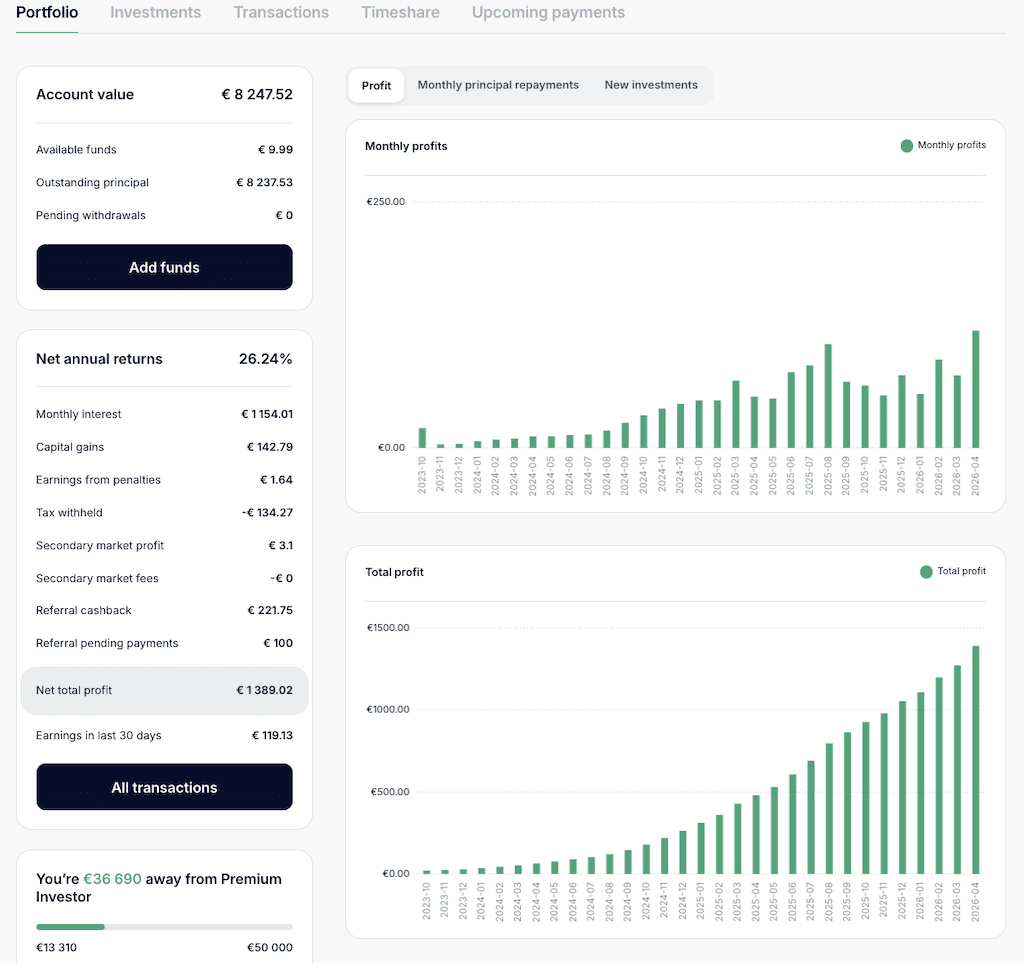
So far I have received a good 1,500 euros in interest income from InRento. Not one of my more than 50 projects has defaulted so far, and only rarely has one been briefly late. For a regulated property platform with first-ranking mortgage security, that is a result I consider respectable.
Country breakdown of my active projects
My InRento return 2026
| Year | Paid in | Paid out | Net earnings | Return p. a. (XIRR) |
|---|---|---|---|---|
| 2023 (from 04 Oct) | €1,494 | €0 | +€9 | – (part year) |
| 2024 | €5,255 | €0 | +€235 | 6.4% |
| 2025 | €1,052 | €814 | +€710 | 9.6% |
| 2026 (to 03 Nov) | €810 | €0 | +€689 | 10.1% |
| total | €8,610 | €814 | +€1,643 | 9.0% |
The annual figures show how the return grows over time. In 2025 I was at 9.6%, and that is likely to rise slightly further, since for some of my projects the repayments, and with them the capital gain component, are still outstanding. That is what is special about the InRento model: the return grows over time, because the capital gains are only paid out once they are realised.
My InRento return
My own investment since 04 Oct 2023 · figures from Portfolio Performance
- €7,796
- net paid in
- +€1,643
- Net earnings
- €9,439
- Portfolio value
- Net paid in
- Net earnings (up to portfolio value)
- Portfolio value
For me, InRento remains a calm base in the portfolio. In my own projects there have been no defaults so far, the interest arrives on time for the most part, and the appreciation in value on repayment comes on top. The first terminated loan does not change that for me for now, as a default was only a matter of time. What I will measure InRento by in the coming months is how it handles this: how quickly the realisation of Harfowa 10 proceeds, what ultimately reaches the investors, and how openly InRento shows it in its statistics. Whether I keep topping up towards 100 projects, while maintaining the Baltic focus and not letting the share of projects in Poland, Finland and Romania become too large, depends on that.
My InRento position (as of 03 Nov 2026)
- Invested since
- 04 Oct 2023
- Invested (net, rounded up)
- €7,800
- Interest received (rounded up)
- €1,650
- Return (XIRR) since start
- 9.0%
All figures for InRento My P2P investing in numbers
My own money, shared for transparency. Not a recommendation. Past returns do not guarantee future results.
Sign up with InRento: €20 after the first investment*
Editorial note: This review reflects my personal experience as an investor. Commissions from affiliate links do not influence my assessment or the platform rating.