My Capitalia Review: On the Market Since 2007, 0.12% Write-off and I Am Finally Getting In!
Translated from the German original, last updated 11 Nov 2026. Read the original (German)
Can a crowdfunding platform for business loans from the Baltics stay on the market since 2007 and consistently deliver over 10% return? Anyone looking into Capitalia reviews will find an EU-regulated platform with one of the longest track records in the entire P2P industry, and a CEO who openly admits to having "lost money in many creative ways" in the early years. In this report I show you what that means for you as an investor, whether the return is right and why Capitalia is not a beginner's investment.
Since April 2026 I have been taking a close look at the platform myself and have started a first investment. You will learn what is behind Capitalia, how the business model works and where I see personal risks, before I report at the end on my first concrete Capitalia experience and my return expectations.
- There is currently no new customer bonus at Capitalia. If you still sign up via my Capitalia link*, you support my work on p2p-game.com, thank you!
This item describes a promotion by the provider, such as a bonus or cashback. It reproduces the provider's statements and is not a recommendation. The provider's terms apply.
Capitalia: data at a glanceAs of 12 Nov 2026
- My platform rating
- 79 out of 100, rank 4 of 46
- Outstanding portfolio
- 18.1m EUR
The most important Capitalia data at a glance
Before going into detail, here is an overview of the most important and relevant data on the P2P lending platform Capitalia (platform figures as of 2026-11-09):

| Founded | 2007 (company); platform since 2017 |
| CEO | Juris Grišins, founder, Chairman of the Management Board of Capitalia SE |
| Regulated | ECSP under Regulation (EU) 2020/1503, supervised by Latvijas Banka, since 01.11.2023 |
| Investors | 2,389 registered (2026-11-09) |
| Headquarters | Riga, Latvia (Capitalia SE); branches in Vilnius and Tallinn |
| Collateral | Standard loans partly secured; EIF loans without hard collateral |
| Return | 10.52% net return according to the platform (20.02.2026) (Quelle) |
| Buyback guarantee | Only for EIF loans; buyback within 30 days after default |
| Secondary market | No; function "in the testing stage", according to the liquidity risk text not transferable |
| Liquidity | Locked until end of term; restructuring up to +18 months |
| Loan types | SME business loans, property and agricultural loans, EIF microloans |
| Financed loan volume | 127.36m € loans issued, 125.92m € invested by investors (2026-11-03) |
| Minimum investment | €100 according to support page (landing page still €200) |
| Investment strategies | Manual, Auto-Invest, Advised Account (10% of profit) |
| Rating | P2P Rating: 79/100 (rank 4 of 46) |
| Platform risk rating | Own risk rating (A+ to D) |
| Loyalty program | No |
| Withholding tax | Latvia 25.5%; with DE certificate 10% |
| Annual report | Group: only unaudited consolidated reports (FY 2025, H1 2026) (Quelle) (Quelle) |
| New customer bonus | none |
Figures from the platform's website, its reports and public registers, as of 11 Nov 2026. Not every figure can be independently verified.
The last two Capitalia news items
Capitalia keeps investors informed in an exemplary way via its own company blog and even publishes quarterly reports voluntarily. Here are the two most important Capitalia news items for you:
- Capitalia publishes financial and operational disclosure for August 2026
Capitalia has published its August 2026 disclosure of financial and operational information, as required under a Code of Good Conduct Certificate it holds. The disclosure covers unaudited interim results for the first and second quarters of 2026.Telegram - Capitalia reports H1 2026 turnover of EUR 1.02 million and profit of EUR 21 thousand
Capitalia recorded a turnover of EUR 1.02 million and a profit of EUR 21 thousand in the first half of 2026. Operating revenue and profit were slightly lower in the most recent quarter, and the platform expects revenue to increase again later in the year. Funding issued in the period totalled EUR 11.1 million, compared with EUR 10.4 million in the first half of 2025.Telegram
Let us take a somewhat closer look at the business loan platform and who is behind it, before I report on my own Capitalia experience.
What kind of P2P lending platform is Capitalia?
Capitalia is a Latvian crowdfunding platform that has been financing small and medium-sized enterprises (SMEs) in the Baltics since 2007. Unlike many platforms that broker consumer loans, here you invest directly in real business loans to real companies, from farms and trading companies to service providers. The platform is regulated by the Latvian financial supervision authority with an ECSP licence under the European standard.
The platform has a long history: before Capitalia launched its own crowdfunding platform in 2018, it was active for years as a lender on Mintos and built a solid track record there. So the company knows the business from both perspectives, as a lender and as a platform operator.
As a rule, there is no classic buyback guarantee here. Instead, Capitalia relies on careful credit assessment: only around 25% of all applications are accepted at all. About half of all loans are backed by physical collateral (pledges, real estate), and in nearly all projects the company owner is personally liable. In addition, Capitalia itself invests 2.5% in every project, so real skin in the game.
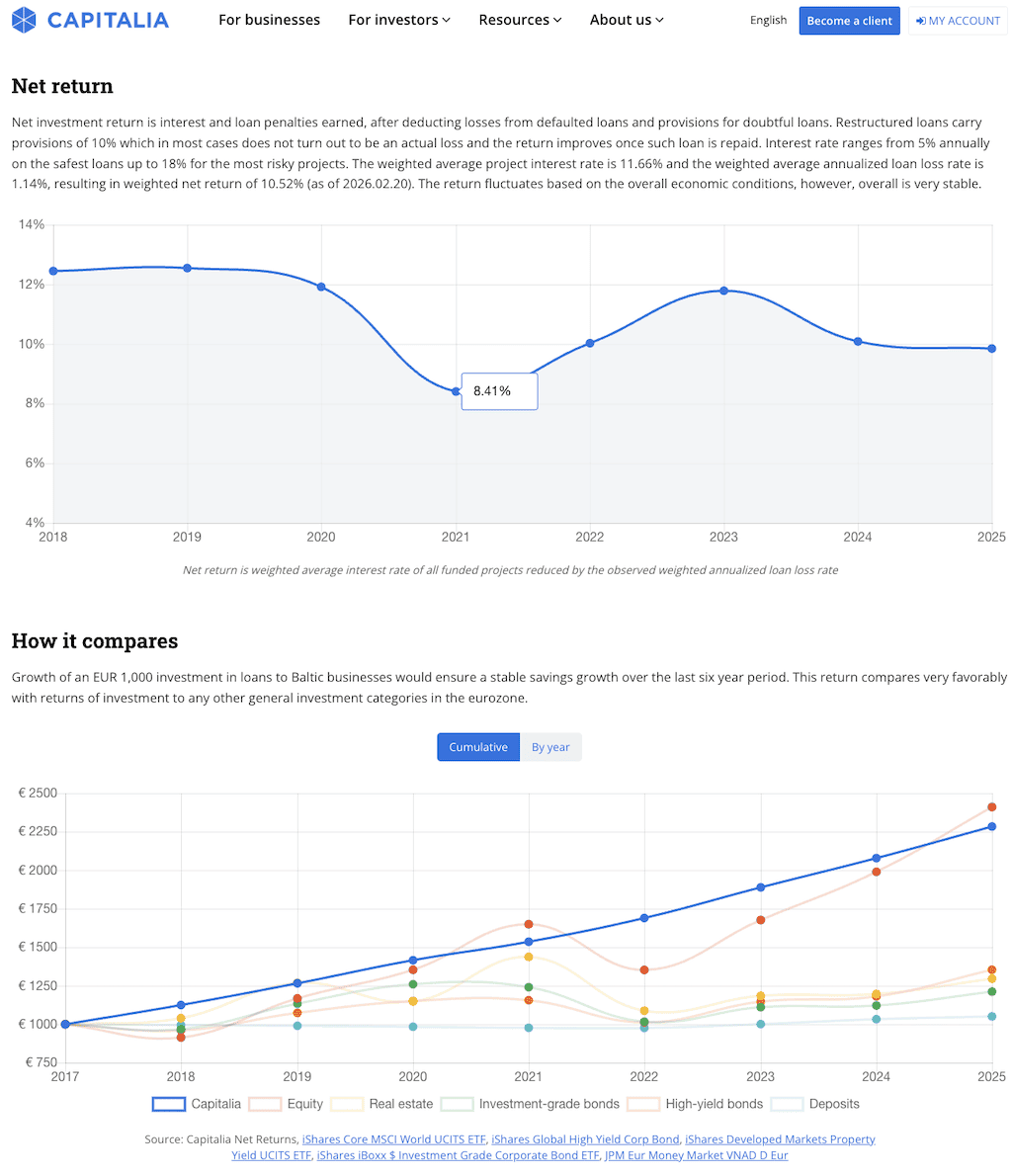
The minimum investment is 200 euros per project. There is an Auto Invest with predefined strategies, but no secondary market, so your capital is tied up until the end of the term. According to CEO Juris Grišins, the historical net return after credit losses is ~10.8% p.a. and has fluctuated between 8.4% and 12.6% in recent years. For investors, Capitalia thus offers a direct way to invest in Baltic and Finnish SME loans with real entrepreneurial risk and real entrepreneurial opportunity.
Capitalia facts & figures as of 2026
Since 2017, business loans with a total volume of around 117 million euros have been financed through the Capitalia platform. The weighted average return for investors after deduction of all credit losses is ~10.8% p.a., with an actual credit loss rate (write-off) of only 0.12%. That means: of 117 million in loans issued, only around 117,000 euros were ultimately lost.
Around 2,120 registered investors are currently active on the platform, with an average investment of 1,724 euros per investor. In total, over 8 million euros in interest have been paid out to investors. All data can be viewed at any time on the statistics page, including a vintage analysis by year and risk class.
Who runs Capitalia?
Capitalia has been led since its founding by CEO Juris Grišins, who started the company in 2007. Under his leadership, the firm has made the transition from a pure lender to a licensed crowdfunding platform, and has come through crises such as COVID-19 and the effects of the war in Ukraine.
In our conversation on the podcast, one thing stood out: Juris is not a typical FinTech founder throwing buzzwords around, but someone who has been practising his trade for almost 20 years. He owns around 83% of the company and is therefore not a hired manager but the main owner, so his interests are aligned with those of the investors to the greatest possible extent.

Organisationally, Capitalia consists of the platform operator Capitalia SE and the parent company Capitalia Investment Holding. The company employs around 15 people, has a supervisory board with three members and follows the corporate governance standards of NASDAQ Baltic. All quarterly and annual reports are voluntarily made publicly available, a level of transparency that few platforms offer.
Registering with Capitalia
Registering with Capitalia is straightforward and entirely in English (there is no German version):
- Create an account
Enter your email address and password. Registering as a company is also possible. - Verify your identity
Confirm your identity with your ID card or passport. - Activate 2-factor authentication
Without active 2FA you cannot deposit any money. It is mandatory. - Deposit money
Click on "Add Funds" in your dashboard. You will receive the transfer details for a SEPA transfer to your personal Lemonway account. Important: the transfer must come from an account in your own name.
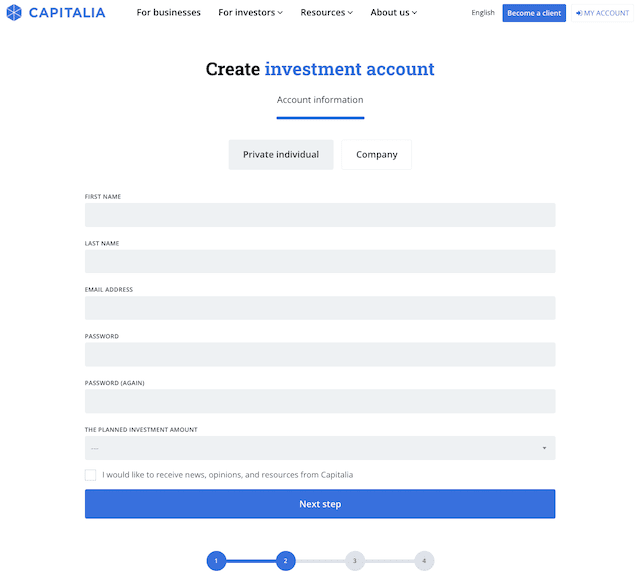
A deposit usually takes 1-2 working days. Credit cards are currently not supported. Payouts are free of charge and go only to a verified bank account in your name. Worth mentioning: when you register, you immediately get tips for a successful portfolio, which I have not seen on any other platform.
Investing with Capitalia
At Capitalia you have three ways to invest your money in business loans: manually via the marketplace, via the Auto Invest or via one of the pre-built strategies. I currently use the manual route myself, so that I can look at the projects in detail.
Manual investing: "Pick & Choose"
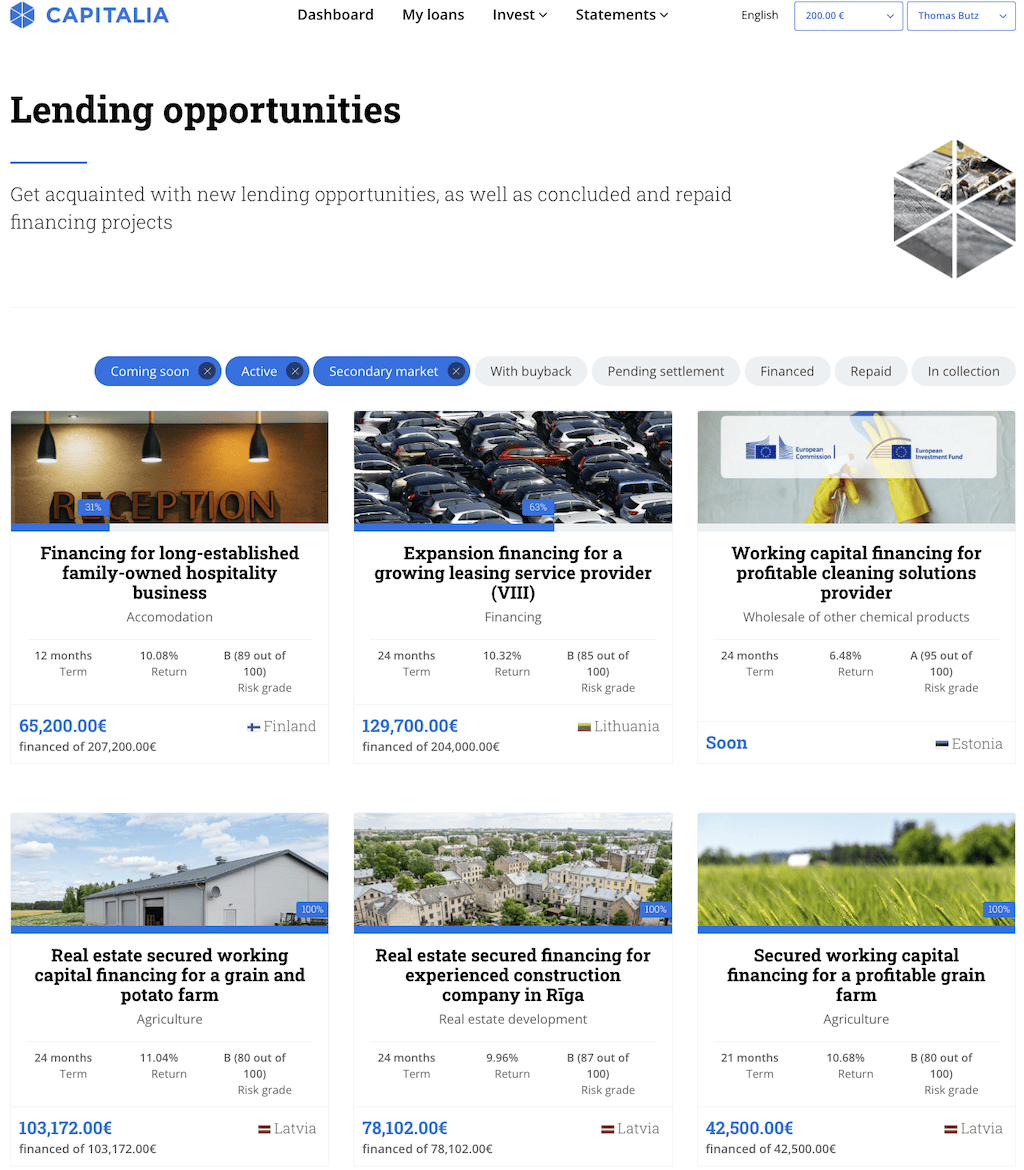
On the marketplace you see all open projects with a clear summary of the most important key data. If you click on a project, you get a really deep insight into:
- Reasons for the loan application and the intended use of funds
- The key risks of the specific project
- Detailed financial key figures of the company (revenue, profit, equity over several years)
- The full payment schedule
- Attachments and the KIIS document (Key Investment Information Sheet)
A nice detail: after investing you still have a 96-hour withdrawal period, during which you can take back your commitment. I only know this from a few other platforms.
The Capitalia Auto Invest
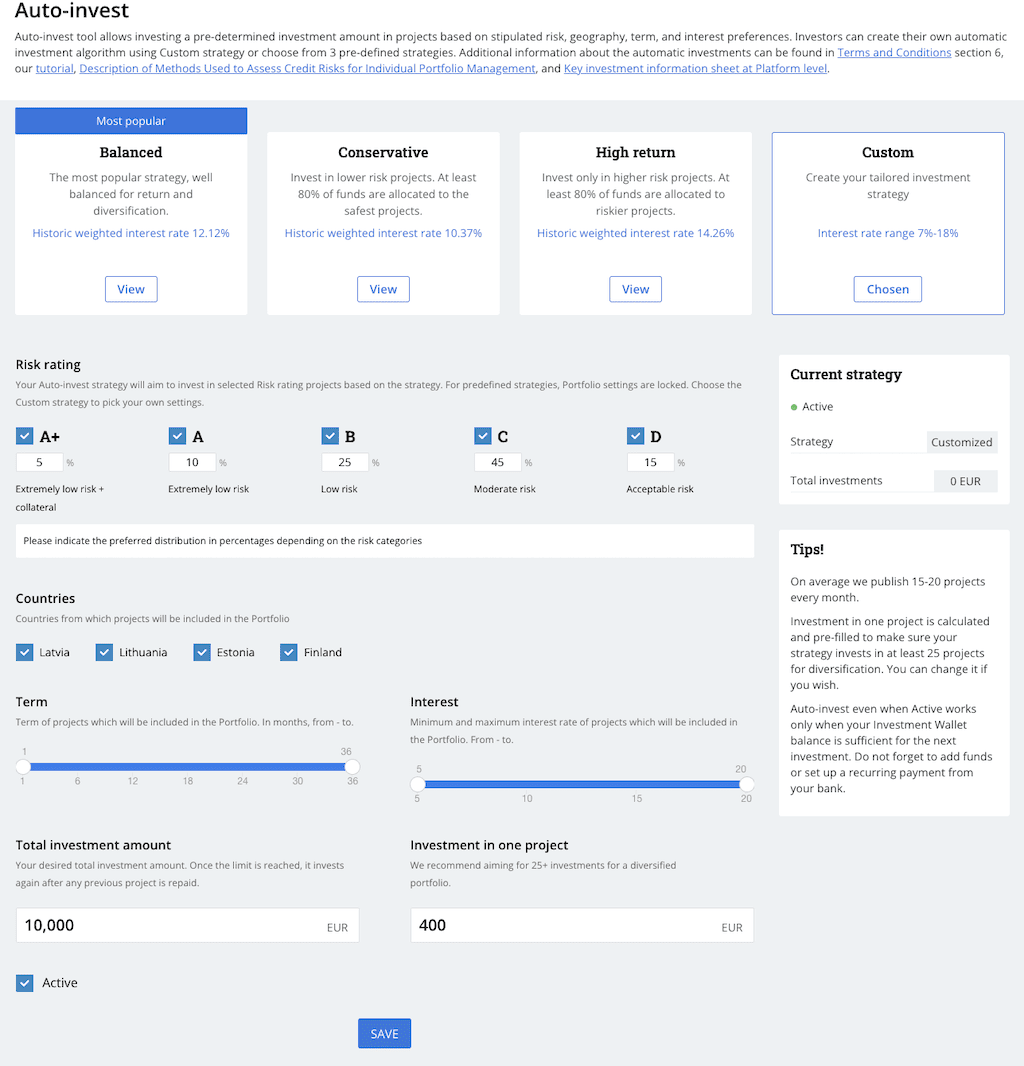
If you do not want to check every project individually, you can configure the Auto Invest. You set the basic parameters: amount per project, risk class (A+ to D), countries, term and minimum interest rate. Capitalia recommends a minimum investment of around 5,000 euros for this, so that the Auto Invest can diversify sensibly.
The Capitalia strategies
It is even simpler with the pre-built strategies, which take the configuration off your hands:
- Very Conservative: expected return ~7.9%
- Conservative: expected return 7.9-11.8%
- Moderate: expected return 7.9-13.8%
- High Return: expected return 13.8-15.3%
Cash flow & term
Loan terms range from 3 to 36 months, with the average currently at around 19 months. Depending on the project, repayment is made as an amortising loan (monthly instalments) or as a bullet loan (bullet payment at the end of the term). Interest payments usually arrive monthly.
How many loans do you need at Capitalia to be reliably diversified?
In the P2P Cafe interview, Juris Grišins (German) put concrete figures on the table, which I know from hardly any other platform. Capitalia regularly analyses its investors' portfolios and can therefore say fairly precisely from which number of projects your portfolio statistically runs smoothly:
| Projects in the portfolio | Expected result |
|---|---|
| From 15 loans | The return visibly begins to converge towards the average |
| From 25 loans | All investors with 25 projects historically had a positive return |
| From 50 loans | At least 5% return: the statistical spread narrows sharply here |
| From 100 loans | Return moves within a range of roughly 7-13% around the average of ~10.8% |
What does that mean in concrete terms? If you only invest in 5 or 10 projects, you may be unlucky and hit a default that drags down the whole return or even pushes it into negative territory. The more projects you hold in your portfolio, the less influence a single default has on your overall result. According to Capitalia's data, from 50 loans onwards no investor has ended up below 5%, and the deviation from the average keeps getting smaller after that.
However, Juris also said honestly in our conversation that even with 100 loans there is still a spread. Some investors end up at 7-8%, others at 12-13%. That depends on which risk classes you chose and whether you were unlucky with a default in the early phase. His conclusion was, roughly: "It is also partly a matter of luck when you hit the first default."
My take on this: In practice, with a minimum investment of €200 per project, you should aim for a target portfolio of at least €5,000 (25 projects) to be sensibly diversified at all. If you want to get into the area where the return reliably converges towards 10%, we are talking more about 10,000, €20,000. That is not small change, but that is exactly why Capitalia is not a play-money investment, but a serious portfolio building block.
Capitalia fees
Good news: for regular investors there are no fees on Capitalia, whether for account maintenance, deposits or withdrawals, or on the investments themselves. The platform is financed through fees paid by the borrower: a financing arrangement fee (1-5% of the loan amount) and a monthly administration fee.
The only exception: anyone using the "Advised" account (i.e. having Capitalia manage their portfolio) pays 10% of the profits generated as a fee. In return, you also get priority in project allocation. The order is: Advised → Auto Invest → Standard.
All commissions that Capitalia receives per project are transparently disclosed under "Disclosure of Capitalia Interests" in each individual loan project, which is exemplary.
The tax topic at Capitalia
As a Latvian platform, Capitalia automatically withholds 25.5% withholding tax on your interest income. That sounds severe at first, but it can be optimised: with a certificate of residence (Ansässigkeitsbescheinigung) from your German tax office, you can reduce the withholding tax to 10%. This 10% is then fully creditable against German capital gains tax (Kapitalertragsteuer), so in Germany you only pay the difference (approx. 15,something% plus solidarity surcharge).
Why not 5% as at Mintos? This is a question Juris answered clearly in the interview: platforms such as Mintos operate under a securities intermediary licence, whereas Capitalia operates under a crowdfunding licence (ECSP). The regulatory frameworks differ. Capitalia is said to be actively working on aligning them, but for now the higher withholding tax applies. From a portfolio of 50,000 euros, the certificate of residence even has to be sent to Capitalia by post as an original document.
You can generate a tax certificate as a PDF at any time in your account under "Account statement".
What you invest in at Capitalia
On the marketplace you will not find consumer loans or property projects, but business loans to small and medium-sized enterprises from a wide range of sectors:
- Trade & production: agricultural machinery dealers, manufacturers, wholesalers
- Services: IT companies, consultancies, logistics firms
- Bridge financing: short-term liquidity needs, often ahead of planned bank financing
- Growth financing: working capital for expanding businesses
Juris Grišins described the niche in the interview like this: "Companies that are almost bankable, but not quite." Capitalia operates precisely in this gap between bank loans and high-risk consumer loans, with human credit assessment by an experienced credit committee, not by algorithm.
Geographically, you invest in the three Baltic states Latvia, Lithuania and Estonia and, since 2025, also in Finland. Juris described the Finnish market as a natural extension, legally and culturally very similar to the Baltics.
Security concept: no buyback, but substance
Capitalia does not offer a buyback guarantee in the classic sense. Your protection consists of several layers: first, the personal guarantee of the company owner (in 99% of all projects), second, for roughly half of the loans, collateral in rem (pledges, mortgages), and third, Capitalia's own stake of 2.5% in every project. With a historical write-off rate of only 0.12%, this model seems to have worked so far.
New: EIF guarantee, 90% protection by the EU
Since Q2 2026, Capitalia has offered another loan category: business loans with a guarantee from the European Investment Fund (EIF) under the InvestEU programme. Over three years, up to 15 million euros of loans to Baltic micro-enterprises are to be financed this way. In concrete terms, the protection works like this: the EIF issues an irrevocable counter-guarantee to Capitalia's parent company, Capitalia Investment Holding, which passes a buyback guarantee on to the platform Capitalia SE. For you as an investor, this means: if a loan defaults, Capitalia buys the loan back from you within 30 days, at 90% of the outstanding capital plus interest. The remaining 10% stays as borrower risk, and you share in any recoveries from debt collection. Capitalia is thus the first crowdfunding platform in Europe with a direct EIF guarantee instrument for retail investors. The interest rates on these loans are at the lower end of the platform's range. For earlier EIF loans, that was around 7% with an A+ rating. Through the guarantee, the project risk is upgraded by up to 20 points: a company with customer risk C can thus receive a project rating of A.
Specific Capitalia projects in detail
So that you can see what Capitalia projects look like in practice, we will look at two examples: a classic business loan without a guarantee and one of the new EIF-backed loans.
Example: classic business loan, agricultural machinery dealer (Latvia)
A Latvian company in agricultural machinery trading, established since 1993 and originally founded as the official representative of a German manufacturer, is seeking short-term bridge financing of around 308,000 euros for 6 months. Background: the company is facing a planned bank refinancing and needs working capital at short notice in order to meet the bank's requirements.
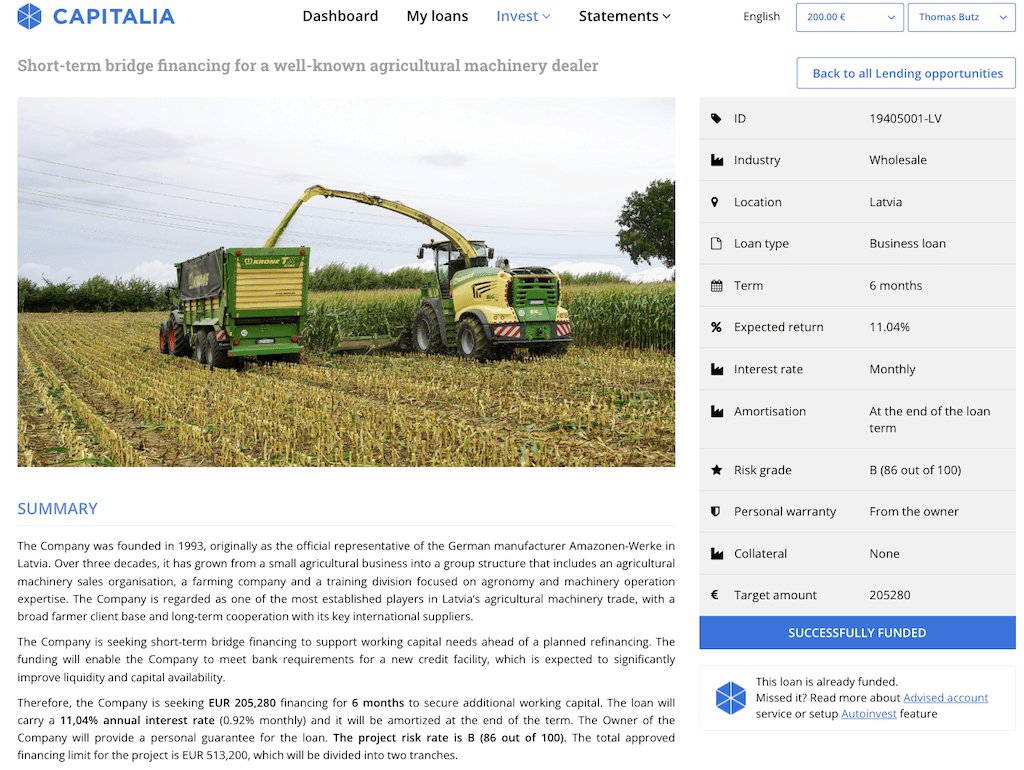
| Feature | Details |
| Company | Agricultural machinery dealer, active since 1993 |
| Loan volume | €307,920 (2nd tranche of a total of €513,200) |
| Term | 6 months |
| Interest rate | 11.04% p.a. (0.92% monthly) |
| Repayment | Bullet payment (repayable at maturity) |
| Risk rating | B (86 out of 100) |
| Security | Personal guarantee of the owner |
| EIF guarantee | No |
| Customer base | Over 2,000 agricultural customers |
| Revenue 2025 | ~20 million euros |
What stands out here: you get to see five years of financial key figures for the company, including revenue development, net result, equity ratio and debt ratio. It is also openly disclosed what Capitalia itself earns on the project (financing brokerage fee: €7,920, monthly administration fee: 0.37% of the remaining capital). This is a level of project detail that you look for in vain on consumer loan platforms.
Example: EIF-backed loan, cleaning products wholesaler (Estonia)
One of the first EIF projects on the platform shows how the guarantee works in practice: ZEP Eesti is an Estonian wholesaler of cleaning solutions for an American brand in the Baltics, active since 2004. The company also runs over 300 maintenance contracts for biological wastewater treatment plants and has been consistently profitable since 2016. Payment discipline at Capitalia is flawless: 18 loans totalling 625,746 euros were repaid on time.
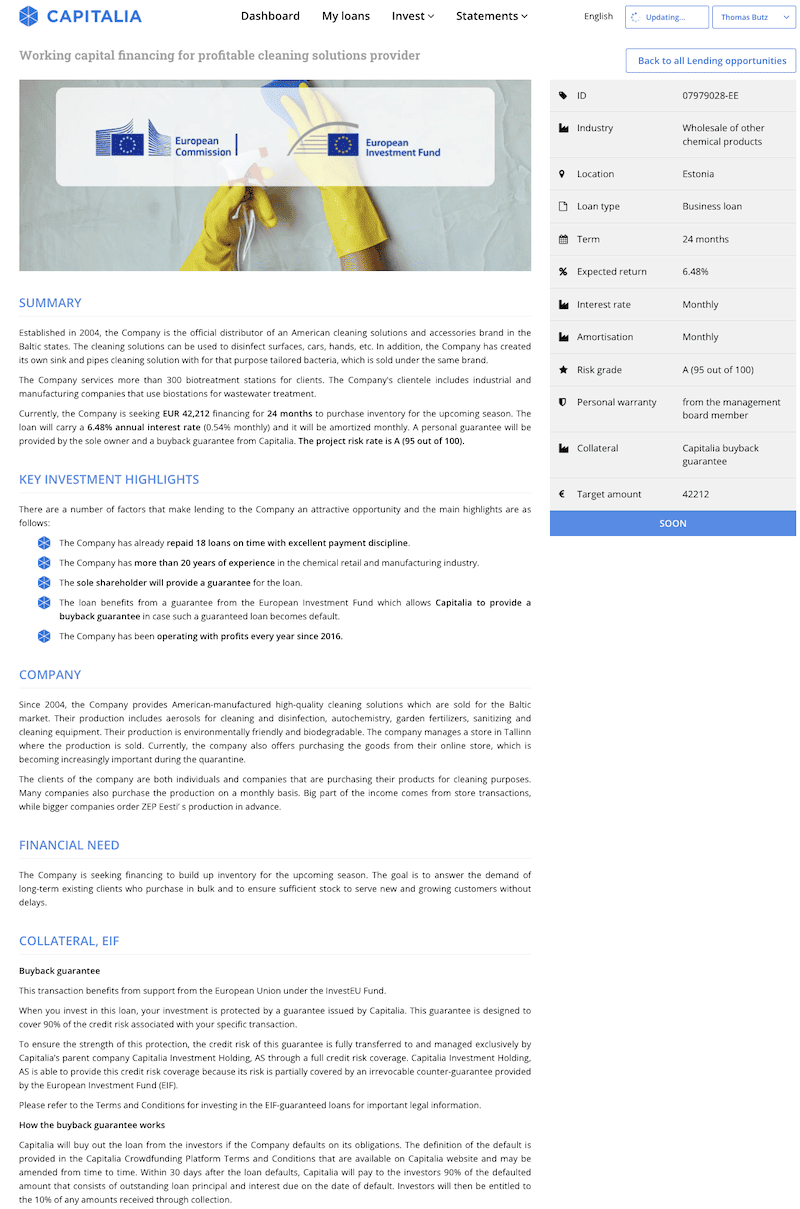
| Feature | Details |
| Company | ZEP Eesti OÜ, wholesaler of cleaning solutions, since 2004 |
| Loan volume | €42,212 |
| Term | 24 months |
| Interest rate | 6.48% p.a. (0.54% monthly) |
| Repayment | Monthly (annuity) |
| Customer risk | C (75 out of 100) |
| Project risk (with EIF) | A (95 out of 100): upgrade through EIF guarantee (+20 points) |
| Security | Personal guarantee of the owner |
| EIF guarantee | 90% coverage on capital + interest (buyback by Capitalia) |
| Revenue 2025 | €456,356 |
| Net profit 2025 | €31,787 (margin: 7.0%) |
| Equity ratio 2025 | 33% |
The difference from the classic project is immediately visible: the interest rate of 6.48% is clearly lower than the 11% for the agricultural machinery dealer, but you get 90% of your capital back if the loan defaults. The customer risk is upgraded from C to A because the EIF guarantee massively reduces the expected loss. For investors who find the default risk on normal Capitalia loans too high, these EIF projects are an interesting way to get started, even if the return is correspondingly lower.
My advice to you: Take the time to look at the financial figures and attachments of each project before you invest. Especially with business loans without physical collateral, the borrower's economic substance is the most important criterion for future stability. The only alternative to looking closely is broad diversification (which is what I will do)
The Capitalia risk FAQ
Despite a stable track record and a solid platform structure, you should keep the risks at Capitalia in view. I have summarised the main P2P platform risks for Capitalia in a short FAQ before moving on to my experience with Capitalia and my conclusion.
How does Capitalia make money?
Is Capitalia profitable?
Is Capitalia legitimate?
Are there loan defaults at Capitalia?
What would be the impact of an insolvency of Capitalia?
Is there deposit protection at Capitalia?
Does Capitalia have "skin in the game"?
Is Capitalia a LANDE alternative?
Is Capitalia a genuine LANDE alternative? In principle, yes, as both platforms issue secured business loans in the Baltics and are EU-regulated. The target group differs, though: while LANDE* has specialised in the agricultural sector, Capitalia covers a broader range of industries, but with a higher minimum investment and more analysis effort per project.
Here is the direct comparison:
| Feature | 🇱🇻 Capitalia | 🇱🇻 LANDE |
|---|---|---|
| Loan type | SME business loans (cross-industry) | Agricultural loans (farming) |
| Net return | ~10.8% p.a. (after losses) | ~11% p.a. |
| Fees for investors | €0.00 | €0.00 |
| Minimum investment | €200 (manual + auto-invest) | €50 |
| Liquidity (secondary market) | No (planned) | Yes |
| Security | ~50% physical, 99% personal guarantee | 100% secured (land, harvest, machinery) |
| Skin in the game | 2.5% per project | Yes (variable) |
| Country focus | Baltics + Finland | Latvia, Lithuania, Romania, among others |
| Bonus | none | 3% cashback (30 days) |
You can find more about the agricultural loan platform in my Lande review and guide on the blog.
My Capitalia review and my Capitalia conclusion
In our 10in10 P2P Cafe podcast, Juris Grišins convinced me, not with marketing promises but with plain speaking. He neither dressed up the default figures (the seemingly high 10% is, calculated correctly, only 1.3%) nor concealed the failed bond and VC experiment. What tips it for me: the return combined with the diversification figures (in profit from 25 loans, at least 5% from 50) and the new EIF guarantee with 90% coverage as an entry point for more conservative investors.
For me, Capitalia is therefore definitely a platform I am now getting into. Everyone knows I am keen on genuine P2P anyway: direct lending to real businesses, with no buyback construct in between.
That said, one has to be honest: the roughly 10% net return after defaults is at the lower end for P2P. I would have liked a bit more, but if it means not having to expect a total loss at any moment, that is completely fine.
What you have to keep in mind: diversification ties up capital. It should be over 100 projects for the return to converge reliably towards the average. With a minimum investment of €200 per loan, we are talking about around 20,000 € in the end before the portfolio runs statistically smoothly. Admittedly, thanks to interest and repayments it will be a little less, depending, but of that order of magnitude, as I also know from InRento. That is not small change: you have to regard Capitalia as a serious portfolio building block and want it as such.
Capitalia review: my account
I have joined Capitalia and deposited 1,000 euros. I am currently invested in 8 projects, and money for another one is ready. Auto Invest is set up and running, so the path to the minimum of 50, better 100 loans has begun. My original plan was to concentrate on C and D loans to achieve a higher return. In practice it has looked different so far: there were almost exclusively B projects and a single A project. So it will probably end up as a ≥B portfolio. I will see how the supply develops over the coming weeks.
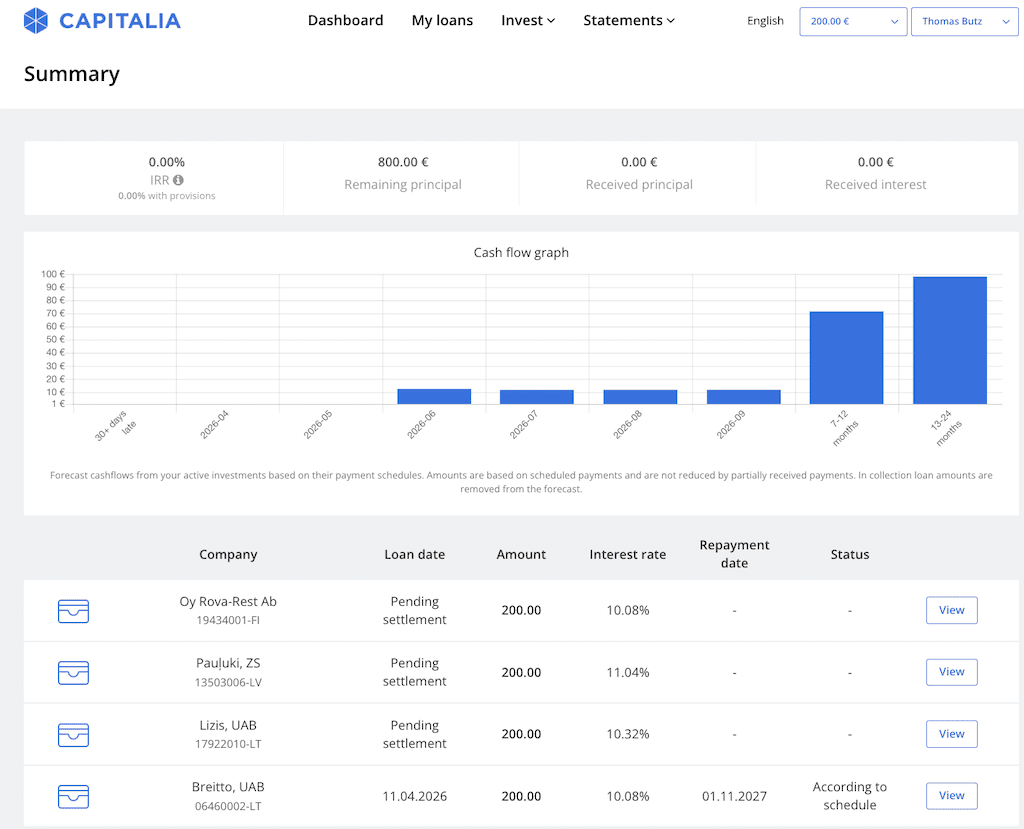
Next, I will take care of the certificate of residence (Ansässigkeitsbescheinigung) to reduce the withholding tax from 25.5% to 10% (done). And then it is a matter of patience: with 5 to 7 new projects per week and a minimum investment of 200 euros, it takes several months for the portfolio to reach the targeted 50+ loans. Through interest payments and repayments, money flows back along the way and is reinvested straight away. Even so, you have to be prepared to build up towards 15,000 Euro so that the return converges reliably towards the average.
My Capitalia return 2026
In my portfolio, Capitalia has been in the build-up phase since April 2026 and, naturally, does not yet deliver meaningful return data.
| Year | Paid in | Paid out | Net earnings | Return p. a. (XIRR) |
|---|---|---|---|---|
| 2026 (19 Apr to 03 Nov) | €6,472 | €0 | +€162 | – (part year) |
| total | €6,472 | €0 | +€162 | – |
As I have only been invested for such a short time, I am not yet giving you an overall return (IRR/XIRR). The target is roughly 8% after withholding tax and losses. For me that would be a solid result given the risk profile.
My Capitalia return
My own investment since 19 Apr 2026 · figures from Portfolio Performance
- €6,472
- net paid in
- €6,633
- Portfolio value
- Net paid in
- Net earnings (up to portfolio value)
- Portfolio value
Depending on how my experience with Capitalia develops, I will expand the platform further. A regulated SME lending platform with Capitalia's track record is an asset to any P2P portfolio, provided you bring the necessary patience and the necessary capital for sensible diversification. The aim now is to reach 50 loans as quickly as possible and then, in the medium term, 100.
And what about you, do you find Capitalia* interesting?
Do you invest in business loans, or do you prefer secured property or agricultural loans? Or do you prefer consumer loans with a buyback promise...
My Capitalia position (as of 03 Nov 2026)
- Invested since
- 19 Apr 2026
- Invested (net, rounded up)
- €6,500
- Interest received (rounded up)
- €170
All figures for Capitalia My P2P investing in numbers
My own money, shared for transparency. Not a recommendation. Past returns do not guarantee future results.
Editorial note: This review reflects my personal experience as an investor. Commissions from affiliate links do not influence my assessment or the platform rating.