Bondora Review: Why You Still Can't Get Around Go & Grow After 18 Years
Translated from the German original, last updated 11 Nov 2026. Read the original (German)
My experience with Bondora goes back to 2017, to a time with Portfolio Manager, secondary market and bots. Today there is only Go & Grow (often also written Go and Grow), and since 2026 there is even a separate company behind it, Go&Grow OÜ. This Bondora guide and overview is meant to help you decide whether you also want to invest on the Estonian P2P lending platform. Before I go into my own long-standing experience with Bondora and explain in the conclusion why you still can't get around Bondora after 18 years, let us take a brief look at the platform as it presents itself today.
- New customers get €5 starting balance directly after sign-up on all investments via my Bondora link*.
This item describes a promotion by the provider, such as a bonus or cashback. It reproduces the provider's statements and is not a recommendation. The provider's terms apply.
Bondora: data at a glanceAs of 12 Nov 2026
- My platform rating
- 64 out of 100, rank 11 of 46
- My return (XIRR)
- 8.12%
- Outstanding portfolio
- 703.0m EUR
The Bondora Profile
Before going into detail, here is an overview of the most important and relevant data on the P2P lending platform Bondora (platform figures as of 2026-11-09):

| Founded | 2008 (Go & Grow since 2018) |
| CEO | Pärtel Tomberg, Co-founder and CEO Bondora Group (Quelle) |
| Regulated | Only lender Bondora AS (EFSA licence 4.1-1/41); Go&Grow OÜ no licence (Quelle) (Quelle) |
| Investors | 517,650 registered (2026-11-09) |
| Headquarters | Tallinn, Estonia. Contracting party Go&Grow OÜ, lender Bondora AS |
| Collateral | None; unsecured consumer loans |
| Return | Up to 6% p.a. according to the platform (cap, not guaranteed) |
| Buyback guarantee | None; only resale to Go&Grow OÜ at the GG price, dependent on liquidity |
| Secondary market | No (closed since 30.09.2025) |
| Liquidity | Payout available on request 24/7, €1 per payout; in case of shortage, suspension and partial payments |
| Loan types | Unsecured consumer loans (€500 to €20,000, term up to 60 months) |
| Financed loan volume | 1.92bn € loans issued, 2.32bn € invested by investors (2026-11-09) |
| Minimum investment | none stated (allocation from €1 per claim) |
| Investment strategies | fully automated, no strategy choice, up to 10 Goals |
| Rating | P2P Rating: 64/100 (rank 11 of 46) · BaFin check: 36/100 |
| Loyalty program | No (loyalty programme planned from 2026, not yet implemented) |
| Withholding tax | 0% (no withholding provided for) |
| Annual report | 2025: Group with KPMG audit opinion, Go&Grow OÜ review only (ISRE 2400) |
| New customer bonus | €5 starting balance directly after sign-up (via this link*) |
Figures from the platform's website, its reports and public registers, as of 11 Nov 2026. Not every figure can be independently verified.
Sign up with Bondora: €5 starting balance directly after sign-up*
The two latest Bondora news items
I automatically pull the two latest news items from Bondora and prepare them for you:
- Bondora: Go & Grow and Bondora Group figures for September 2026
Customers added EUR 39,437,371 to Go & Grow in September and earned EUR 3,895,768 in returns. 804 new customers joined. Bondora AS originated EUR 31,972,294 in loans across its European markets, 54.09% of it in Finland.Telegram - Go & Grow and Bondora Group August 2026 statistics: investments, returns and loan originations
Go & Grow recorded EUR 40,393,068 in customer investments in August 2026 and a new all-time high of EUR 3,980,583 in returns. Bondora AS originated EUR 38,261,388 in loans across its European markets, with Finland the largest at 64.4% of the total.Telegram
Let us take a somewhat closer look at the oldest European consumer P2P lending platform and who is behind it, before I report on my long-standing experience with Bondora.
What is Bondora?
Bondora, founded in Estonia in 2008, is one of the most renowned and oldest P2P platforms in Europe. It allows you, as an investor, to invest in a wide range of European consumer loans.
With more than 18 years of market experience, Bondora has made a name for itself as a reliable and transparent platform. The investment product 'Go & Grow', introduced in 2018, was nothing short of visionary. This development moved the platform forward enormously and set new standards in the P2P lending industry.
Another change at Bondora is the reduction to the "One-Click-Investing" model. Here you can invest as an investor with just one click. Since 27.02.2023, every new investment has gone through Go & Grow, and the secondary market and API have been closed since 30.09.2025. Borrowers also benefit from this platform, as they can take out loans with a term of up to 60 months.
On 12.05.2022 the product "Go & Grow Unlimited" was added (up to 4%, but with no deposit limit). This underlines Bondora's efforts to keep offering user-friendly investment solutions. New since April 2026 are Goals, with which you can set up to ten sub-accounts with the same interest rate.
Unlimited was discontinued on 01.04.2025. Since then, Go&Grow has offered a uniform rate of up to 6% with no deposit limit (previously up to 6.75% with a monthly limit, or 4% in Unlimited). From 09.09.2024, the amount above the monthly limit also received up to 6.75% for a limited period.
Who owns Bondora and runs the platform?
Still at the helm is Pärtel Tomberg, co-founder and CEO of the Bondora Group. He founded the company in 2008 while studying for his bachelor's degree. Since 2026 he has also sat on the management board of Go&Grow OÜ, which he runs together with Triin Sarapuu (Chief Legal Officer Go & Grow).
Before working full time at Bondora, he worked as a Development Business Manager at Quelle AG, which was later taken over by Halens.
Other co-founders are Mihkel Tasa and Martin Rask.

The CFO of the Bondora Group has been Kerli Lõhmus since January 2024. The management board also includes COO Liisi Klettenberg, Chief Risk Officer Vytautas Jūras and Chief People Officer Olga Kikas.
Since 2026, Tomberg has therefore led both groups of companies at the same time: lending in the Bondora Group and the investor product in the Go&Grow Holding.
As regards ownership, the same well-known investors have been involved for years. According to the commercial register, the shareholders include Tomberg Management & Consulting OÜ, the Global Founders Fund from the circle of Global Founders Capital and Rocket Internet (Berlin), OÜ Schnurberg and the nominee SIX SIS AG.
Global Founders Capital came in with the seed round in 2014, and Valinor Management LLC from New York with the Series A round in 2015. Exact shareholdings are not public.
Bondora and Go & Grow: two companies since 2026
Since 2026, lending and the investor product have been legally separated. The former Bondora Capital OÜ has been called Go&Grow OÜ since 20.04.2026 and is your contractual partner. Since 30.06.2026 it has belonged to Go&Grow Holding AS and therefore no longer to the Bondora Group. The loans continue to be issued by Bondora AS, which is licensed as a lender by the Estonian financial supervision authority. Both holdings have the same shareholders.
What to bear in mind: Go&Grow OÜ has around 3.6 million euros of equity against a good 700 million euros of investor money, and its 2024 and 2025 financial statements were only reviewed, not fully audited. In everyday use this changes nothing about Go & Grow, but for me it still belongs in the overall picture.
What the latest Bondora annual report looked like
The most recent report is the 2025 annual report, again audited under IFRS by KPMG Baltics OÜ with an unqualified opinion. The opinion applies to the group. For 2024 and 2025, the contractual partner Go&Grow OÜ only had a review without an audit opinion. I have summarised the most important key figures here, and the detailed Bondora 2025 annual report is available to read. For Bondora it was the ninth profitable year in a row, and by far the strongest in terms of profit.
- Revenue: 62.7 million euros
- Net profit: 9.5 million euros
- Net margin: around 15%
- Loans issued: 349 million euros in total across 182,000 loans
(main markets Finland and Estonia, plus the Netherlands) - Loan portfolio: 697 million euros (+16%)
- Active investors: 221,000
- Revenue growth compared with the previous year (2024): +19%
- Net profit almost eightfold compared with 2024 (from 1.2 to 9.5 million euros)
- Return on equity (ROE): 40%
- Return on assets (ROA): 30%
- Very solid balance sheet: equity ratio 74.7%, debt ratio 0.34, current ratio 3.18
- The average number of employees in this financial year was 194 (previous year: 177)
What needs putting into context: The large jump in profit is partly due to a special effect. In 2025, Bondora sold part of the non-performing Finnish loans from the investors' portfolios to an institutional investor. Bondora will only receive part of the purchase price over a period of up to three years, which appears in the balance sheet as a long-term receivable of 2.65 million euros. However, the full amount has already been paid out to the investors. The report itself does not state how large this one-off effect was within the 9.5 million profit. The recurring, "real" profit is therefore somewhat lower, but it cannot be quantified cleanly from the outside.
The historical development over the last 5 years
A single year says little about a P2P platform; the trend is more interesting. Over the last five financial years, a clear pattern shows at Bondora: revenue grows year after year, while profit fluctuates strongly, depending on how much Bondora is currently investing in its own growth.
| Key figure | 2021 | 2022 | 2023 | 2024 | 2025 |
|---|---|---|---|---|---|
| Revenue (EUR m) | 29.8 | 36.7 | 44.4 | 52.6 | 62.7 |
| Net profit (EUR m) | 6.7 | 2.1 | 3.4 | 1.2 | 9.5 |
| Net margin | 22% | 6% | 8% | 2% | 15% |
| Loans issued (EUR m) | n/p | 173 | 202 | 262 | 349 |
| Return on equity (ROE) | 48% | 13% | 17% | 6% | 40%* |
| Return on assets (ROA) | 37% | 10% | 13% | 5% | 30%* |
| Ø employees | 90 | 138 | 166 | 177 | 194 |
Revenue more than doubled from 29.8 million euros (2021) to 62.7 million euros (2025), and did so in every single year without a setback.
Net profit tells a different story. After the exceptional year 2021 with 6.7 million euros, 2022 to 2024 brought three years of weaker profit. During this time Bondora increased its headcount from 90 to almost 200 and invested heavily in new markets such as the Netherlands, Latvia and Denmark. In 2024 only a slim profit of 1.2 million euros was left at the bottom line. In 2025 the picture then tipped clearly upwards, to 9.5 million euros and a net margin of around 15% (I have already put the special effect behind it into context above).
The loan volume has risen in parallel from 173 to 349 million euros per year. So behind the growing margin there is also real volume growth, not just balance sheet cosmetics.
For me, this trend is the real point: Bondora has reported profits throughout, even in the lean years, and financed the whole growth phase from its own resources. What will be interesting is whether the 2025 profit level can be maintained without the special effect, or whether it was an upward outlier.
Registering with Bondora and the sign-up bonus
Registering with Bondora*is straightforward and can be done in five simple steps:
- Start the registration: Click on “Jetzt anmelden” (Sign up now) on the home page.
- Provide your personal details: Enter your email address, your name and your phone number.
- Email confirmation: Check your inbox and confirm the verification email from Bondora.
- Add further information: Log in with your email and password to enter further personal details such as your address and to answer AML-related questions about your employment and the origin of your funds.
- Complete the identification process: Carry out the final identification (selfie and ID document) to fully activate your account. Until then, any money you have paid in stays reserved and is not invested.
To invest with Bondora, you must be at least 18 years old and have your permanent residence in the European Economic Area (EU plus Norway, Iceland and Liechtenstein) or in Switzerland. Companies from these countries can also open an account. One account per person is allowed.
Once you have registered successfully and made a deposit, your money is automatically distributed across loan receivables. Choosing individual loans is no longer possible. Paying in money is easy by SEPA transfer using your reference number. In your account you will find a button called “Einzahlen” (Deposit) for this.
AML check and proof of origin of funds: what you should know about larger deposits
Go & Grow is subject to the European anti-money laundering rules (AML/KYC). This means that even after successful initial verification, the platform can ask for additional evidence of the origin of funds (Source of Funds) at any time, with a deadline of 7 days. This happens in particular if you pay in larger sums within a short time.
What you should know about the AML check
- For deposits of four or five figures, especially several in quick succession, Bondora regularly asks for proof of the origin of funds.
- During the check, money you have paid in can be marked as “reserved”. During this time no interest is earned.
- A simple bank statement is often not enough. What is usually accepted: a recent payslip, a pension notice, a tax assessment, a sales contract (e.g. property or securities account), a certificate of inheritance or a deed of gift. In other words, documents that show the source of the funds, not just the flow of money.
- This is not Bondora harassment but a consequence of the EU anti-money laundering rules. It works the same way on Mintos, Esketit, Capitalia & Co.
This is what I do: Before a larger deposit, I get the relevant evidence ready and send it straight away once the request arrives. This usually shortens the reservation period considerably.
An additional bonus for new investors:
When you first register, you receive a welcome bonus of 5 euros if you use my link*. If you do not invest at least 50 euros within 30 days, it is deducted again. You can find all current promotions on my page with the P2P bonus offers.
Investing with Bondora
How do you invest with Bondora? What should you know and what should you pay attention to? In this section you will find a compact overview of its now only product, Bondora Go & Grow. If you are interested in the old Bondora, you can look at my very old review (German), where you will also see why there is now only the much simpler way of investing via Go&Grow.
The one-click P2P investment Bondora Go & Grow
Bondora Go & Grow is probably the best-known and most user-friendly offer in the area of P2P investments. You only have to pay in an amount of money. Once it has been distributed across receivables, the value of your account grows day by day.
The key features of Bondora Go & Grow include:
- Very simple to use: It is perfect for beginners: just pay in and get started.
- High liquidity: You can request payouts at any time, and the money is usually there within a few banking days. There is, however, no contractual guarantee of immediate payout, and in a shortage payouts are suspended (see crises!).
- No hidden costs: Use is free of charge, with only a small withdrawal fee of 1 euro.
- Tax efficiency: According to the provider, tax only arises on payout, not on the daily increase in value. This has not been conclusively clarified for tax purposes (note: I am not a tax adviser).
- Saving with a “call money” effect: The product gives the feeling of a call money account, although it is not one. There is no deposit protection.
The core of Bondora Go & Grow is a diversified portfolio with several 100,000 borrowers. The return is capped at up to 6% per year and is not guaranteed. The increase in value is calculated and displayed daily, but it is only realised on payout.
As early as January 2023, according to Bondora, over 96% of all investments went through Go & Grow. Since 27.02.2023, Portfolio Manager and Portfolio Pro can no longer be used for new investments, and since the closure of the API and the secondary market on 30.09.2025, Go & Grow has in practice been the only product, at 100%. Old portfolios are only running off.
- Bondora Go&Grow
The one-click investment product launched in 2018, which is, and has been, so often advertised as a “call money” substitute.- Interest rate: up to 6% (cap, not guaranteed)
- Deposit limit: none
- Payout €1
- Payout can be requested at any time (for the exception see the Covid crisis)
- Goals: up to 10 sub-accounts with the same interest
- no deposit protection
However, Bondora has built clauses into its product. Firstly, that it can adjust the interest to the market situation, and secondly on the subject of liquidity. It describes very precisely and transparently in its risk warnings that neither is guaranteed.
The terms now also set out exactly how payouts are made in a shortfall: every banking day at 10 am, the available money is distributed in equal amounts to everyone waiting until all are paid in full. Previously this was done in proportion to balances. Small amounts are therefore fully returned sooner, while large ones take longer.
Liquidity has also already been restricted once by partial payouts, see the Covid crisis.
How do you invest in Bondora Go&Grow?
The actual investing is then really just a single click in the Go&Grow area. In the Bondora Go&Grow tab you can also set a savings goal, create up to ten Goals, and under Reports you will find your tax report (“Tax report”), which only becomes relevant once you withdraw more money than you have paid in!
The Bondora loan portfolio - What are you actually investing in?
Many investors have so far not been aware of which P2P loans Bondora Go & Grow invests in. There were suspicions that Go & Grow contains only inferior loans and therefore serves as a discontinued model. The full automation of the tool reinforced this suspicion, as there no longer seemed to be any transparency. It was also unclear who the borrowers actually were. This was of course nonsense at the latest from the point when new investors could no longer use Bondora's old investment tools.
In practice, the entire Bondora loan portfolio is now the Go&Grow universe. And it consists of unsecured consumer loans from Finland, the Netherlands, Estonia, Denmark and Latvia. Spain is running off.
Bondora is transparent here too, reporting monthly on new lending and regularly on the composition of the portfolio.
This is how new lending was distributed across the countries in August 2026:
| Country | New loans August 2026 | Share |
|---|---|---|
| Finland | €24.6m | 64.4% |
| Netherlands | €6.2m | 16.3% |
| Estonia | €4.1m | 10.8% |
| Denmark | €2.4m | 6.2% |
| Latvia | €0.8m | 2.2% |
| Total | €38.3m | 100% |
- In August 2026, a total of €38.3 million in new loans was issued. In June it was €43.4 million, the highest figure ever.
- At the end of 2025, 514 of 697 million € in the portfolio were being serviced properly, which is 73.7%.
- New lending now concentrates mainly on the better Bondora ratings AA to C.
The probability of default and the interest rate also follow the rating. - Finland is by far the largest market. Denmark has been new since 2025.
As an investor, you have to trust that Bondora assesses the borrowers and their creditworthiness correctly and manages the portfolio profitably. You no longer have any influence on the selection process.
For Go & Grow to be able to pay up to 6% in the long term, the loan portfolio has to earn clearly more after defaults and costs. According to the provider, whatever lies above that stays in the system as a buffer, though its size is not stated. Bondora itself earns from the borrowers' fees, while the investors bear the credit risk. Bondora still has a strong interest in a healthy portfolio, because the loans are refinanced almost entirely through Go & Grow. If the structure fails to deliver the 6%, Bondora lacks the money for new loans. As an investor, you are therefore relatively well positioned.
That was not always the case with their earlier investment products.
The Bondora expected return
Because only one product remains, the return on Bondora is easy to grasp. Bondora Go & Grow offers up to 6% per year, which is a cap and not a guarantee.
The value growth is calculated daily and shown in the dashboard.
Bondora during the Covid and Russia crises
This section is particularly important for Go & Grow investors who rely on the liquidity promise. Bondora's terms and conditions allow the company to restrict it, and that is exactly what happened!
Bondora during the coronavirus pandemic
In the coronavirus crisis of 2020, Bondora reacted to the challenges in good time and introduced partial payouts to cope with the increased demand for payouts. There is evidence of them from April 2020, and by the end of July 2020 they had ended again. Investors should always keep in mind that the underlying loan investments simply keep running, regardless of their wish to withdraw money. In other words, once liquidity has dried up, it takes time until enough repayments from loan receivables have been collected.
Besides this short-term adjustment, Bondora quickly adapted its business processes overall to the circumstances of the pandemic. New lending was greatly reduced and in Spain and Finland it was even suspended completely.
The cost structure was also reviewed: savings were made on many expense-dependent operating costs. For Bondora all of this was lucrative, and 2020 was one of its most profitable years so far.
As a further measure, a monthly deposit limit was introduced at Bondora Go & Grow from 09.09.2020, initially €1,000. This made it possible to control investor demand better and to align it with the supply of borrowers. Since 01.04.2025 there has been no limit.
Bondora during the Ukraine-Russia war
Even in times of political uncertainty such as Russia's invasion of Ukraine, Bondora remains stable. At first there was a brief state of shock , but once it became clear that no direct effects on the company were to be expected, normality soon returned.
The company's loan markets are in Finland, the Netherlands, Estonia, Denmark and Latvia, and are therefore not directly affected by the Ukraine-Russia conflict.
Despite uncertain global events, according to its own statements Bondora has no operational restrictions. The company's figures are also unaffected by them.
What are the advantages and disadvantages of Bondora?
The pros & cons of Bondora at a glance
Advantages of Bondora
- It could not be simpler: one click is enough to invest
- has been on the market for a very long time
- profitable and tested in crises
- high liquidity, payout can be requested at any time
- value growth calculated daily
- Tax trick: according to the provider, taxation only at payout
Disadvantages of Bondora
- A single lender with one loan portfolio
- Return limited to 6%
- liquidity restricted in crises
- no deposit protection
- The counterparty Go&Grow OÜ is unregulated, only the lender is under supervision
- thin equity at the counterparty (around €3.6m against just over €700m of investor money)
- Like any investment, P2P investments are risky
Sign up with Bondora: €5 starting balance directly after sign-up*
My Bondora Review: From 20% to 6%
I started investing with Bondora very early, in products that no longer exist today, and in doing so I gained experience and earned a return that is no longer comparable with today's. I therefore divide my experience with Bondora into a time before and after Bondora Go&Grow.
My Experience with Bondora before Bondora Go&Grow
I already started in 2017 to build a first Bondora portfolio. The platform had then existed for around nine years. The golden times were already over, when you could collect many loans without great expertise and record double-digit returns. My first portfolio did in the end earn a positive return, but it was only just at the level that today's Bondora Go&Grow investors receive!
It quickly became clear that without active portfolio maintenance and cherry picking, there would be no success at Bondora.
My second portfolio, with red defaulted loans actively bought together on the secondary market, by contrast did excellently. With arbitrage and successful collections I finally had a return of well over 20%, and some investors even got more out of it. The only problem was that it cost time and was also not scalable beyond the low four-figure area. In return, I was able to consider myself among the 10 best investors at Bondora for a long time :).
The third attempt was then via a Bondora bot (German), that is, a tool that used the Bondora API and automates cherry picking. It started off excellently, with a return clearly above 10% (not above 20%, but close). Unfortunately, the bot developer lost interest in the tool, and a little later Bondora also discontinued everything except Go&Grow. With the closure of the API on 30.09.2025 it was finally over.

As you can see, you missed quite a bit, but on the other hand not really.
Many investors lost a fair amount of money at Bondora because of the complexity, impatience and a lack of knowledge.
Others, by contrast, achieved a nice excess return. I once interviewed one of the successful Bondora investors (German), in case the history interests you. In any case, with very little effort it was definitely possible to earn more than the 6% (logical, really) that we are offered today.
So much for the history and how Bondora has developed over the years. Much more important is: what is my experience with Bondora today?
My Bondora return
My own investment since 19 Jun 2017 · figures from Portfolio Performance
- €6,433
- net paid in
- +€2,757
- Net earnings
- €9,190
- Portfolio value
- Net paid in
- Net earnings (up to portfolio value)
- Portfolio value
| Year | Paid in | Paid out | Net earnings | Return p. a. (XIRR) |
|---|---|---|---|---|
| 2017 (from 19 Jun) | €508 | €0 | +€35 | – (part year) |
| 2018 | €336 | €0 | +€73 | 10.5% |
| 2019 | €57 | €734 | +€5 | 1.1% |
| 2020 | €703 | €288 | +€78 | 13.4% |
| 2021 | €1,644 | €220 | +€221 | 20.6% |
| 2022 | €1,157 | €445 | +€319 | 11.1% |
| 2023 | €3,494 | €665 | +€332 | 8.2% |
| 2024 | €2,531 | €309 | +€579 | 7.1% |
| 2025 | €7,911 | €9,466 | +€629 | 7.2% |
| 2026 (to 03 Nov) | €5,325 | €5,105 | +€485 | 5.8% |
| total | €23,666 | €17,232 | +€2,757 | 8.1% |
My Bondora Go & Grow Review
With the launch of Bondora Go & Grow, I also built up a small portfolio. Partly just to test it, and for those famous occasions when you need money quickly and flexibly.
These were never large sums, as I always thought (and still think) that in the P2P environment you can earn more than 6% return at a similar risk (my Mintos review shows this nicely).
And they have definitely kept the promise of a "one click" investment that works very simply.
Right from the start, Go & Grow was smooth and extremely easy to use. Withdrawing was super fast, and with deposits, too, the money was available in Go&Grow quickly.
It became interesting in 2020, when Corona shook not only the stock market. Almost at the same time everyone wanted their money, partly out of fear, partly to use the opportunity for bargain purchases on the stock market. And what Bondora writes in its terms and conditions happened: payouts were limited. I was lucky and was still quite early, and only a small part of my deposit was paid out with a delay. And that is the good thing: all withdrawals were carried out in the end, even if considerably delayed. Nobody lost money, they just could not access it immediately.
Since then it has worked again as expected, and payouts reach me immediately, within minutes. The product convinced so many investors that Bondora at times also limited deposits, in between to only €400 to €1,000 per month. Since 01.04.2025, however, this limit has been lifted completely and you can again deposit as much as you like.

And of course Bondora does everything to keep investors' money on the platform, with many features such as the Go & Grow Forecast (forecast calculator) and the Goals.
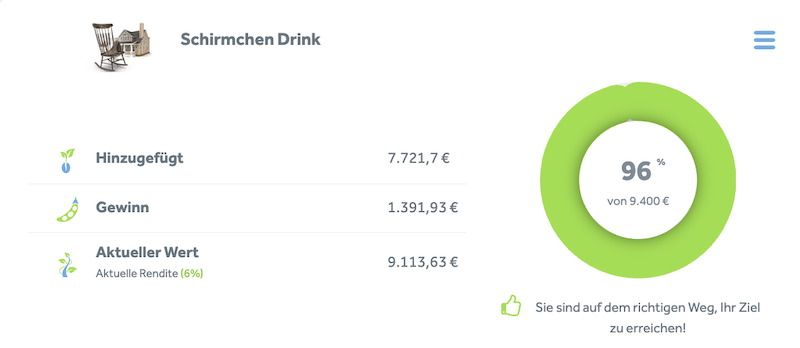
My Bondora Go&Grow portfolio is currently around €8,800, so a good four figures, and will certainly not make up the largest part of my P2P loans portfolio. A savings plan of €50 a month continues to run, but in the longer term I see myself at more like 6,000 than 10,000 €. For that reason I have already withdrawn quite a bit since the end of April and in part moved it to other platforms. Overall, Go & Grow has brought me around €1,910 in interest so far, and around €440 so far this year.
But liquidity is quite important to me and I like to use it for cashback promotions or for an expense planned for later, always with the knowledge, of course, that Bondora is not a substitute for a "call money account" either, because there is no deposit protection!
The Bondora risk FAQ
Despite the many years of experience and the reliable return so far, you should not lose sight of the risks at Bondora. I have summarised these P2P loan platform risks for you in the form of an FAQ, before I come to my Bondora conclusion.
How does Bondora make money?
Bondora earns its income mainly through various fees in connection with the loans it arranges. A substantial part of its revenue comes from administration fees, which are calculated as a percentage of the original loan amount.
Bondora also charges a fixed fee for arranging loans, which falls due at the start of the loan term.
Bondora* also offers additional services and earns good money from further fees when payments are late. In 2025 the lender Bondora AS took in 62.3 million euros this way, of which 32.3 million euros were administration fees. The credit risk itself is borne by the investors.
Is Bondora legitimate?
Bondora* has established itself as a reputable company. The lender Bondora AS is licensed in Estonia and supervised by the Estonian Financial Supervision Authority, and it also holds licences in other European countries. The investor product Go & Grow itself is not subject to any financial supervision. It was not entirely free of objections: in 2023 the supervisory authority issued an order concerning the creditworthiness assessment, and in 2025 a fine of 200,000 euros followed. With over 18 years of market experience and continuous profitability since 2016, I still consider Bondora reputable. Investments are of course always associated with a certain risk, which one should consciously come to terms with.
Is Bondora a safe P2P platform?
Bondora* is regarded as one of the safer P2P platforms, has successfully come through several crises and recessions and has been profitable for many years. Even so, investments in P2P loans generally involve high risks, up to and including total loss. That is why I only invest money here that I could afford to lose in an emergency.
Is Bondora profitable?
Yes, Bondora Group has been profitable since 2016, and in 2025, for the ninth year in a row, with a profit of 9.5 million euros. The financial stability of Bondora* is remarkable and is a big advantage over many other P2P platforms. The balance sheet shows very positive key figures, including an equity ratio of 74.7% and favourable values for liquidity and gearing. However, that applies to the group. The contractual partner Go&Grow OÜ is placed much more thinly, with roughly 3.6 million euros of equity.
Is Bondora Go & Grow an alternative to an instant-access savings account?
Looking at the up to 6% and the mostly available daily access, one might think Bondora Go & Grow*is better than any instant-access savings account. However, there is no deposit guarantee (usually 100,000 €). You invest indirectly in a loan portfolio and receive the good return for it. In exchange, you bear the corresponding lender risk. That is why, for me, P2P "instant-access savings" always belongs in quotation marks.
Is there a deposit guarantee with Go & Grow?
No. Go & Grow is not a bank account, but the purchase of loan claims with a right to sell them back to Go&Grow OÜ. According to the risk warning, the claims are neither guaranteed by a state fund nor secured in any other way. There is also no investor compensation scheme as with regulated securities firms. That is the decisive difference from a genuine instant-access savings account.
What impact would a Bondora insolvency have?
If Go&Grow OÜ, as your contractual partner, becomes insolvent, then according to the terms of Bondora* all new assignment and resale agreements end abruptly and the money in the user account is returned. The user receives all relevant information about the claims they hold. The validity of existing loan, assignment or resale agreements remains unaffected. Your claim to the buyback price then becomes due immediately, but it is a claim against the insolvent company. There is no named replacement service provider; Bondora only endeavours to transfer the administration of the loan agreements to another company. The terms contain no provision for the insolvency of the lender Bondora AS. All of this is as intended according to the provider, but it has never been tested.
Where do I find the Bondora tax report?
In the dashboard under the reports or "Statements". There you choose "Tax report" as the report type, then a single goal or "All" and the period, as PDF or Excel. Go & Grow does not withhold any withholding tax, and the income belongs in the Anlage KAP (the tax return form for investment income). When it counts as received for tax purposes, however, has not been conclusively clarified. If in doubt, a tax adviser can help.
Show all questions and the original answers
Bondora in the BaFin check: the six questions and Bondora's answers
After BaFin's action against Ventus Energy, five urgent questions needed to be clarified, and a sixth asked for a message to investors: deposit-taking business under § 1 KWG (the German Banking Act), legal safeguards, segregation of funds, dependence on banks and the consequences drawn from the Ventus case. Bondora answered the questionnaire via Triin Sarapuu (Chief Legal Officer, Go & Grow), although the last question remained open in the text received. These are the platform's own statements, which I have not independently verified. My assessment is AI-assisted and is neither a legal assessment nor one that would stand up in court.
- Do you plan a licence or supervision (e.g. ECSP licence, MiFID regulation or status as a payment institution)? If so, which one and by when? If not, why not?
The company says it continuously assesses the regulatory requirements in the markets in which it operates. On the basis of the current Go & Grow structure, there is no additional licence or authorisation to announce at this time, and the analysis rests on the specific claim assignment structure and the applicable local laws.
Beyond that, Go&Grow OÜ is subject to general rules, including the Estonian Consumer Protection Act, the Law of Obligations Act, the Commercial Code, the Accounting Act, the Competition Act and the GDPR. The company also says it regularly publishes financial updates, audited annual accounts and other disclosures.
No ECSP, MiFID or payment roadmap is named. - How is your contract structure set up for German investors, and do you see a § 1 KWG risk (deposit-taking business as with Ventus)? Have you had this legally reviewed?
The company says it cannot comment on the Ventus structure or on the BaFin assessment, as it does not know the details of the case. In general, the regulatory classification of a product depends on its specific legal structure, the contractual rights, the repayment mechanics, the allocation of risk and the communication.
The key point with Go & Grow is, it says, that the product is not structured as a loan agreement under which investors lend money to Go&Grow OÜ (formerly Bondora Capital OÜ) or have an unconditional right to repayment against Go&Grow OÜ. It is a claim assignment product: investors acquire exposure to claims that are directly linked to the underlying loans, and they bear the economic risk.
The company says it has reviewed the regulatory treatment of Go & Grow in Germany together with external local legal counsel and continues to review it. On the basis of this assessment, Go & Grow is not structured or operated as a deposit account, and Bondora does not conduct deposit-taking business in Germany via Go & Grow. - Are deposited funds and wallet balances legally separated from the company's assets (e.g. via a licensed payment institution or a trust/escrow arrangement)?
Client funds in Go & Grow would not be described as deposits, since Go & Grow is not structured or operated as a deposit account.
Client payment flows would be handled via dedicated bank accounts at AS LHV Pank and are separate from the operating funds of Go & Grow. These funds would only be used in line with the applicable terms of use and agreements.
A licensed payment institution or a trust/escrow arrangement is not named. - How dependent are you on individual banks and payment service providers, and what would happen if a bank connection were lost?
Go & Grow says it works with banks and payment service providers to process client payments. These relationships are managed as part of the normal operational and risk management processes. The focus is on ensuring secure, reliable and smooth payment processing for clients, in line with the applicable requirements and internal controls.
Specific details such as the number of banks or a failure scenario are missing. - Have you drawn concrete consequences from the Ventus case (contracts, structures, communication)?
The company says it cannot comment on the Ventus case in detail, as it does not know the particulars or the full basis of the BaFin assessment. The focus is on continuously assessing regulatory requirements in its own markets, acting in line with the applicable laws and rules, and operating Go & Grow clearly and responsibly for clients.
No concrete consequence attributable to the Ventus case is named. - Is there anything you would like to tell your investors right now?
No statement on this. This question is not answered in the text received.
My assessment: 36 out of 100 points for Bondora
On Q2, Bondora explains the Go & Grow claim assignment model in a legally clean way: I do not lend money to Go&Grow OÜ and have no unconditional right to repayment, but buy claims, and that is exactly the first of the three routes out of deposit-taking business. However, the evidence remains thin, because the external legal advice in Germany is mentioned without naming a law firm and without an opinion, so it remains a self-declaration.
On Q1, a licensing roadmap is missing: neither ECSP nor MiFID nor a payment licence is planned. The segregation of funds runs via dedicated accounts at the named AS LHV Pank, but via ordinary bank accounts rather than a licensed payment institution, and on dependence on banks and Ventus consequences Bondora retreats to a "cannot comment", while the message to investors is missing from the text entirely. In sum I arrive at 36 out of 100 points.
How Bondora compares with all the others and how the regulation score is calculated can be found in the overall evaluation: The big BaFin check at a glance.
What alternatives are there to Bondora Go&Grow?
Bondora, one of the most innovative and adaptable P2P lending platforms, has specialised completely in the one-click product Go & Grow. The Monefit SmartSaver works just as simply and with slightly more return, and one could almost call it a Go&Grow clone. Also brand new is Modena, which follows a very similar model with attractive interest rates.
Nevertheless, there are other investment options such as Esketit and Twino, with in some cases considerably higher returns. And of course Mintos, a Latvian platform that follows a completely different concept as a marketplace. Anyone interested in the highest P2P lending returns (German) currently cannot, of course, get around Lendermarket.
You can find detailed information on these and many other options on my blog and in the comparison of P2P platforms
My Bondora conclusion
I am impressed by the Bondora* management, by how they recognised the signs of the times and focused on Bondora Go&Grow. In doing so they killed two birds with one stone: a simple product with interest rates that are attractive to many investors, which also secures a better margin for themselves. Bondora is profitable, as we have seen, despite strong growth (in staff) and I assume that this will remain so in future.
What will be interesting for me is how the separation of Bondora and Go & Grow plays out. In everyday use I have noticed nothing so far, and the payouts are running as usual. Structurally, however, my money is now tied to a separate, thinly capitalised company, and I am keeping an eye on that. Let's see.
Until then I will remain a more or less intensive user of Go&Grow. Currently there are around 8,800 euros in the account, and at its peak in April it was 13,300 euros. This fluctuates, as is normal on a flexible account that is used for taxes, special offers and opportunities ;)
To say it once more: Bondora Go&Grow is not a savings account and not an identical alternative to one, if only because there is no deposit protection. But you will already know that after reading this article anyway...
What is your experience with Bondora*? Are you also a satisfied Bondora investor, or have you had less good experiences of your own with Bondora?
My Bondora position (as of 03 Nov 2026)
- Invested since
- 19 Jun 2017
- Invested (net, rounded up)
- €6,500
- Interest received (rounded up)
- €2,760
- Return (XIRR) since start
- 8.1%
All figures for Bondora My P2P investing in numbers
My own money, shared for transparency. Not a recommendation. Past returns do not guarantee future results.
Sign up with Bondora: €5 starting balance directly after sign-up*
Editorial note: This review reflects my personal experience as an investor. Commissions from affiliate links do not influence my assessment or the platform rating.