Afranga Review: earning up to 16% interest with Bulgarian P2P lenders!
Translated from the German original, last updated 11 Nov 2026. Read the original (German)
My Afranga review is now based on a good five years: first on the old platform, and since July 2025 on the new, licensed one. Afranga is a P2P platform from Bulgaria with an ECSP licence, where you grant loans to lenders. Most of them come from Stikcredit and its affiliated Lendivo and Tiberus, plus independent lenders such as Credirect, Lev Credit and Swiss Funds.
Since the restart in March 2025, interest rates have regularly been 8 to 14% p. a., and in promotions there were rates of up to 16%. In 2026 two new features were added that change liquidity: an early partial payout on the fixed-interest product SaveSmart (since 01.08.2026) and a secondary market for the primary market loans (since 27.08.2026).
- Term: 12 months (SaveSmart)
- For whom: New customers / new money
- Bonus: Level 1: target 1,000 € in SaveSmart = €15; Level 2: target 2,000 € = €40; Level 3: target 4,000 € = €100
- Tiers:
- Target 1: 1,000 € in SaveSmart = €15
- Target 2: 2,000 € in SaveSmart = €40
- Target 3: 4,000 € in SaveSmart = €100
- How it works: I invest new money in the 12-month SaveSmart and reach one of the three levels by 30 November. Money already invested does not count, nor do the 3- and 6-month terms.
- Payout: December, into the wallet
- Important: The bonus level is individual. New money only, 12-month SaveSmart only; 3- and 6-month terms do not count.
This item describes a promotion by the provider, such as a bonus or cashback. It reproduces the provider's statements and is not a recommendation. The provider's terms apply.
Afranga: data at a glanceAs of 12 Nov 2026
- My platform rating
- 59 out of 100, rank 15 of 46
- My return (XIRR)
- 14.28%
- Investors
- 9,051
The key Afranga data in the fact sheet
Before going into detail, here is an overview of the most important and relevant data on the P2P lending platform Afranga (platform figures as of 2026-11-10):

| Founded | AFRANGA EOOD registered 29.12.2020; platform since 2021, relaunched under ECSP 03/2025 |
| CEO | Svetlin Nikolov Sabev, Managing Director and sole shareholder |
| Regulated | yes, ECSP (Regulation 2020/1503), FSC decision of 12.09.2023, status "Active" (Quelle) |
| Investors | 9,051 registered (2026-11-10) |
| Headquarters | Sofia, Bulgaria (AFRANGA EOOD) |
| Collateral | Lender loans: no specific collateral (general liability); SaveSmart Business: none |
| Return | Regular 8 to 14%, promotions up to 16%; all rates gross before 10% withholding tax |
| Buyback guarantee | No (since relaunch); only guarantee: Stikcredit for Tiberus loans |
| Secondary market | Yes, since 27.08.2026; price 85-115%, from €100, fee-free |
| Liquidity | Exit only via secondary market (no guarantee); SaveSmart up to 30% early, 1% fee |
| Loan types | Business loans to lenders (consumer, property, leasing finance); property development loan |
| Financed loan volume | 45.24m € invested by investors (2026-11-10) |
| Minimum investment | €10 per investment (Marketplace and SaveSmart); secondary market €100 |
| Investment strategies | Manually on the primary market; SaveSmart with re-invest switch; no auto-invest |
| Rating | P2P Rating: 59/100 (rank 15 of 46) |
| Platform risk rating | 76 out of 100 points in my P2P rating |
| Loyalty program | No |
| Withholding tax | 10% Bulgarian, flat rate; in DE, according to Afranga, only 5% creditable |
| Annual report | Platform: none published; Stik-Credit AD and Lendivo: audited 2025 (Quelle) (Quelle) |
| New customer bonus | 0.5% cashback for 90 days (via this link*) |
Figures from the platform's website, its reports and public registers, as of 11 Nov 2026. Not every figure can be independently verified.
The two latest Afranga news items
Afranga informs us investors via its own blog, but not every change ends up there: for the launch of the secondary market on 27.08.2026 and for the Stikcredit guarantee for Tiberus of 31.08.2026, there was no blog post up to the end of September. Here are the two latest Afranga news items for you:
- Afranga compares savings account interest of 1.52% with its SaveSmart product offering up to 10%
Afranga's blog post calculates what savings earn at an average 1.52% annual rate. It presents its SaveSmart product, with rates of 8%, 9% or 10%, as an alternative, and notes the risk of loss and the absence of deposit protection.Telegram - Afranga World Savings Day draw: Martial from France wins EUR 3,000 first prize
Afranga held a live prize draw on 31 October, World Savings Day, with three winners. Martial from France, who had only recently begun investing, won the first prize of EUR 3,000. The post relays his views on saving and investing.Telegram
What is Afranga?
Afranga is a Bulgarian P2P platform that came back in March 2025 with a new concept after a longer break. The operating company AFRANGA EOOD has been authorised as a European crowdfunding service provider (ECSP) by the Bulgarian financial supervisory authority FSC since 12.09.2023, and the actual relaunch under this licence took place in March 2025. The licence provides rules on information, investor protection and segregation of funds, but it does not protect against losses.
In the current model, with each investment you enter into a direct loan agreement with the respective lender. There is no security, no bundling into investment products and no collateralisation through loan portfolios. The lender, e.g. Stikcredit, is liable with its company assets and uses the money to refinance its own consumer loans. Classic individual loans to end customers no longer exist on the platform.
A buyback guarantee like in the past no longer exists, and the credit risk lies with you as an investor. The lender remains responsible for receivables management and the handling of its end customers. The platform is deliberately kept lean: investments are possible from 10 euros, and there is no auto-invest so far. For investors, Afranga is therefore a licensed way to invest in Bulgarian lenders, with a clear focus on Stikcredit, now six lenders and full credit risk.
With SaveSmart (since February 2026) and the Real Estate Loans (since June 2026), Afranga has grown beyond pure consumer loans. The lean Stikcredit platform is gradually becoming a small multi-asset platform with fixed-interest and real estate products under one roof.
Since August 2026 there have also been two ways to get at your capital before the end of the term: the early partial payout for SaveSmart (since 01.08.2026) and the secondary market for loans from the primary market (since 27.08.2026). Both have limits, and I describe both in their own chapters further below.
Afranga key figures & facts as of 2026
Since the relaunch, investors have invested a cumulative total of around 43.4 million euros via Afranga up to 25.09.2026, including reinvestments. In this time the new platform has paid out 3.53 million euros in interest. Interest is normally 8 to 14%, and in time-limited promotions it was up to 16%. According to Afranga, the average return per lender is between 8.97% (Lev Credit) and 11.58% (Lendivo).
So far, 8,422 investors have invested via the new platform (cumulative). Currently six lenders are active: Stikcredit, Lendivo, Credirect, Lev Credit, Swiss Funds and Tiberus, plus one real estate project.
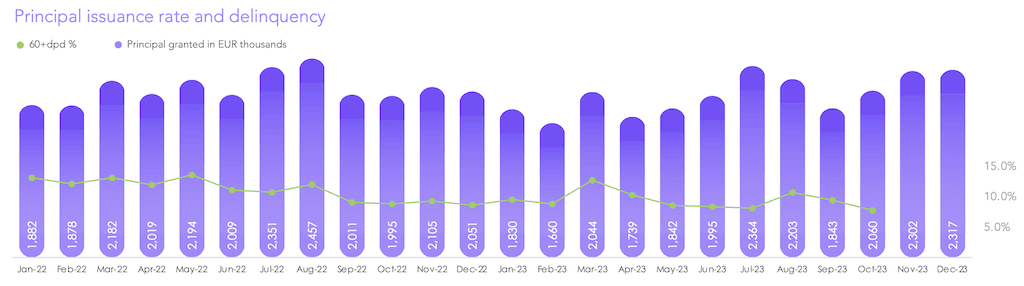
Statistics and lender reports are published regularly, which provides transparency. The statistics are even updated daily. The arrears statistics show 100% of loans on time. What lies behind that is explained in the chapter on the loan portfolio.
Who runs Afranga?
Afranga is run by Svetlin Sabev. He is managing director and sole shareholder of AFRANGA EOOD, based in Sofia, which has existed since the end of 2020.
Organisationally, Afranga is therefore a separate company. Economically and in terms of personnel, however, it remains closely connected to the lender Stik Credit, which has been on the market since 2013, is registered with the Bulgarian National Bank as a non-bank financial institution and regularly publishes annual reports. How close this connection is, is covered in the chapter on Stikcredit.
Svetlin Sabev has been founder & CEO of Afranga since February 2021.
At the same time, he is co-founder & CEO of Lendivo (since April 2024), co-founder of Tiberus and investor at WorkFactory (both since February 2024).
At Stik Credit he started in 2018 as Business Development Manager and has been a member of the management board and COO since December 2021. Before that he was a consultant at Vitol; he studied International Business Management (HFU) and Financial Services (Edinburgh Napier).

Afranga registration and the welcome bonus
Registering with Afranga is simple and structured similarly to other well-known P2P platforms. The website is now also available in German, along with a German-language telephone hotline. The platform guides you through the registration process step by step:
- Start registration
Click on Create Account on the Afranga home page. - Enter your personal details
Enter your email address and set a secure password. - Email confirmation
Check your inbox and confirm the verification email from Afranga to continue. - Complete the identification process
Carry out the final identification by uploading a valid identity card or passport to fully activate your account. - KYC and AML
Additional information (Know Your Customer) may be needed to meet regulatory requirements. This includes a knowledge test and a loss simulation, as required by the ECSP regulation.
You may also have to prove the origin of the deposited funds (anti-money laundering, AML).
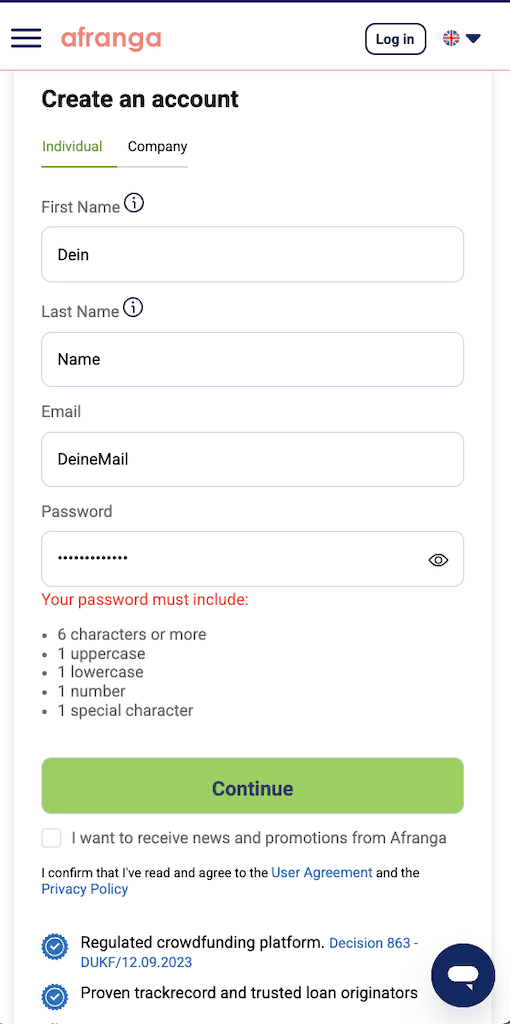
It is enough to register via my Afranga link* to receive the new customer bonus. A promo code is not needed.
To invest with Afranga, you must be at least 18 years old. You also need citizenship or permanent residence in the EU, the EEA or Switzerland.
After you have registered successfully and made a deposit, you can invest in projects on the platform. Depositing money is straightforward: in the account dashboard you will find the Add Money button, where you get all the necessary SEPA details and can then simply make a transfer.
The first deposit must come from a personal bank account in your own name, as this is verified for payouts via the payment service provider Lemonway. Each investor has their own payment account there, so uninvested funds are not on Afranga's balance sheet. Card payments are not currently possible. In my experience, credits by SEPA bank transfer take 1-2 working days, while SEPA instant transfers are faster.
What matters is that the deposit comes from an EU account in your own name.
An additional bonus for new investors
When you register for the first time via my blog, you receive a welcome bonus in the form of 0.5% cashback on your investments in the first 90 days, if you use my Afranga bonus link*.
Separately from this, Afranga has its own open-ended referral programme: anyone who joins through the referral of an existing investor and invests at least €1,000 in SaveSmart or on the primary market within 30 days of verification receives €50, and so does the referrer. Secondary market purchases do not count towards this. I collect the time-limited promotions of all platforms on my bonus page.
Investing with Afranga
With Afranga, you invest manually on the primary market, take over loans on the secondary market, or invest via SaveSmart. I am currently invested with around 9,300 euros on Afranga.
Investing on the primary market at Afranga
On the primary market, you invest manually in the lenders' offers.
The market view is clear, and simple filters help with the preselection (e.g. interest rate, term, lender/country). In the detail view you will find the key data on the offer.
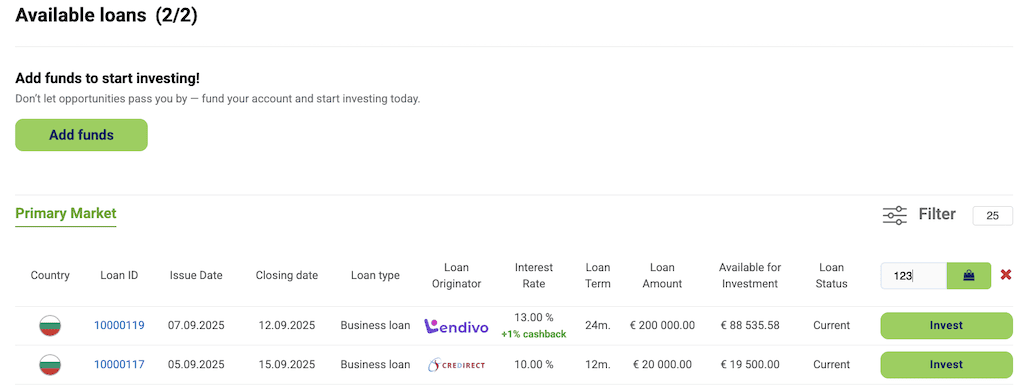
- Lender and country (focus: Bulgaria; also the Czech Republic)
- Interest rate (regularly up to 14%, up to 16% in promotions)
- Term (usually 1-3 years)
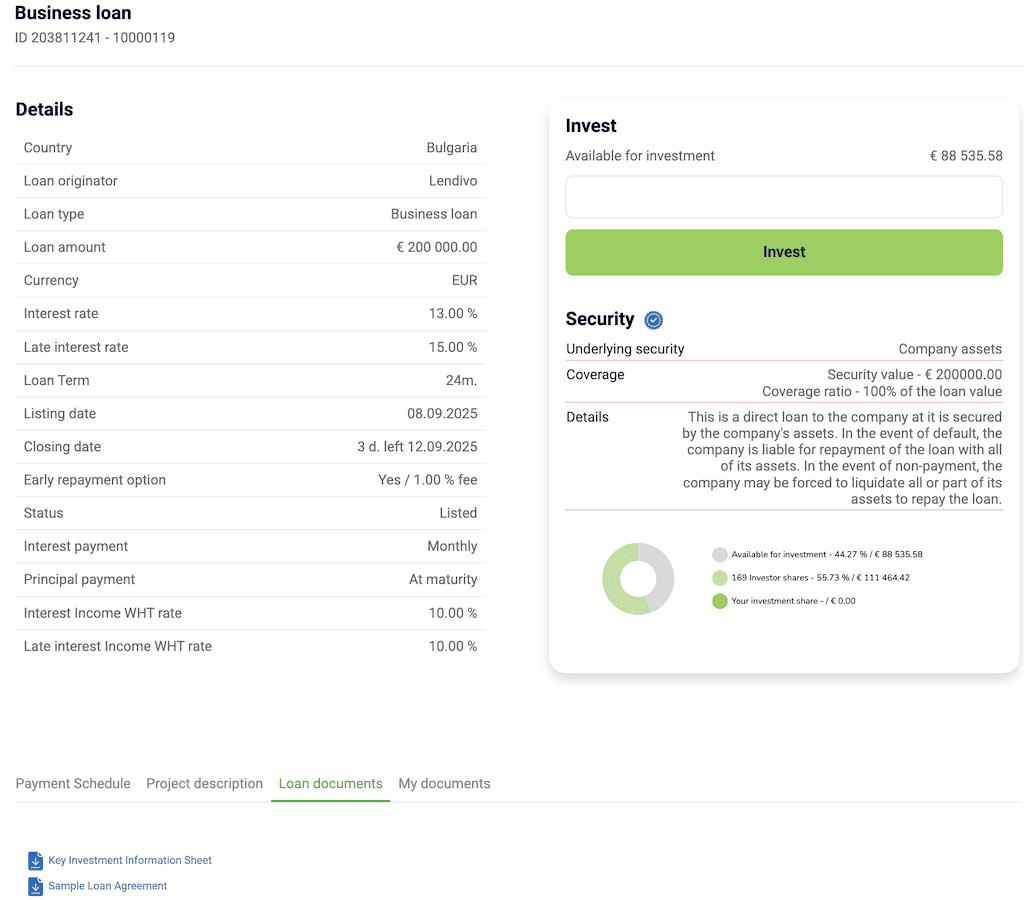
The detail pages are presented cleanly; you can filter the offers beforehand and look deeper if needed. All relevant documents are also stored there, above all the KIIS document with the key terms of the loan.
If you decide on an investment, you enter the desired amount (minimum investment €10) and invest with one click.
Afranga also offers an Invest all button on the market page, which lets you invest your available balance in all currently matching offers with one click. Handy if you also want to take every loan that is offered.
What you can keep in mind for the primary market: these loans run to maturity, and before that you can only get out via the secondary market. The early payout at a fixed rate applies only to SaveSmart.
The Afranga secondary market
Since 27.08.2026, Afranga has had a secondary market again. Legally, it is a so-called bulletin board under Art. 25 of the ECSP Regulation: you indicate there that you want to sell a loan or a share of a loan, and another investor can take it over. Afranga itself is not a trading venue, does not match orders and does not buy itself. Each transfer is a transaction directly between seller and buyer.
The rules of the Afranga secondary market
- The price is between 85 and 115% of the outstanding capital at the time of the offer.
- The minimum amount is €100, and smaller remainders can only be sold in full.
- Accrued interest that has not yet been paid stays with the seller, apportioned to the day.
- According to the price list of 01.08.2026, the secondary market is free of charge, but the terms and conditions allow for future fees.
- SaveSmart investments cannot be offered on the secondary market.
- Afranga guarantees no liquidity: if no buyer is found, you hold the loan until the end of its term.
For loans from the primary market, this is the first exit before the end of the term since the relaunch. How liquid this market is in practice, meaning how many offers there are and what discounts sales actually happen at, is not published by Afranga. A worked example does show what a discount costs: anyone who sells a loan paying 14% interest at a 5% discount gives up a good four months of interest.
A nice detail: at the end of September, the FAQ on the Afranga website still claimed that investments from the primary market cannot be redeemed before maturity. The terms and conditions of 27.08.2026 are what count, and they cover the secondary market in a section of its own.
Investing with the Afranga Auto-Invest
There is still no Auto-Invest at Afranga. It was announced in May 2025, and the current terms and conditions of 27.08.2026 still only list it as a function that Afranga “may introduce in future”. Until it arrives, investing remains manual on the primary market.
Part of the gap has been closed in the meantime, though. SaveSmart offers an Auto-Reinvest (capital automatically rolls over after maturity) and an early partial payout. This does not replace an Auto-Invest, but it makes the platform clearly less demanding to look after.
SaveSmart: the fixed-interest product at Afranga
Since February 2026, Afranga has offered SaveSmart (not “Safe Smart”, even though the name sounds like it) as a second investment model alongside the classic primary market. SaveSmart is a fixed-interest product with monthly interest payments, intended for investors who prefer a simpler and more predictable alternative to buying loans manually. During the year, however, Afranga has changed the product considerably: a fixed interest scale by term, a second variant with a real estate loan and the early payout.
This is how SaveSmart currently works:
- Terms and interest: 3 months at 8% p.a., 6 months at 9% p.a., 12 months at 10% p.a. You see the fixed interest rate before investing. At the launch in February, according to the website data at the time, 6 and 12 months were still at 10% and 12% respectively; by mid-April 2026 at the latest, Afranga lowered them to today's rates without an announcement of its own. The advertising still shows an “up to 12%” alongside, but the investment calculator lists these three levels.
- Bullet structure: interest is paid out monthly to your Afranga wallet, and the capital is repaid in full at the end of the term.
- Early payout: since 01.08.2026 you can access part of your capital at any time. The exact limits are in the next section.
- Auto-Reinvest: optionally, the capital is automatically reinvested at maturity at the interest rate valid at that time. You will find the Reinvest switch on the loan detail page.
- Security: SaveSmart comes in two variants. The standard variant (Business) is a loan to Stikcredit without special security, and Stikcredit is liable only with its company assets. The label “Real estate secured” belongs solely to the Real Estate variant (see below). The details of each loan are in the KIIS document.
- Lender: in the standard variant still exclusively Stikcredit. Further providers and products are meant to be added.
- Minimum investment and denomination: from 10 euros. Several investments with identical parameters on the same day can be combined into one position, and limits may apply against excessive fragmentation.
- Regulation: SaveSmart remains fully within the ECSP framework. For non-experienced investors, a 4-day reflection period with a right of withdrawal applies.
SaveSmart is not a bank deposit product and is not covered by deposit protection. As with all investments on Afranga, there is a risk of losing capital, and the new payout option does not change that. However, anyone looking for a hands-off approach with predictable interest income will find a complement here to active marketplace investing.
Early payout with SaveSmart: how liquid Afranga really is
Until now, the rule with SaveSmart was: capital goes in, capital stays in until the end of the term. Since 01.08.2026 that is over, though only in part.
The rules of the early payout in detail
- You can request a payout at any time during the term, without waiting for a buyer.
- The upper limit is 30% of your SaveSmart investment.
- In addition, an absolute maximum of 5,000 euros applies.
- If 30% of your investment is below 100 euros, you can still get up to 100 euros, provided you have invested at least 100 euros.
- A fee of 1% of the requested amount applies to every early payout.
What does that mean in practice? With 10,000 euros in SaveSmart, you can get at most 3,000 euros, which costs you 30 euros in fees. The remaining 7,000 euros stay locked in. With 20,000 euros, 30% would come to 6,000 euros on paper, but the 5,000 euro limit applies here. And with a 200 euro position it is 100 euros, because the minimum rule applies. So anyone planning to be able to withdraw most of their money at short notice is mistaken here. It is a liquidity buffer, not an emergency exit.
Even so, for me this is an important step forward at Afranga since the restart. A one per cent fee on a partial amount is cheap compared with the discounts I see on some secondary markets. And unlike on the secondary market, there is no "price" that depends on whether someone happens to want to buy.
The 1% does look different, however, if you leave after two months: calculated on a 3-month position at 8%, the fee eats up around one sixth of the interest on the part paid out. For my own split between the primary market and SaveSmart, that does make a difference.
Afranga communicates the payout as working without a buyer search. It is, however, contractually governed by the SaveSmart terms, which are not public, and Afranga does not say who finances the payout in a real emergency.
Real Estate Loans: property loans at Afranga
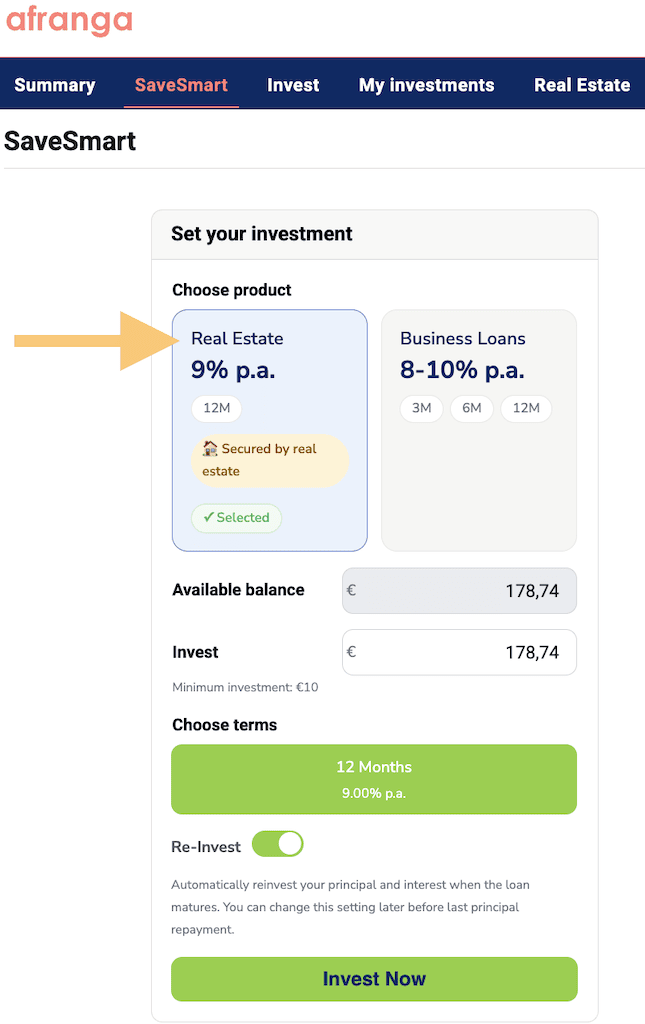
Since June 2026 Afranga has had a third product line: Real Estate Loans, that is, property loans. They run through the SaveSmart area, but economically they are something different from the pure Stikcredit fixed rate. With a Real Estate Loan, several investors jointly finance a property development project. You lend capital to the project developer and receive a fixed interest rate for it, with monthly payout to your wallet. The loan is meant to be secured by the plot of land that the project developer intends to acquire. What of this is evidenced is stated further down for the specific project.
As with SaveSmart, the full ECSP framework applies: before investing you can view the Key Investment Information Sheet (KIIS) and the loan agreement, and for non-experienced investors the 4-day reflection period with a right of withdrawal applies. You invest in the same way as with the fixed-rate product: log in, open SaveSmart in your account and select Real Estate there.
The basic terms: fixed term, fixed interest, monthly interest payment. You cannot offer the loan on the secondary market, because it runs through SaveSmart. The announced Quick Liquidity feature has been implemented as an early payout in the SaveSmart area. Whether and in what form it applies to an individual property loan is stated in the relevant KIIS.
The Afranga fees
For investors, there are no ongoing fees: account maintenance, deposits, investing and the payout of the wallet balance are free of charge. According to the price list dated 01.08.2026, the secondary market is also free of charge, but the terms and conditions allow fees to be charged in future according to the price list. The one exception is the early payout from SaveSmart, at 1% of the amount requested. Afranga is paid by the lenders and project developers, more on this in the risk FAQ.
The tax topic at Afranga
Afranga is licensed (ECSP), so the alternative taxation does not apply. Bulgaria withholds 10% withholding tax on interest income, which the lenders pay as a flat amount. A certificate of residence therefore does not help.
According to an Afranga newsletter:
"For German investors, Afranga interest is fully taxable in Germany as foreign investment income and must be declared in the Anlage KAP (German tax return form for investment income) at the gross interest amount. In the tax return, up to 5% of the withholding tax retained in Bulgaria can be credited under the German-Bulgarian double taxation agreement (DBA)."
The tax certificate for 2025 has been available since February 2026 and can be retrieved in your profile under Settings → Tax Statements.
The Afranga loan portfolio: what are you actually investing in?
On Afranga you fund loans to lenders, not individual end loans (see "Was ist Afranga?"). Classic short-term loans in the payday sense are not the main focus: the offers come with a clearly stated term, mostly between one and three years, and a fixed interest rate, regularly up to 14%.
Because there is no buyback guarantee, no 60-day buyback logic applies if the originator defaults. What matters is the creditworthiness and profitability of the lender. The lenders provide detailed reporting on this, which can be reached via the Afranga lender page.
The picture for the end customers is different from what the Afranga statistics suggest. In its presentation for the first half of 2026, Stikcredit reports an arrears rate from 60 days of 10 to 13% per loan vintage. The audited annual financial statements for 2025 show an even clearer picture: 56.6% of the gross loan portfolio was more than 90 days overdue, and in 2025 Stikcredit wrote off no loans (in 2024 it was still 8.32 million BGN).
The Afranga statistics nevertheless show 100% on-time loans. That is not a contradiction: they measure the loans to the lenders, not to their end customers. As long as Stikcredit pays, they stay green.
In terms of countries, the focus is on Bulgaria, with offers from the Czech Republic also available as a supplement. Afranga is therefore more concentrated than many marketplaces; diversification takes place mainly across lenders and loan terms within this framework. Interest rates and availability can fluctuate, and the offering is rather slim overall, which can lead to cash drag with larger sums.
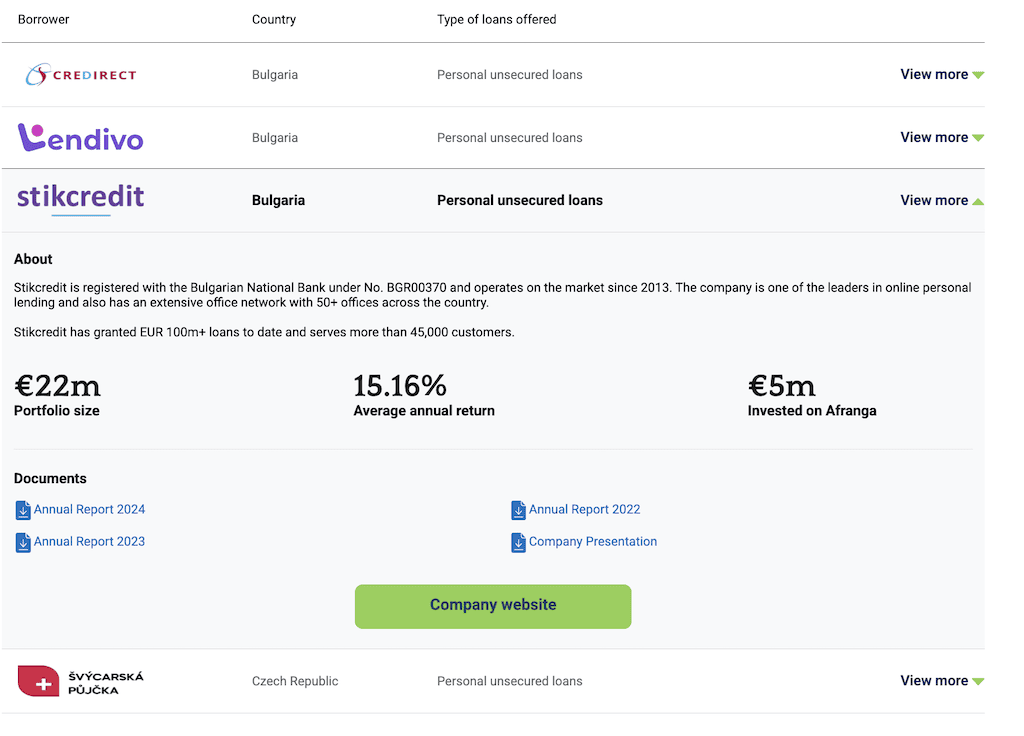
The individual lenders at present are (key figures according to the lender page, as of 25.09.2026):
- Stikcredit (Bulgaria): Registered with the Bulgarian National Bank as a non-bank financial institution under no. BGR00370, on the market since 2013. One of the leading providers of online personal loans, with a nationwide branch network of 50+ locations. Loan volume originated is over EUR 100 million according to Afranga and over EUR 200 million according to its own presentation, with over 45,000 customers. Portfolio: €22 million, Invested: €5 million (for the actual amount, see the chapter on Stikcredit). Average return: 10.67%. By far the largest lender and the only originator behind SaveSmart Business.
- Lendivo (Bulgaria): Fintech for consumer loans issued entirely online, launched in April 2024, part of the Stikcredit group (see the table in the chapter on Stikcredit). According to the audited 2025 financial statements, profit was BGN 334,000 (the self-set target was over BGN 1 million). 58% of the gross portfolio is more than 90 days overdue, the loan loss allowance is 67% and the equity ratio is 13.8%. As of 30.06.2026, Lendivo had receivables from related parties of €2.70 million, which is 140% of equity. Portfolio: €2.3 million, Invested: €4.4 million. Average return: 11.58%.
- Credirect (Bulgaria): Online lending platform since 2017, part of the international financial group MV Finance LTD. Payday loans up to €700 and instalment loans up to €5,100, over 30,000 active customers. Portfolio size: €5.9 million, Invested: €113,900. Average return: 9.86%.
- Lev Credit (Bulgaria): BNB-registered (no. BGR00421), eight branches plus a digital network. Offers payday and instalment loans up to €2,500 as well as secured loans up to €50,000. Special feature: according to the lender page, about 60% of the portfolio is secured by a first-ranking mortgage with an LTV of max. 50%; in the 2025 financial statements it is 54% of consumer loans and all business loans. According to Lev Credit, the secured loans have so far had a default rate of 0%. Over 1,600 active borrowers, more than 10,000 loans issued. Portfolio size: €1.2 million, Invested: €294,700. Average return: 8.97%.
- Swiss Funds (Czech Republic): Non-bank provider, operating the Swiss-Loan platform under ORKA Group Management since 2022. Short-term consumer loans with terms of 15 to 30 days. Licensed by the Czech National Bank, part of Orka Ventures Ltd. Over 16,000 users. Portfolio size: €1.4 million, Invested: €148,400. Average return: 10.49%. The only originator outside Bulgaria.
- Tiberus (Bulgaria): Car financing company (used car leasing), BNB-registered, part of the Stikcredit group. Enables vehicle financing within 24 hours via digital and physical locations. The end-customer contracts are secured by the vehicle, so the risk profile differs from pure consumer loans. However, Tiberus is making losses: −€292,000 in financial year 2025 and −€280,000 in the first half of 2026, and the equity ratio was 6.1% as of 30.06.2026 (unaudited). Since 31.08.2026, Stikcredit has guaranteed all Tiberus loans on Afranga (see below). Portfolio size: €11 million, Invested: €2.9 million. Average return: 10.82%.
On the key figures: Portfolio probably means the lender's loan book; Afranga does not explain what Invested means. For Lendivo the value is above the portfolio, which points more towards a cumulative figure; for Stikcredit it is far below the amount actually outstanding. I therefore reproduce the values as Afranga shows them.
SaveSmart, at 8 to 10%, is below the interest rates on the loans to the lenders, but there you get the partial liquidity. Our loan terms naturally differ considerably from those of the end customers.
There is no group guarantee between all lenders: each claim is a loan to the respective lender. The only exception since 31.08.2026 is the guarantee from Stikcredit for Tiberus, more on this in the chapter on Stikcredit.
The first real estate project: Modern Housing, Ovcha Kupel
Alongside the consumer loans, since June 2026 you can also invest in a specific real estate project. The first one is called "Modern Housing, Ovcha Kupel" and is located in the west of Sofia. The plan is for 315 furnished one-room studios with a kitchenette and private bathroom, spread across two four-storey buildings with a central green space and a solar roof. The target group is students and young professionals near the New Bulgarian University. The plot is 8,072 m², three metro stations are within walking distance, and according to the project documents the planned rents start at 350 euros per month.
| Interest rate | 9% p.a. fixed |
| Term | 12 months |
| Interest payment | monthly to the Afranga wallet |
| Security | according to Afranga, the building land to be acquired (8,072 m²); registration and ranking of the mortgage not publicly evidenced |
| Loan-to-value (LTV) | 66%, the land value covers the loan about 1.5 times |
| Additional security | Guarantee from Lendivo, not evidenced in the public documents |
| Early exit | via the SaveSmart rule (up to 30%, max. €5,000, 1% fee); details in the relevant KIIS; no secondary market |
| Project status | Feasibility, legal review and concept design completed; land purchase planned for August 2026 according to Afranga, not reported as completed by 25.09.2026; then 36 months of construction |
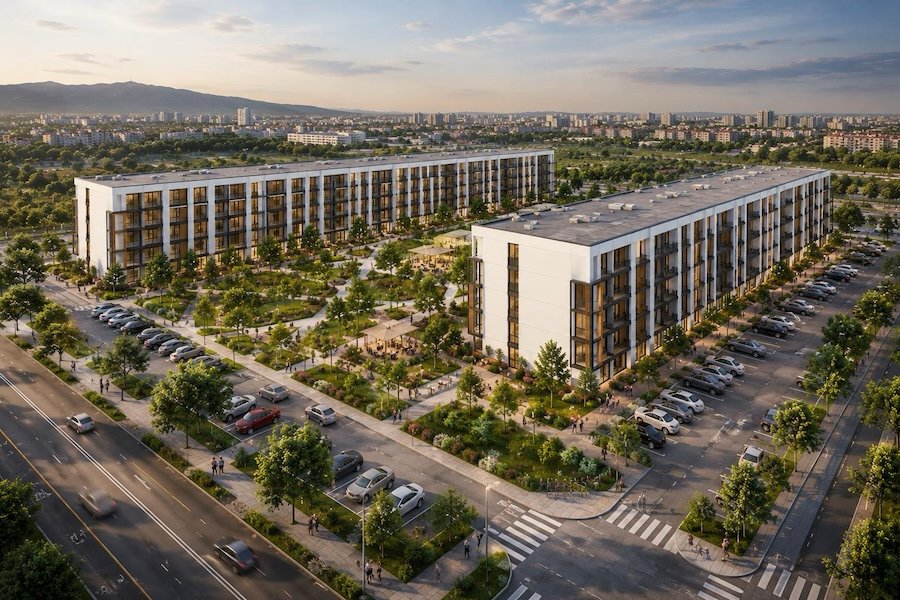
What to bear in mind: A development project has a different risk profile from consumer loans, and you should know that.
- The loan finances only the land purchase, not the construction. Construction is to be funded through the project sponsor's equity and separate bank financing. So you are financing the land, not the finished building.
- This raises a question of term: the loan runs for 12 months, while the project with construction takes 36+ months. Rental income is therefore years away. Your loan is to be repaid from follow-on financing or from the project sponsor's equity. If the construction financing does not come through, repayment is also under pressure.
- The additional guarantee is meant to come from Lendivo, that is, from a related party in the same group as Stikcredit and Afranga (see the section on interconnections). It does not appear in the public documents (blog, project page, presentation). Who the project sponsor itself is does not emerge clearly from the documents.
- The security is meant to be the undeveloped building land, which according to Afranga was independently valued (LTV 66%). On paper that gives coverage of roughly 1.5 times. As long as the purchase is not completed and the mortgage is not registered, the loan is effectively unsecured. In an enforcement scenario, raw land is also harder to sell, often below value, and enforcement in Bulgaria can take time.
- The early payout covers 30% at most, and there is no secondary market for this loan. The bulk of your capital therefore stays firmly locked in.
By comparison, on real estate platforms such as Profitus* or InRento* you get similar or higher interest, although often on completed or let properties and with a much longer track record. What Afranga has going for it is the geography: Bulgaria instead of the Baltics is genuinely a diversification you do not get with the Lithuanian platforms.
For me this is a strategically interesting step. At 9% for a development project with these risk points, though, it would have to be at least 10% for me, even with the new partial liquidity behind it. The Stikcredit loans at 14% fit better for me. Above all, I will be watching whether the land purchase is reported and how the first loan is repaid once the follow-on financing falls due.
Stikcredit: Who is behind the main lender?
Stik-Credit AD is a Bulgarian consumer lender from Shumen, on the market since 2013 and registered with the Bulgarian National Bank as a non-bank financial institution, not a bank. Stikcredit operated the first Afranga platform itself from 2021 and is still by far the largest lender.
The lender page shows only €5 million Invested. By my calculation from the half-year balance sheet, however, Stikcredit holds around €22 to 23 million of Afranga money, SaveSmart included, so a good three quarters of the outstanding Afranga volume. Anyone investing with Afranga is therefore mainly investing in Stikcredit.
Stikcredit balance sheet analysis: How solid is the anchor lender?
For 2025 there are audited annual financial statements (audited by Zaharinova Nexia, a member of Nexia International, one of the top 10 audit networks worldwide, with an unqualified audit opinion). In addition there are the unaudited half-year figures as at 30.06.2026.
Note: Stikcredit reported in Bulgarian lev (BGN) until the end of 2025; Bulgaria has been in the euro area since 01.01.2026. The conversion rate is fixed: €1 = 1.95583 BGN. All euro figures have been converted accordingly.
| Key figure | 2023 | 2024 (audited) | 2025 (audited) | H1 2026 (unaudited) |
|---|---|---|---|---|
| Net profit | 2.96 Mio. € | 3.49 Mio. € | 2.25 Mio. € | 1.46 Mio. € |
| Return on equity (ROE) | 24.0% | 22.8% | ~14% | – |
| Return on assets (ROA) | 13.6% | 12.3% | ~6% | – |
| Equity ratio | 56.6% | 54.0% | 44% | 37.2% |
| Debt-to-equity ratio (liabilities/equity) | – | – | 1.27× | 1.69× |
| Loan portfolio (net) | 11.74 Mio. € | 14.58 Mio. € | 16.06 Mio. € | – |
| Total assets | 21.80 Mio. € | 28.32 Mio. € | 35.3 Mio. € | – |
| Equity | 12.35 Mio. € | 15.28 Mio. € | 15.5 Mio. € | 17.05 Mio. € |
| Liabilities to platforms | 8.22 Mio. € | 11.48 Mio. € | ~17.7 Mio. € | 26.88 Mio. € |
| Dividend (resolved) | €0.77m | €0.55m | €1.94m | – |
What do the numbers say?
Stikcredit is consistently profitable, now for the third audited year in a row. However, net profit in 2025, at €2.25m, fell clearly below the previous year (€3.49m). The reasons: higher loan losses (impairments of −13.9m BGN vs −9.9m in 2024) and higher staff costs, which is to be expected given the pace of growth. In the first half of 2026, an unaudited €1.46m was added.
Total assets grew by 25% in 2025 to €35.3m. The loan portfolio rose to €16.06m net. A considerable part of this growth is financed with debt, including through us investors: platform liabilities rose from €11.5m to around €17.7m and, by mid-2026, further to €26.88m. Stikcredit has no bank loans; its financing runs entirely through crowdlending platforms.
As a result, the equity ratio has fallen further: from 54% (2024) to 44% (2025) and, by mid-2026, to 37.2%, while the debt-to-equity ratio rose to 1.69×. By industry standards this is still solid, as many P2P lenders are considerably more heavily indebted. But the trend is clearly downward, and it is worth watching whether it stabilises.
The dividend stands out: for 2025, €1.94m was resolved, which is 86% of profit; €1.85m was paid out in 2025. So a large part is distributed rather than retained. This also explains why equity hardly grows despite profitability.
Receivables from related companies: At the end of 2025, Stikcredit had lent around €11.8m to related companies and persons, which is 75% of equity. By 30.06.2026 the amount rose to €14.46m, or 85% of equity.
According to the financial statements, these loans were granted without collateral. Recipients include Sabevs SN Investment (2.43m BGN), shareholder Topuzakov personally (1.70m BGN) and Tiberus (€5.56m). The half-year presentation, by contrast, speaks of real estate collateral of around €15m; the audited financial statements contradict this. In doing so, Stikcredit is financing its own corporate network to a considerable extent.
My conclusion on Stikcredit: Profitable for years, audited reports, but the key figures are getting weaker: equity ratio down, debt-to-equity ratio at 1.69×, high distribution, unsecured loans to related parties and, since August, the guarantee for Tiberus. I am watching this closely, but for me the substance is still there. Stikcredit remains the strongest lender on the platform for me, and that is why almost all of my Afranga investment is placed there.
For SaveSmart, this balance sheet is particularly relevant. After all, the early payout is only worth as much as Stikcredit is able to honour it if in doubt. It is not a secondary market with outside buyers, but a commitment from the counterparty.
Owners and interconnections of the Stikcredit group
The same people stand behind Stikcredit, Lendivo and Tiberus, and Afranga head Svetlin Sabev is represented in the ownership or management of all three:
| Company | Owners | Management | Role on Afranga |
|---|---|---|---|
| Stik-Credit AD | Stefan Topuzakov 47%, Kristiyan Kostadinov 47%, Ivaylo Todorov 6% | Management board: Topuzakov, Kostadinov, Sabev | largest lender, originator SaveSmart Business, guarantor for Tiberus |
| Lendivo | 30% each held by the holding companies of Topuzakov, Kostadinov and Sabev | Managing directors: Topuzakov, Sabev | Lender, according to Afranga guarantor for the property project |
| Tiberus | one third each, the same three holding companies | – | Lender |
| AFRANGA EOOD | Svetlin Sabev 100% | Managing director: Sabev | Platform operator |
Lendivo, Tiberus and Sabev's SN Investment are now registered at the same address in Sofia as Afranga.
The money also flows in several directions. In 2025 Lendivo paid around 446,000 BGN in commission to Afranga and gave the platform itself a loan of 202,000 BGN (12% interest, unsecured). In 2025 Stikcredit paid around 1.14 million BGN to Afranga. I did not find on the platform a disclosure of conflicts of interest of the kind required by Art. 8 of the ECSP Regulation. By my calculation, around 98% of the outstanding Afranga volume is with lenders that have the same owners.
The six lenders on Afranga are therefore not six independent risks. Anyone who spreads their money across Stikcredit, Lendivo and Tiberus is spreading it within one group of companies. Credirect, Lev Credit and Swiss Funds are independent lenders, but they account for only a small part of the volume.
The Stikcredit guarantee for Tiberus
Since 31.08.2026, Stik-Credit AD has guaranteed all loans that investors make to Tiberus via Afranga, unconditionally, irrevocably and with no upper limit. Tiberus is making losses (figures in the lender profile above). Its financing of €11.25 million comes mainly from the Stikcredit group, and around €2.9 million runs through Afranga.
For Tiberus investors the guarantee is a plus. For Stikcredit it is an additional obligation, and therefore an additional risk for everyone who lends money to Stikcredit, including SaveSmart investors. If Tiberus gets into difficulty, Stikcredit ultimately has to stand behind it.
What are the advantages and disadvantages of Afranga?
The pros & cons of Afranga at a glance
Advantages of Afranga
- Licensed platform (ECSP authorisation since 2023, operating under ECSP since March 2025)
- High interest rates compared with the market, regularly up to 14%.
- Low entry threshold (minimum investment €10) and no ongoing investor fees.
- Established main lender Stikcredit with audited financial statements
- Secondary market since 27.08.2026, free of charge
- Partial liquidity with SaveSmart: early payout of up to 30% (max. €5,000) at any time and without looking for a buyer
Disadvantages of Afranga
- No auto-invest, although it has been announced since May 2025
- Secondary market without a sale guarantee, discounts of up to 15% possible
- The early payout only applies to SaveSmart, covers a maximum of 30% and costs 1%. SaveSmart is also excluded from the secondary market.
- No classic buyback guarantee
- Heavy dependence on one group of companies (Stikcredit, Lendivo, Tiberus)
- The platform itself does not publish annual financial statements
- 10% withholding tax in Bulgaria, of which only half can be credited in Germany
- Geographically focused (mainly Bulgaria)
- Like any investment, P2P investments are risky
Sign up with Afranga: 0.5% cashback for 90 days*
The Afranga risk FAQ
Despite the licence and attractive interest rates, the risks at Afranga are part of the overall picture. I have summarised the most important P2P platform risks for Afranga in a short FAQ beforehand, before I move on to my Afranga review and conclusion.
How does Afranga make money?
Afranga earns its money from the lenders and project owners, not from the investors. According to the price list, Afranga charges them a due diligence fee of €3,000 and a success fee of up to 10% p.a. On the investor side, the only addition is the 1% fee for early payouts on SaveSmart. For 2025, payments to Afranga from Stikcredit (around 1.14 million BGN) and Lendivo (446,000 BGN) are documented, together around €0.81 million. The lenders themselves earn from the interest margin on their consumer loans and refinance themselves for this, among other things, through Afranga.
Is Afranga profitable?
According to the audited 2025 annual financial statements, the main lender Stikcredit is profitable: net profit of €2.25 million (2024: €3.49 million), equity ratio of 44%, and an unaudited 37.2% in mid-2026. Lendivo, Credirect and Lev Credit also report profits, while Tiberus reports losses. The platform company AFRANGA EOOD has not published its 2024 and 2025 financial statements in the Bulgarian commercial register, although it is obliged to do so. Whether Afranga itself is profitable therefore cannot be said. The price list at least shows what Afranga charges the lenders.
Is Afranga legitimate?
Afranga has been authorised as a European Crowdfunding Service Provider (ECSP) since 12.09.2023 and has operated under this licence since March 2025. The platform is closely linked to the established lender Stikcredit, whose history and annual reports can be publicly traced. The overall picture also includes this: the platform does not publish its own financial statements, and three of the six lenders belong to the same owners, among them the head of Afranga. The licence governs information and investor protection, but it does not protect against losses.
Who is Stikcredit?
Stik-Credit AD is a Bulgarian consumer lender from Shumen, on the market since 2013 and registered with the Bulgarian National Bank as a non-bank financial institution (BGR00370), not a bank. Stikcredit itself operated the first Afranga platform from 2021 and is today by far the largest lender on Afranga: by my calculation, a good three quarters of the outstanding Afranga volume is with Stikcredit, SaveSmart included. In 2025, according to its audited financial statements, Stikcredit made a profit of €2.25 million. The owners are Stefan Topuzakov and Kristiyan Kostadinov (47% each) and Ivaylo Todorov (6%); the head of Afranga, Svetlin Sabev, sits on the management board.
Are there loan defaults at Afranga?
Defaults on the end-customer side do exist, and they are not small: at Stikcredit, 56.6% of the gross loan portfolio was more than 90 days overdue at the end of 2025, and at Lendivo 58%. The Afranga statistics nevertheless show 100% of loans paid on time, because they measure the loans to the lenders, not to their end customers. There is no classic buyback guarantee. You invest in loans to the lender; in the event of default, the originator is liable with its company assets. There is no deposit guarantee, and in the worst case your invested capital can be lost entirely.
How quickly can I get my money back from Afranga?
Since 27.08.2026 you can offer loans from the primary market on the secondary market, at 85 to 115% of the outstanding capital, from €100 and free of charge. There is no guaranteed buyer. SaveSmart is excluded from the secondary market, but you can have up to 30% of your investment paid out early at any time, with a maximum of 5,000 euros, for a 1% fee. If 30% is less than 100 euros, up to 100 euros is possible. The rest stays tied up until the end of the term. Interest is credited to the wallet monthly and can be withdrawn at any time.
Does Afranga have an auto-invest?
No. Afranga announced auto-invest in May 2025, but in the terms and conditions of 27.08.2026 it still appears only as a possible future feature. You therefore invest manually on the primary market, take over loans from other investors on the secondary market, or use SaveSmart. There, on request, the capital is automatically reinvested at maturity at the interest rate valid at that time, which at least comes close to an auto-invest.
How risky are the real estate loans (Real Estate Loans) at Afranga?
Real Estate Loans finance a property development project and, according to Afranga, are meant to be secured against the plot of land to be acquired. As of 25.09.2026, the land purchase planned for August had not been reported as completed, and the registration and ranking of the mortgage are not publicly evidenced. The first loan finances only the land purchase; it is repaid from follow-on financing or from the project developer's equity, not from rental income. Undeveloped building land can often only be realised below its appraised value in a worst-case scenario. There is no deposit protection, and a partial or total loss is possible.
What would be the impact of an Afranga insolvency?
If Afranga gets into difficulty, the loans to the lenders continue to run; an insolvency administrator would distribute the repayments. An insolvency of the main originator Stikcredit or of another lender would be more critical: in that case, repayment would be directly at stake. In the case of Stikcredit, the guarantee for Tiberus and the loans to related companies would make things worse. The early payout at SaveSmart would also be worthless then, because it is a commitment from the counterparty. There is no deposit protection, and the proceedings can be lengthy.
Is there deposit protection at Afranga?
No, there is no deposit protection and no investor compensation scheme either. Your money is invested in an interest-bearing product with a high risk. Afranga is not a bank, and no safety funds apply if the company gets into difficulty. There is likewise no group guarantee; the only exception is the guarantee from Stikcredit for Tiberus loans since 31.08.2026. Despite the early payout, SaveSmart is also not a bank deposit.
An investment in P2P loans always carries a high risk.
Is there an Afranga bonus or promo code?
A promo code is not necessary. Anyone who registers via my Afranga link* gets 0.5% cashback on all investments in the first 90 days. In addition, Afranga has its own open-ended referral programme: €50 for the referrer and the person referred, if the person referred invests at least €1,000 within 30 days of verification. Time-limited promotions change; the current ones are listed on my bonus page.
My Afranga review and my Afranga conclusion
I got in at Afranga right at the start, in March 2021.
You may now wonder why 2021, when Afranga has only run as a licensed platform since March 2025. Well, I was already there for the first Afranga, which Stikcredit operated itself back then, and also later, when the old platform continued under stikcredit.eu and only loans from Stikcredit were offered. And my experience with Afranga was consistently flawless.
Except for the familiar phenomenon that at the beginning we received 14 to 16% interest, which then dropped considerably over time. We can already see the same at the new Afranga. It is a perfectly normal approach: new platforms offer higher interest and cashback promotions instead of spending on marketing.
After the platform relaunched and was also licensed with the ECSP licence, there was no question for me that I would invest here again.
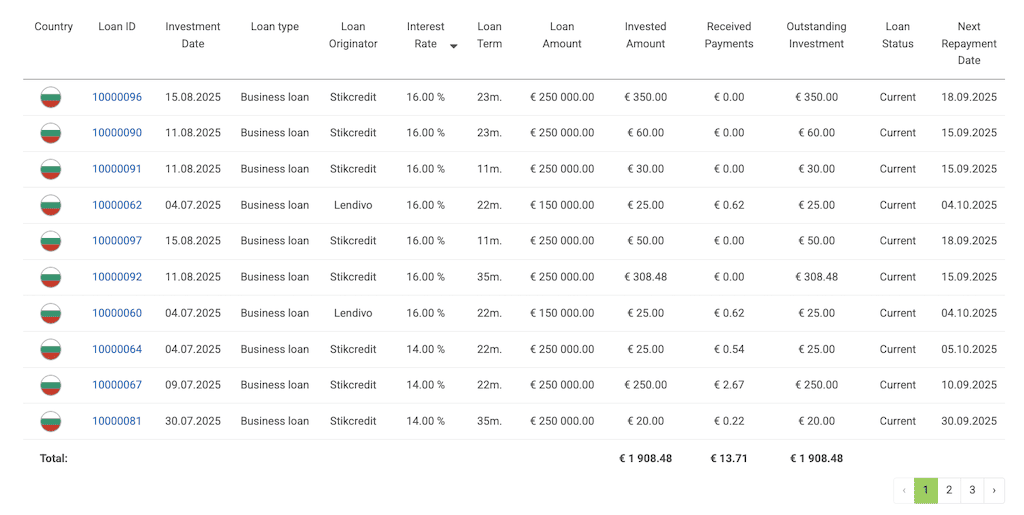
This time I was a little later and do not only have 16% loans in my portfolio. Regular rates at Stikcredit are now 12 to 14% depending on the term, and it was clear anyway that the promotional rates would not last.
Afranga Review - my account
The new Afranga is again a clear and intuitive P2P loan platform that makes it easy for us investors to invest.
A tidy interface that is easy to use. I use the account in English; the website is now also available in German, though that doesn't bother me anyway …
True, auto-invest is (still) missing, but since there are no buybacks and interest is paid monthly, there is not that much to do anyway.
So far I have invested almost exclusively in the Stikcredit loans, as I had already had some positive experiences with them. I welcome the option of investing in further lenders, especially as they are not once again lenders you know from other platforms (some are). That said, the diversification is smaller than the number six suggests, because Lendivo and Tiberus belong to the Stikcredit group.
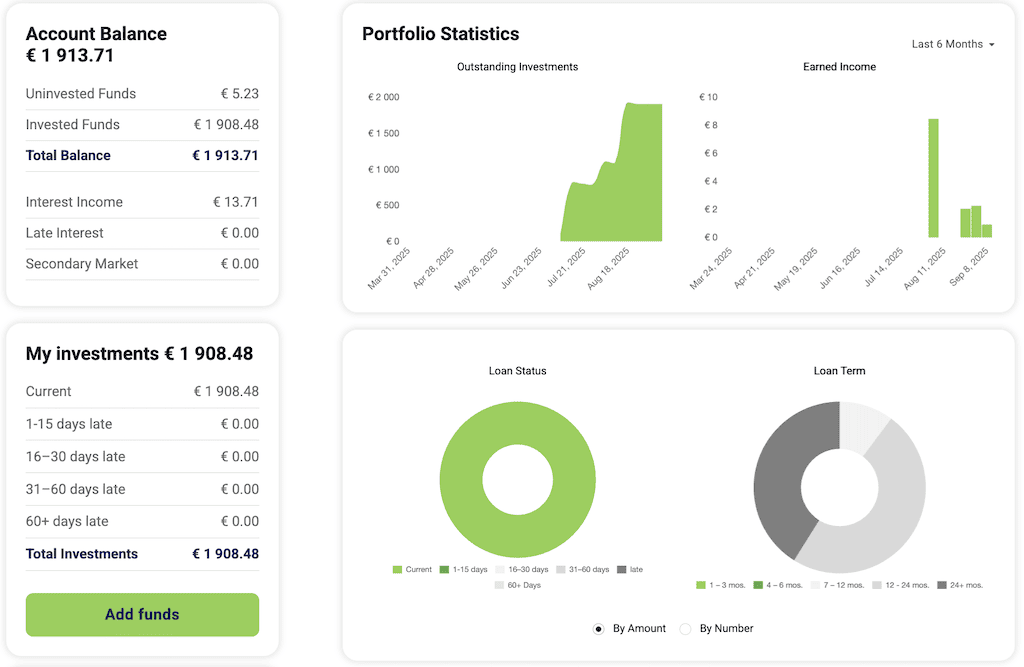
In mid-2025 I increased my investment to just under 2,000 euros, adding a good amount again in August in particular, when there were once more 16% loans in a promotion on the platform. In March 2026 I increased it considerably thanks to another 16% promotion, and in July I added around 1,400 euros once more. That puts me at around 9,300 euros (as of 30.09.2026).
I have therefore clearly exceeded my original target of 5,000 euros. My target is now 10,000 euros, and I am not far off. Almost my entire Afranga investment is with Stikcredit; the other lenders play hardly any role for me. Naturally, I have mainly secured long-term loans with high interest, because interest rates will fall in the long run, and the 16% loans in particular are clearly driven by marketing.
This is how I do it: Since autumn 2026 I have been taking the interest as a payout. New money only goes in if there is a promotion of at least 14%. Until then the interest is paid out, and the existing holding keeps running with the loans I have.
My roughly 9,300 euros are still entirely in the primary market, and I have nothing in SaveSmart. For me, that is exactly the interesting point about the SaveSmart update: a 14% loan over three years earns me more interest, while a SaveSmart share at 10% gives me a buffer that I can actually access.
So far the lock-in has not bothered me, because I do not need the money anyway. Looked at rationally, I should still move part of it, purely for the sake of flexibility. I will watch this over the next few months.
My Afranga return in 2026
In my portfolio, Afranga has been present since March 2021 and has delivered interest reliably ever since. The new Afranga was added in July 2025, and the old account ran off by the end of 2025. The table shows both accounts together; from 2026 only the new one remains:
| Year | Paid in | Paid out | Net earnings | Return p. a. (XIRR) |
|---|---|---|---|---|
| 2025 (from 09 Jul) | €2,687 | €0 | +€122 | – (part year) |
| 2026 (to 03 Nov) | €6,020 | €241 | +€794 | 14.4% |
| total | €8,707 | €241 | +€916 | 14.3% |
The annual return according to Modified Dietz takes into account when during the year money was paid in and out. In the first year, 2021, the figure is therefore distorted, because the capital was only added gradually. On the old platform, I achieved an overall return of 14.1% (IZF/XIRR) up to the end in 2025, with interest rates tending to fall over the years.
The new Afranga has been running for me since July 2025 and provides solid figures: 809 euros in interest up to the end of September 2026 and a return of 14.4% (IZF/XIRR), as at 30.09.2026. Across both platforms since March 2021, I come to 1,290 euros in interest and 14.3% (XIRR).
The XIRR is calculated over all payments in and out, with the account balance as the end value; I count bonus and referral credits as deposits, not as income. Withholding tax does eat into the gross return (10% in Bulgaria, of which only 5% can be credited under the DBA, the double taxation treaty), but even net a decent result remains.
My Afranga return
My own investment since 09 Jul 2025 · figures from Portfolio Performance
- €8,466
- net paid in
- +€916
- Net earnings
- €9,382
- Portfolio value
- Net paid in
- Net earnings (up to portfolio value)
- Portfolio value
I am very satisfied with the platform, and the portfolio has developed splendidly. Afranga remains a fixed component of my P2P portfolio. I am looking at Stikcredit more closely: I am keeping an eye on the half-year figures, the missing write-offs and the guarantee for Tiberus, and also on whether Afranga will eventually publish its own financial statements.
The fact that at least part of the capital is now accessible at SaveSmart, and that there is a secondary market again for the primary market loans, makes the platform more well-rounded for me. Neither is a free pass, but compared with the state of "everything locked until the end of the term", it is a real step forward.
My Afranga position (as of 03 Nov 2026)
- Invested since
- 09 Jul 2025
- Invested (net, rounded up)
- €8,500
- Interest received (rounded up)
- €920
- Return (XIRR) since start
- 14.3%
All figures for Afranga My P2P investing in numbers
My own money, shared for transparency. Not a recommendation. Past returns do not guarantee future results.
Sign up with Afranga: 0.5% cashback for 90 days*
Editorial note: This review reflects my personal experience as an investor. Commissions from affiliate links do not influence my assessment or the platform rating.